{"title":"揭露隐藏的威胁:多形鱼食源性无机汞和甲基汞的分子、细胞和行为影响","authors":"Clarisse Seguin , Alice Marant , Séverine Palacios-Paris , Isabelle Bonnard , Jean-Luc Loizeau , Elise David , Damien Rioult , Claudia Cosio","doi":"10.1016/j.chemosphere.2025.144306","DOIUrl":null,"url":null,"abstract":"<div><div>Methylmercury (MeHg) bioaccumulation in food webs has been recognized as a significant health risk for over 50 years, yet most studies focus on high concentrations of waterborne inorganic mercury (IHg). This study investigates the effects of dietborne mercury (Hg) exposure at environmentally realistic IHg and MeHg levels on a freshwater food chain.</div><div>Freshwater mussels, <em>Dreissena polymorpha</em>, were fed with microalgae previously contaminated with 2 and 20 fg IHg or MeHg per cell for 4 d. Filtration behavior, Hg bioaccumulation, histopathology, antioxidant enzyme activity, and gene expression related to defense and energy metabolism were measured across gills, digestive glands, and other soft tissues (rests) for 1, 2, and 4 d. While all microalgae were filtered at the end of feeding, only MeHg exposure led to a reduced filtration at the beginning of feeding. Bioaccumulation factors were higher for MeHg than IHg, particularly in gills. Dietborne MeHg also caused more fibrosis and structural changes in gills than IHg, in line with bioaccumulation. Necrosis, tubular atrophy, and hemocyte infiltration were observed in the digestive gland. Both IHg and MeHg triggered oxidative stress, as evidenced by significant changes in antioxidant enzyme activities and increased lipid peroxidation levels. MeHg exposure significantly upregulated the <em>sod</em> gene in rests and modulated <em>cs</em> and <em>aox</em> genes involved in energy metabolism in gills and digestive gland, depending on exposure duration. The findings aligned with established Hg toxicity targets but demonstrated notable differences in response depending on Hg forms and tissue type, emphasizing the importance of Hg speciation and tissue type in assessing toxicity.</div></div>","PeriodicalId":276,"journal":{"name":"Chemosphere","volume":"376 ","pages":"Article 144306"},"PeriodicalIF":8.1000,"publicationDate":"2025-05-01","publicationTypes":"Journal Article","fieldsOfStudy":null,"isOpenAccess":false,"openAccessPdf":"","citationCount":"0","resultStr":"{\"title\":\"Unveiling the hidden threat: Molecular, cellular and behavioral effects of dietborne inorganic mercury and methylmercury in Dreissena polymorpha\",\"authors\":\"Clarisse Seguin , Alice Marant , Séverine Palacios-Paris , Isabelle Bonnard , Jean-Luc Loizeau , Elise David , Damien Rioult , Claudia Cosio\",\"doi\":\"10.1016/j.chemosphere.2025.144306\",\"DOIUrl\":null,\"url\":null,\"abstract\":\"<div><div>Methylmercury (MeHg) bioaccumulation in food webs has been recognized as a significant health risk for over 50 years, yet most studies focus on high concentrations of waterborne inorganic mercury (IHg). This study investigates the effects of dietborne mercury (Hg) exposure at environmentally realistic IHg and MeHg levels on a freshwater food chain.</div><div>Freshwater mussels, <em>Dreissena polymorpha</em>, were fed with microalgae previously contaminated with 2 and 20 fg IHg or MeHg per cell for 4 d. Filtration behavior, Hg bioaccumulation, histopathology, antioxidant enzyme activity, and gene expression related to defense and energy metabolism were measured across gills, digestive glands, and other soft tissues (rests) for 1, 2, and 4 d. While all microalgae were filtered at the end of feeding, only MeHg exposure led to a reduced filtration at the beginning of feeding. Bioaccumulation factors were higher for MeHg than IHg, particularly in gills. Dietborne MeHg also caused more fibrosis and structural changes in gills than IHg, in line with bioaccumulation. Necrosis, tubular atrophy, and hemocyte infiltration were observed in the digestive gland. Both IHg and MeHg triggered oxidative stress, as evidenced by significant changes in antioxidant enzyme activities and increased lipid peroxidation levels. MeHg exposure significantly upregulated the <em>sod</em> gene in rests and modulated <em>cs</em> and <em>aox</em> genes involved in energy metabolism in gills and digestive gland, depending on exposure duration. The findings aligned with established Hg toxicity targets but demonstrated notable differences in response depending on Hg forms and tissue type, emphasizing the importance of Hg speciation and tissue type in assessing toxicity.</div></div>\",\"PeriodicalId\":276,\"journal\":{\"name\":\"Chemosphere\",\"volume\":\"376 \",\"pages\":\"Article 144306\"},\"PeriodicalIF\":8.1000,\"publicationDate\":\"2025-05-01\",\"publicationTypes\":\"Journal Article\",\"fieldsOfStudy\":null,\"isOpenAccess\":false,\"openAccessPdf\":\"\",\"citationCount\":\"0\",\"resultStr\":null,\"platform\":\"Semanticscholar\",\"paperid\":null,\"PeriodicalName\":\"Chemosphere\",\"FirstCategoryId\":\"93\",\"ListUrlMain\":\"https://www.sciencedirect.com/science/article/pii/S0045653525002486\",\"RegionNum\":2,\"RegionCategory\":\"环境科学与生态学\",\"ArticlePicture\":[],\"TitleCN\":null,\"AbstractTextCN\":null,\"PMCID\":null,\"EPubDate\":\"2025/3/14 0:00:00\",\"PubModel\":\"Epub\",\"JCR\":\"Q1\",\"JCRName\":\"ENVIRONMENTAL SCIENCES\",\"Score\":null,\"Total\":0}","platform":"Semanticscholar","paperid":null,"PeriodicalName":"Chemosphere","FirstCategoryId":"93","ListUrlMain":"https://www.sciencedirect.com/science/article/pii/S0045653525002486","RegionNum":2,"RegionCategory":"环境科学与生态学","ArticlePicture":[],"TitleCN":null,"AbstractTextCN":null,"PMCID":null,"EPubDate":"2025/3/14 0:00:00","PubModel":"Epub","JCR":"Q1","JCRName":"ENVIRONMENTAL SCIENCES","Score":null,"Total":0}
Unveiling the hidden threat: Molecular, cellular and behavioral effects of dietborne inorganic mercury and methylmercury in Dreissena polymorpha
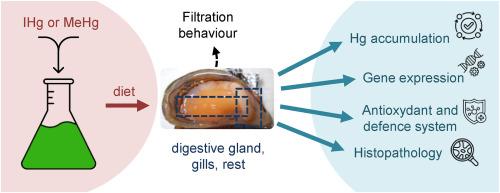
Methylmercury (MeHg) bioaccumulation in food webs has been recognized as a significant health risk for over 50 years, yet most studies focus on high concentrations of waterborne inorganic mercury (IHg). This study investigates the effects of dietborne mercury (Hg) exposure at environmentally realistic IHg and MeHg levels on a freshwater food chain.
Freshwater mussels, Dreissena polymorpha, were fed with microalgae previously contaminated with 2 and 20 fg IHg or MeHg per cell for 4 d. Filtration behavior, Hg bioaccumulation, histopathology, antioxidant enzyme activity, and gene expression related to defense and energy metabolism were measured across gills, digestive glands, and other soft tissues (rests) for 1, 2, and 4 d. While all microalgae were filtered at the end of feeding, only MeHg exposure led to a reduced filtration at the beginning of feeding. Bioaccumulation factors were higher for MeHg than IHg, particularly in gills. Dietborne MeHg also caused more fibrosis and structural changes in gills than IHg, in line with bioaccumulation. Necrosis, tubular atrophy, and hemocyte infiltration were observed in the digestive gland. Both IHg and MeHg triggered oxidative stress, as evidenced by significant changes in antioxidant enzyme activities and increased lipid peroxidation levels. MeHg exposure significantly upregulated the sod gene in rests and modulated cs and aox genes involved in energy metabolism in gills and digestive gland, depending on exposure duration. The findings aligned with established Hg toxicity targets but demonstrated notable differences in response depending on Hg forms and tissue type, emphasizing the importance of Hg speciation and tissue type in assessing toxicity.
期刊介绍:
Chemosphere, being an international multidisciplinary journal, is dedicated to publishing original communications and review articles on chemicals in the environment. The scope covers a wide range of topics, including the identification, quantification, behavior, fate, toxicology, treatment, and remediation of chemicals in the bio-, hydro-, litho-, and atmosphere, ensuring the broad dissemination of research in this field.




 京公网安备 11010802042870号
京ICP备2023020795号-1
京公网安备 11010802042870号
京ICP备2023020795号-1

 分享
分享
 求助内容:
求助内容: 应助结果提醒方式:
 扫码关注我们
