K.S. Nivedhitha , T. Beena , R. Venkatesh , N.R. Banapurmath , K. Ramesh , Ashok M. Sajjan , N.H. Ayachit , Bipin S. Chikkatti , M.A. Umarfarooq , K. Subramanian , Manzoore Elahi M. Soudagar , Sagar Shelare , Shubham Sharma , Ehab El Sayed Massoud
{"title":"通过机械合金化合成的碳纤维取代三元合金(Mg-Ni-Ti)用于储氢应用:降低活化能和疏水的好处","authors":"K.S. Nivedhitha , T. Beena , R. Venkatesh , N.R. Banapurmath , K. Ramesh , Ashok M. Sajjan , N.H. Ayachit , Bipin S. Chikkatti , M.A. Umarfarooq , K. Subramanian , Manzoore Elahi M. Soudagar , Sagar Shelare , Shubham Sharma , Ehab El Sayed Massoud","doi":"10.1016/j.jpowsour.2025.236525","DOIUrl":null,"url":null,"abstract":"<div><div>This study focuses on the preparation of Mg-Ni-Ti ternary alloys substituted with varying weight ratios of carbon fiber, synthesized using mechanical alloying for hydrogen storage applications. X-ray diffraction (XRD) analysis confirms the presence of carbon in the ternary alloy at 2θ = 71° along with the ternary alloy characteristic peaks. The substitution of carbon fiber increases the dislocation density from 5.3x10<sup>−3</sup> nm<sup>−2</sup> to 7.845x10<sup>−3</sup> nm<sup>−2</sup> and significantly enhances the strain within the samples. Selected area diffraction (SAED) confirms the formation of alloys as well presence of carbon. High-resolution Transmission Electron Microscopy shows carbon encapsulated in metal alloy particles, which helps as a barrier to resist the corrosion of metal alloy. Carbon fiber substitution lowers the activation energy of Mg-Ti-Ni from 79.96 kJ/mol to 65.54 kJ/mol, as estimated by Kissinger's analysis. Cyclic Voltammetry (CV) analysis for the alloy substituted with carbon fiber has unveiled a more substantial reduction peak than the oxidation peak, attributed to the hydrophobic nature of carbon fiber. The oxidation property of carbon fiber also reduces the corrosion rate from 0.146 mgpy to 0.083 mgpy. Hydrogen absorption/desorption studies for carbon fiber substituted ternary alloy have indicated that the ternary alloy with 5 wt% carbon fiber substitution has achieved a maximum higher discharge capacity of 1020 mAhg<sup>−1</sup>.</div></div>","PeriodicalId":377,"journal":{"name":"Journal of Power Sources","volume":"640 ","pages":"Article 236525"},"PeriodicalIF":7.9000,"publicationDate":"2025-06-01","publicationTypes":"Journal Article","fieldsOfStudy":null,"isOpenAccess":false,"openAccessPdf":"","citationCount":"0","resultStr":"{\"title\":\"Enhancing tunneling, microstructural morphology, and electrochemical performance of carbon fiber substituted ternary alloys (Mg-Ni-Ti) synthesized via mechanical alloying for hydrogen storage applications: Activation energy reduction and hydrophobic benefits\",\"authors\":\"K.S. Nivedhitha , T. Beena , R. Venkatesh , N.R. Banapurmath , K. Ramesh , Ashok M. Sajjan , N.H. Ayachit , Bipin S. Chikkatti , M.A. Umarfarooq , K. Subramanian , Manzoore Elahi M. Soudagar , Sagar Shelare , Shubham Sharma , Ehab El Sayed Massoud\",\"doi\":\"10.1016/j.jpowsour.2025.236525\",\"DOIUrl\":null,\"url\":null,\"abstract\":\"<div><div>This study focuses on the preparation of Mg-Ni-Ti ternary alloys substituted with varying weight ratios of carbon fiber, synthesized using mechanical alloying for hydrogen storage applications. X-ray diffraction (XRD) analysis confirms the presence of carbon in the ternary alloy at 2θ = 71° along with the ternary alloy characteristic peaks. The substitution of carbon fiber increases the dislocation density from 5.3x10<sup>−3</sup> nm<sup>−2</sup> to 7.845x10<sup>−3</sup> nm<sup>−2</sup> and significantly enhances the strain within the samples. Selected area diffraction (SAED) confirms the formation of alloys as well presence of carbon. High-resolution Transmission Electron Microscopy shows carbon encapsulated in metal alloy particles, which helps as a barrier to resist the corrosion of metal alloy. Carbon fiber substitution lowers the activation energy of Mg-Ti-Ni from 79.96 kJ/mol to 65.54 kJ/mol, as estimated by Kissinger's analysis. Cyclic Voltammetry (CV) analysis for the alloy substituted with carbon fiber has unveiled a more substantial reduction peak than the oxidation peak, attributed to the hydrophobic nature of carbon fiber. The oxidation property of carbon fiber also reduces the corrosion rate from 0.146 mgpy to 0.083 mgpy. Hydrogen absorption/desorption studies for carbon fiber substituted ternary alloy have indicated that the ternary alloy with 5 wt% carbon fiber substitution has achieved a maximum higher discharge capacity of 1020 mAhg<sup>−1</sup>.</div></div>\",\"PeriodicalId\":377,\"journal\":{\"name\":\"Journal of Power Sources\",\"volume\":\"640 \",\"pages\":\"Article 236525\"},\"PeriodicalIF\":7.9000,\"publicationDate\":\"2025-06-01\",\"publicationTypes\":\"Journal Article\",\"fieldsOfStudy\":null,\"isOpenAccess\":false,\"openAccessPdf\":\"\",\"citationCount\":\"0\",\"resultStr\":null,\"platform\":\"Semanticscholar\",\"paperid\":null,\"PeriodicalName\":\"Journal of Power Sources\",\"FirstCategoryId\":\"5\",\"ListUrlMain\":\"https://www.sciencedirect.com/science/article/pii/S0378775325003611\",\"RegionNum\":2,\"RegionCategory\":\"工程技术\",\"ArticlePicture\":[],\"TitleCN\":null,\"AbstractTextCN\":null,\"PMCID\":null,\"EPubDate\":\"2025/3/15 0:00:00\",\"PubModel\":\"Epub\",\"JCR\":\"Q1\",\"JCRName\":\"CHEMISTRY, PHYSICAL\",\"Score\":null,\"Total\":0}","platform":"Semanticscholar","paperid":null,"PeriodicalName":"Journal of Power Sources","FirstCategoryId":"5","ListUrlMain":"https://www.sciencedirect.com/science/article/pii/S0378775325003611","RegionNum":2,"RegionCategory":"工程技术","ArticlePicture":[],"TitleCN":null,"AbstractTextCN":null,"PMCID":null,"EPubDate":"2025/3/15 0:00:00","PubModel":"Epub","JCR":"Q1","JCRName":"CHEMISTRY, PHYSICAL","Score":null,"Total":0}
Enhancing tunneling, microstructural morphology, and electrochemical performance of carbon fiber substituted ternary alloys (Mg-Ni-Ti) synthesized via mechanical alloying for hydrogen storage applications: Activation energy reduction and hydrophobic benefits
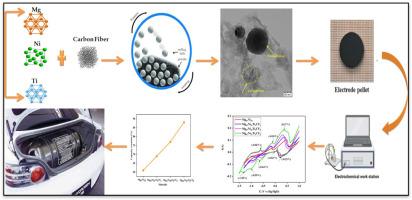
This study focuses on the preparation of Mg-Ni-Ti ternary alloys substituted with varying weight ratios of carbon fiber, synthesized using mechanical alloying for hydrogen storage applications. X-ray diffraction (XRD) analysis confirms the presence of carbon in the ternary alloy at 2θ = 71° along with the ternary alloy characteristic peaks. The substitution of carbon fiber increases the dislocation density from 5.3x10⁻³ nm−2 to 7.845x10⁻³ nm−2 and significantly enhances the strain within the samples. Selected area diffraction (SAED) confirms the formation of alloys as well presence of carbon. High-resolution Transmission Electron Microscopy shows carbon encapsulated in metal alloy particles, which helps as a barrier to resist the corrosion of metal alloy. Carbon fiber substitution lowers the activation energy of Mg-Ti-Ni from 79.96 kJ/mol to 65.54 kJ/mol, as estimated by Kissinger's analysis. Cyclic Voltammetry (CV) analysis for the alloy substituted with carbon fiber has unveiled a more substantial reduction peak than the oxidation peak, attributed to the hydrophobic nature of carbon fiber. The oxidation property of carbon fiber also reduces the corrosion rate from 0.146 mgpy to 0.083 mgpy. Hydrogen absorption/desorption studies for carbon fiber substituted ternary alloy have indicated that the ternary alloy with 5 wt% carbon fiber substitution has achieved a maximum higher discharge capacity of 1020 mAhg−1.
期刊介绍:
The Journal of Power Sources is a publication catering to researchers and technologists interested in various aspects of the science, technology, and applications of electrochemical power sources. It covers original research and reviews on primary and secondary batteries, fuel cells, supercapacitors, and photo-electrochemical cells.
Topics considered include the research, development and applications of nanomaterials and novel componentry for these devices. Examples of applications of these electrochemical power sources include:
• Portable electronics
• Electric and Hybrid Electric Vehicles
• Uninterruptible Power Supply (UPS) systems
• Storage of renewable energy
• Satellites and deep space probes
• Boats and ships, drones and aircrafts
• Wearable energy storage systems




 京公网安备 11010802042870号
京ICP备2023020795号-1
京公网安备 11010802042870号
京ICP备2023020795号-1

 分享
分享
 求助内容:
求助内容: 应助结果提醒方式:
 扫码关注我们
