Asad Ur Rahman , Naveed Ullah Khan , Pharkphoom Panichayupakaranant , Jiang Ni
{"title":"一种标准化的富含 chamuangone 的提取物在转移性乳腺癌异体移植模型中显示出抗癌功效","authors":"Asad Ur Rahman , Naveed Ullah Khan , Pharkphoom Panichayupakaranant , Jiang Ni","doi":"10.1016/j.jff.2025.106730","DOIUrl":null,"url":null,"abstract":"<div><div>Chamuangone is a polyprenylated benzophenone found in the leaves of the Thai vegetable <em>Garcinia cowa</em> Roxb., which has been reported for its <em>in vitro</em> anticancer properties. The leaves have traditionally been used for the treatment of inflammation, infections, and diabetes. In this study, a standardized chamuangone-enriched extract (CEE) from <em>G. cowa</em> leaves, containing 73.0 ± 2.0 % w/w of chamuangone, was evaluated <em>in vitro</em> and <em>in vivo</em> in allograft models (4 T1-luc cells) of breast cancer (BC) and metastatic breast cancer (MBC). The effects of CEE on 4 T1-luc cell viability, apoptosis, cell cycle, and cell migration were analyzed using CCK-8, flow cytometry, and wound healing assays. The <em>in vivo</em> antitumor and antimetastatic efficacy of CEE at doses of 25, 50, and 100 mg/kg body weight (b.w.) was evaluated in BALB/c mice. Tumor markers (CEA, CA 125, CA 15–3), apoptotic markers (p53, Bcl-2), and inflammatory markers (MMP-2, MMP-9, IL-6, NF-κB, and TNF-α) were assessed using ELISA assays. Additionally, the pharmacokinetic and biodistribution profiles of CEE were assessed using the normal mice. The results revealed that CEE (10 µg/mL) decreased 4 T1-luc cell viability, with IC<sub>50</sub> values of 62.5, 48.07, and 31.18 μg/mL at 24, 48, and 72 h, respectively. CEE induced early apoptosis (18.38 %) and late apoptosis (42.79 %), inhibited cell migration and triggered cell cycle arrest, with 59.92 % of cells in the subG1 phase. Furthermore, CEE at 100 mg/kg b.w., significantly inhibited tumor growth and metastasis, <em>in vivo</em> and significantly modulating apoptotic, tumor, and inflammatory markers. The plasma half-life (t½) of CEE at 100 mg/kg b.w. was found to be 11 h. The liver achieved the maximum concentration of chamuangone, followed by the spleen, kidneys, lungs, and heart. Based on the preclinical safety assessment of CEE, a green extract, a dose of 100 mg/kg b.w. is considered safe for therapeutic application as a chemopreventive functional ingredient in BC treatment.</div></div>","PeriodicalId":360,"journal":{"name":"Journal of Functional Foods","volume":"127 ","pages":"Article 106730"},"PeriodicalIF":4.0000,"publicationDate":"2025-04-01","publicationTypes":"Journal Article","fieldsOfStudy":null,"isOpenAccess":false,"openAccessPdf":"","citationCount":"0","resultStr":"{\"title\":\"A standardized chamuangone enriched extract shows anticancer efficacy in allograft models of metastatic breast cancer\",\"authors\":\"Asad Ur Rahman , Naveed Ullah Khan , Pharkphoom Panichayupakaranant , Jiang Ni\",\"doi\":\"10.1016/j.jff.2025.106730\",\"DOIUrl\":null,\"url\":null,\"abstract\":\"<div><div>Chamuangone is a polyprenylated benzophenone found in the leaves of the Thai vegetable <em>Garcinia cowa</em> Roxb., which has been reported for its <em>in vitro</em> anticancer properties. The leaves have traditionally been used for the treatment of inflammation, infections, and diabetes. In this study, a standardized chamuangone-enriched extract (CEE) from <em>G. cowa</em> leaves, containing 73.0 ± 2.0 % w/w of chamuangone, was evaluated <em>in vitro</em> and <em>in vivo</em> in allograft models (4 T1-luc cells) of breast cancer (BC) and metastatic breast cancer (MBC). The effects of CEE on 4 T1-luc cell viability, apoptosis, cell cycle, and cell migration were analyzed using CCK-8, flow cytometry, and wound healing assays. The <em>in vivo</em> antitumor and antimetastatic efficacy of CEE at doses of 25, 50, and 100 mg/kg body weight (b.w.) was evaluated in BALB/c mice. Tumor markers (CEA, CA 125, CA 15–3), apoptotic markers (p53, Bcl-2), and inflammatory markers (MMP-2, MMP-9, IL-6, NF-κB, and TNF-α) were assessed using ELISA assays. Additionally, the pharmacokinetic and biodistribution profiles of CEE were assessed using the normal mice. The results revealed that CEE (10 µg/mL) decreased 4 T1-luc cell viability, with IC<sub>50</sub> values of 62.5, 48.07, and 31.18 μg/mL at 24, 48, and 72 h, respectively. CEE induced early apoptosis (18.38 %) and late apoptosis (42.79 %), inhibited cell migration and triggered cell cycle arrest, with 59.92 % of cells in the subG1 phase. Furthermore, CEE at 100 mg/kg b.w., significantly inhibited tumor growth and metastasis, <em>in vivo</em> and significantly modulating apoptotic, tumor, and inflammatory markers. The plasma half-life (t½) of CEE at 100 mg/kg b.w. was found to be 11 h. The liver achieved the maximum concentration of chamuangone, followed by the spleen, kidneys, lungs, and heart. Based on the preclinical safety assessment of CEE, a green extract, a dose of 100 mg/kg b.w. is considered safe for therapeutic application as a chemopreventive functional ingredient in BC treatment.</div></div>\",\"PeriodicalId\":360,\"journal\":{\"name\":\"Journal of Functional Foods\",\"volume\":\"127 \",\"pages\":\"Article 106730\"},\"PeriodicalIF\":4.0000,\"publicationDate\":\"2025-04-01\",\"publicationTypes\":\"Journal Article\",\"fieldsOfStudy\":null,\"isOpenAccess\":false,\"openAccessPdf\":\"\",\"citationCount\":\"0\",\"resultStr\":null,\"platform\":\"Semanticscholar\",\"paperid\":null,\"PeriodicalName\":\"Journal of Functional Foods\",\"FirstCategoryId\":\"97\",\"ListUrlMain\":\"https://www.sciencedirect.com/science/article/pii/S1756464625000726\",\"RegionNum\":2,\"RegionCategory\":\"农林科学\",\"ArticlePicture\":[],\"TitleCN\":null,\"AbstractTextCN\":null,\"PMCID\":null,\"EPubDate\":\"2025/3/15 0:00:00\",\"PubModel\":\"Epub\",\"JCR\":\"Q2\",\"JCRName\":\"FOOD SCIENCE & TECHNOLOGY\",\"Score\":null,\"Total\":0}","platform":"Semanticscholar","paperid":null,"PeriodicalName":"Journal of Functional Foods","FirstCategoryId":"97","ListUrlMain":"https://www.sciencedirect.com/science/article/pii/S1756464625000726","RegionNum":2,"RegionCategory":"农林科学","ArticlePicture":[],"TitleCN":null,"AbstractTextCN":null,"PMCID":null,"EPubDate":"2025/3/15 0:00:00","PubModel":"Epub","JCR":"Q2","JCRName":"FOOD SCIENCE & TECHNOLOGY","Score":null,"Total":0}
A standardized chamuangone enriched extract shows anticancer efficacy in allograft models of metastatic breast cancer
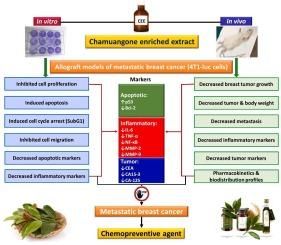
Chamuangone is a polyprenylated benzophenone found in the leaves of the Thai vegetable Garcinia cowa Roxb., which has been reported for its in vitro anticancer properties. The leaves have traditionally been used for the treatment of inflammation, infections, and diabetes. In this study, a standardized chamuangone-enriched extract (CEE) from G. cowa leaves, containing 73.0 ± 2.0 % w/w of chamuangone, was evaluated in vitro and in vivo in allograft models (4 T1-luc cells) of breast cancer (BC) and metastatic breast cancer (MBC). The effects of CEE on 4 T1-luc cell viability, apoptosis, cell cycle, and cell migration were analyzed using CCK-8, flow cytometry, and wound healing assays. The in vivo antitumor and antimetastatic efficacy of CEE at doses of 25, 50, and 100 mg/kg body weight (b.w.) was evaluated in BALB/c mice. Tumor markers (CEA, CA 125, CA 15–3), apoptotic markers (p53, Bcl-2), and inflammatory markers (MMP-2, MMP-9, IL-6, NF-κB, and TNF-α) were assessed using ELISA assays. Additionally, the pharmacokinetic and biodistribution profiles of CEE were assessed using the normal mice. The results revealed that CEE (10 µg/mL) decreased 4 T1-luc cell viability, with IC50 values of 62.5, 48.07, and 31.18 μg/mL at 24, 48, and 72 h, respectively. CEE induced early apoptosis (18.38 %) and late apoptosis (42.79 %), inhibited cell migration and triggered cell cycle arrest, with 59.92 % of cells in the subG1 phase. Furthermore, CEE at 100 mg/kg b.w., significantly inhibited tumor growth and metastasis, in vivo and significantly modulating apoptotic, tumor, and inflammatory markers. The plasma half-life (t½) of CEE at 100 mg/kg b.w. was found to be 11 h. The liver achieved the maximum concentration of chamuangone, followed by the spleen, kidneys, lungs, and heart. Based on the preclinical safety assessment of CEE, a green extract, a dose of 100 mg/kg b.w. is considered safe for therapeutic application as a chemopreventive functional ingredient in BC treatment.
期刊介绍:
Journal of Functional Foods continues with the same aims and scope, editorial team, submission system and rigorous peer review. We give authors the possibility to publish their top-quality papers in a well-established leading journal in the food and nutrition fields. The Journal will keep its rigorous criteria to screen high impact research addressing relevant scientific topics and performed by sound methodologies.
The Journal of Functional Foods aims to bring together the results of fundamental and applied research into healthy foods and biologically active food ingredients.
The Journal is centered in the specific area at the boundaries among food technology, nutrition and health welcoming papers having a good interdisciplinary approach. The Journal will cover the fields of plant bioactives; dietary fibre, probiotics; functional lipids; bioactive peptides; vitamins, minerals and botanicals and other dietary supplements. Nutritional and technological aspects related to the development of functional foods and beverages are of core interest to the journal. Experimental works dealing with food digestion, bioavailability of food bioactives and on the mechanisms by which foods and their components are able to modulate physiological parameters connected with disease prevention are of particular interest as well as those dealing with personalized nutrition and nutritional needs in pathological subjects.



 京公网安备 11010802042870号
京ICP备2023020795号-1
京公网安备 11010802042870号
京ICP备2023020795号-1

 分享
分享
 求助内容:
求助内容: 应助结果提醒方式:
 扫码关注我们
