Airton C. Martins , Gustavo H. Oliveira-Paula , Alexey A. Tinkov , Anatoly V. Skalny , Yousef Tizabi , Aaron B. Bowman , Michael Aschner
{"title":"锰在大脑健康和疾病中的作用:关注氧化应激。","authors":"Airton C. Martins , Gustavo H. Oliveira-Paula , Alexey A. Tinkov , Anatoly V. Skalny , Yousef Tizabi , Aaron B. Bowman , Michael Aschner","doi":"10.1016/j.freeradbiomed.2025.03.013","DOIUrl":null,"url":null,"abstract":"<div><div>Manganese (Mn) is an essential trace element crucial for various physiological processes, but excessive exposure can lead to significant health concerns, particularly neurotoxicity. This review synthesizes current knowledge on Mn-induced oxidative stress and its role in cellular dysfunction and disease. We discuss how Mn promotes toxicity through multiple mechanisms, primarily through reactive oxygen species (ROS) generation, which leads to oxidative stress and disruption of cellular processes. The review examines key pathways affected by Mn toxicity, including mitochondrial dysfunction, endoplasmic reticulum stress, inflammasome activation, and epigenetic modifications. Recent studies have identified promising therapeutic compounds, including both synthetic and natural substances such as probucol, metformin, curcumin, resveratrol, and daidzein, which demonstrate protective effects through various mechanisms, including antioxidant enhancement, mitochondrial function preservation, and epigenetic pathway modulation. Understanding these mechanisms provides new insights into potential therapeutic strategies for Mn-induced disorders. This review also highlights future research directions, emphasizing the need for developing targeted therapies and investigating combination approaches to address multiple aspects of Mn toxicity simultaneously.</div></div>","PeriodicalId":12407,"journal":{"name":"Free Radical Biology and Medicine","volume":"232 ","pages":"Pages 306-318"},"PeriodicalIF":8.0000,"publicationDate":"2025-05-01","publicationTypes":"Journal Article","fieldsOfStudy":null,"isOpenAccess":false,"openAccessPdf":"","citationCount":"0","resultStr":"{\"title\":\"Role of manganese in brain health and disease: Focus on oxidative stress\",\"authors\":\"Airton C. Martins , Gustavo H. Oliveira-Paula , Alexey A. Tinkov , Anatoly V. Skalny , Yousef Tizabi , Aaron B. Bowman , Michael Aschner\",\"doi\":\"10.1016/j.freeradbiomed.2025.03.013\",\"DOIUrl\":null,\"url\":null,\"abstract\":\"<div><div>Manganese (Mn) is an essential trace element crucial for various physiological processes, but excessive exposure can lead to significant health concerns, particularly neurotoxicity. This review synthesizes current knowledge on Mn-induced oxidative stress and its role in cellular dysfunction and disease. We discuss how Mn promotes toxicity through multiple mechanisms, primarily through reactive oxygen species (ROS) generation, which leads to oxidative stress and disruption of cellular processes. The review examines key pathways affected by Mn toxicity, including mitochondrial dysfunction, endoplasmic reticulum stress, inflammasome activation, and epigenetic modifications. Recent studies have identified promising therapeutic compounds, including both synthetic and natural substances such as probucol, metformin, curcumin, resveratrol, and daidzein, which demonstrate protective effects through various mechanisms, including antioxidant enhancement, mitochondrial function preservation, and epigenetic pathway modulation. Understanding these mechanisms provides new insights into potential therapeutic strategies for Mn-induced disorders. This review also highlights future research directions, emphasizing the need for developing targeted therapies and investigating combination approaches to address multiple aspects of Mn toxicity simultaneously.</div></div>\",\"PeriodicalId\":12407,\"journal\":{\"name\":\"Free Radical Biology and Medicine\",\"volume\":\"232 \",\"pages\":\"Pages 306-318\"},\"PeriodicalIF\":8.0000,\"publicationDate\":\"2025-05-01\",\"publicationTypes\":\"Journal Article\",\"fieldsOfStudy\":null,\"isOpenAccess\":false,\"openAccessPdf\":\"\",\"citationCount\":\"0\",\"resultStr\":null,\"platform\":\"Semanticscholar\",\"paperid\":null,\"PeriodicalName\":\"Free Radical Biology and Medicine\",\"FirstCategoryId\":\"3\",\"ListUrlMain\":\"https://www.sciencedirect.com/science/article/pii/S0891584925001637\",\"RegionNum\":2,\"RegionCategory\":\"生物学\",\"ArticlePicture\":[],\"TitleCN\":null,\"AbstractTextCN\":null,\"PMCID\":null,\"EPubDate\":\"2025/3/12 0:00:00\",\"PubModel\":\"Epub\",\"JCR\":\"Q1\",\"JCRName\":\"BIOCHEMISTRY & MOLECULAR BIOLOGY\",\"Score\":null,\"Total\":0}","platform":"Semanticscholar","paperid":null,"PeriodicalName":"Free Radical Biology and Medicine","FirstCategoryId":"3","ListUrlMain":"https://www.sciencedirect.com/science/article/pii/S0891584925001637","RegionNum":2,"RegionCategory":"生物学","ArticlePicture":[],"TitleCN":null,"AbstractTextCN":null,"PMCID":null,"EPubDate":"2025/3/12 0:00:00","PubModel":"Epub","JCR":"Q1","JCRName":"BIOCHEMISTRY & MOLECULAR BIOLOGY","Score":null,"Total":0}
Role of manganese in brain health and disease: Focus on oxidative stress
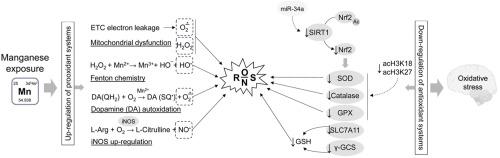
Manganese (Mn) is an essential trace element crucial for various physiological processes, but excessive exposure can lead to significant health concerns, particularly neurotoxicity. This review synthesizes current knowledge on Mn-induced oxidative stress and its role in cellular dysfunction and disease. We discuss how Mn promotes toxicity through multiple mechanisms, primarily through reactive oxygen species (ROS) generation, which leads to oxidative stress and disruption of cellular processes. The review examines key pathways affected by Mn toxicity, including mitochondrial dysfunction, endoplasmic reticulum stress, inflammasome activation, and epigenetic modifications. Recent studies have identified promising therapeutic compounds, including both synthetic and natural substances such as probucol, metformin, curcumin, resveratrol, and daidzein, which demonstrate protective effects through various mechanisms, including antioxidant enhancement, mitochondrial function preservation, and epigenetic pathway modulation. Understanding these mechanisms provides new insights into potential therapeutic strategies for Mn-induced disorders. This review also highlights future research directions, emphasizing the need for developing targeted therapies and investigating combination approaches to address multiple aspects of Mn toxicity simultaneously.
期刊介绍:
Free Radical Biology and Medicine is a leading journal in the field of redox biology, which is the study of the role of reactive oxygen species (ROS) and other oxidizing agents in biological systems. The journal serves as a premier forum for publishing innovative and groundbreaking research that explores the redox biology of health and disease, covering a wide range of topics and disciplines. Free Radical Biology and Medicine also commissions Special Issues that highlight recent advances in both basic and clinical research, with a particular emphasis on the mechanisms underlying altered metabolism and redox signaling. These Special Issues aim to provide a focused platform for the latest research in the field, fostering collaboration and knowledge exchange among researchers and clinicians.




 京公网安备 11010802042870号
京ICP备2023020795号-1
京公网安备 11010802042870号
京ICP备2023020795号-1

 分享
分享
 求助内容:
求助内容: 应助结果提醒方式:
 扫码关注我们
