Katie Knaub , Md Habibullah-Al-Mamun , Kara E. Huff Hartz , Gregory Whitledge , Louise Cominassi , Andrea Chandler , Mia Arkles , John Reeve , Amelie Segarra , Richard E. Connon , Michael J. Lydy
{"title":"开发联苯菊酯在幼年大鳞大麻哈鱼(Oncorhynchus tshawytscha)中的反应谱模型","authors":"Katie Knaub , Md Habibullah-Al-Mamun , Kara E. Huff Hartz , Gregory Whitledge , Louise Cominassi , Andrea Chandler , Mia Arkles , John Reeve , Amelie Segarra , Richard E. Connon , Michael J. Lydy","doi":"10.1016/j.envpol.2025.126070","DOIUrl":null,"url":null,"abstract":"<div><div>Long-term declines in salmonid populations observed in California Central Valley have prompted efforts to enhance the understanding of how environmental stressors impact sensitive species. Bifenthrin, a current-use insecticide, has been consistently detected throughout the Sacramento-San Joaquin River Delta (Delta) and has been linked to detrimental effects in salmon. Traditionally, aqueous concentration is used in toxicological studies to evaluate the effects of pesticides on aquatic organisms, which assumes that concentration of the toxicant in water is a valid surrogate for dose. The critical body residue approach was established as an improved technique for assessing toxicity of hydrophobic contaminants, but there is a lack of data to support the application of this method in assessing risk of contaminant exposure in the environment. The current study creates a response spectrum model (RSM) demonstrating the relationship between internal residue and effects observed in Chinook Salmon from laboratory-based exposures. To develop the RSM, a series of behavioral and physiological endpoints were measured using bifenthrin-dosed Chinook Salmon to use with previously generated sublethal and mortality data for incorporation in the model. The most sensitive endpoints were locomotion and shoaling behavior, followed by anxiety, growth, swim performance, upper thermal sensitivity, olfactory response, and lethality. The RSM endpoints were compared to bifenthrin residues in field-collected juvenile Chinook Salmon collected in 2019–2020 as part of our earlier studies. We found bifenthrin tissue residues were at similar levels to the most sensitive endpoints featured in the RSM, suggesting that bifenthrin exposure in the field could cause behavioral effects to salmon as they out-migrate through the Delta. The developed RSM is a tool that could be used by water quality managers to evaluate the extent to which bifenthrin exposure may impact behavior and performance in juvenile salmon, providing a field-based verification of its effects on outmigration.</div></div>","PeriodicalId":311,"journal":{"name":"Environmental Pollution","volume":"372 ","pages":"Article 126070"},"PeriodicalIF":7.3000,"publicationDate":"2025-05-01","publicationTypes":"Journal Article","fieldsOfStudy":null,"isOpenAccess":false,"openAccessPdf":"","citationCount":"0","resultStr":"{\"title\":\"Development of a response spectrum model for bifenthrin in juvenile Chinook Salmon (Oncorhynchus tshawytscha)\",\"authors\":\"Katie Knaub , Md Habibullah-Al-Mamun , Kara E. Huff Hartz , Gregory Whitledge , Louise Cominassi , Andrea Chandler , Mia Arkles , John Reeve , Amelie Segarra , Richard E. Connon , Michael J. Lydy\",\"doi\":\"10.1016/j.envpol.2025.126070\",\"DOIUrl\":null,\"url\":null,\"abstract\":\"<div><div>Long-term declines in salmonid populations observed in California Central Valley have prompted efforts to enhance the understanding of how environmental stressors impact sensitive species. Bifenthrin, a current-use insecticide, has been consistently detected throughout the Sacramento-San Joaquin River Delta (Delta) and has been linked to detrimental effects in salmon. Traditionally, aqueous concentration is used in toxicological studies to evaluate the effects of pesticides on aquatic organisms, which assumes that concentration of the toxicant in water is a valid surrogate for dose. The critical body residue approach was established as an improved technique for assessing toxicity of hydrophobic contaminants, but there is a lack of data to support the application of this method in assessing risk of contaminant exposure in the environment. The current study creates a response spectrum model (RSM) demonstrating the relationship between internal residue and effects observed in Chinook Salmon from laboratory-based exposures. To develop the RSM, a series of behavioral and physiological endpoints were measured using bifenthrin-dosed Chinook Salmon to use with previously generated sublethal and mortality data for incorporation in the model. The most sensitive endpoints were locomotion and shoaling behavior, followed by anxiety, growth, swim performance, upper thermal sensitivity, olfactory response, and lethality. The RSM endpoints were compared to bifenthrin residues in field-collected juvenile Chinook Salmon collected in 2019–2020 as part of our earlier studies. We found bifenthrin tissue residues were at similar levels to the most sensitive endpoints featured in the RSM, suggesting that bifenthrin exposure in the field could cause behavioral effects to salmon as they out-migrate through the Delta. The developed RSM is a tool that could be used by water quality managers to evaluate the extent to which bifenthrin exposure may impact behavior and performance in juvenile salmon, providing a field-based verification of its effects on outmigration.</div></div>\",\"PeriodicalId\":311,\"journal\":{\"name\":\"Environmental Pollution\",\"volume\":\"372 \",\"pages\":\"Article 126070\"},\"PeriodicalIF\":7.3000,\"publicationDate\":\"2025-05-01\",\"publicationTypes\":\"Journal Article\",\"fieldsOfStudy\":null,\"isOpenAccess\":false,\"openAccessPdf\":\"\",\"citationCount\":\"0\",\"resultStr\":null,\"platform\":\"Semanticscholar\",\"paperid\":null,\"PeriodicalName\":\"Environmental Pollution\",\"FirstCategoryId\":\"93\",\"ListUrlMain\":\"https://www.sciencedirect.com/science/article/pii/S0269749125004439\",\"RegionNum\":2,\"RegionCategory\":\"环境科学与生态学\",\"ArticlePicture\":[],\"TitleCN\":null,\"AbstractTextCN\":null,\"PMCID\":null,\"EPubDate\":\"2025/3/15 0:00:00\",\"PubModel\":\"Epub\",\"JCR\":\"Q1\",\"JCRName\":\"ENVIRONMENTAL SCIENCES\",\"Score\":null,\"Total\":0}","platform":"Semanticscholar","paperid":null,"PeriodicalName":"Environmental Pollution","FirstCategoryId":"93","ListUrlMain":"https://www.sciencedirect.com/science/article/pii/S0269749125004439","RegionNum":2,"RegionCategory":"环境科学与生态学","ArticlePicture":[],"TitleCN":null,"AbstractTextCN":null,"PMCID":null,"EPubDate":"2025/3/15 0:00:00","PubModel":"Epub","JCR":"Q1","JCRName":"ENVIRONMENTAL SCIENCES","Score":null,"Total":0}
Development of a response spectrum model for bifenthrin in juvenile Chinook Salmon (Oncorhynchus tshawytscha)
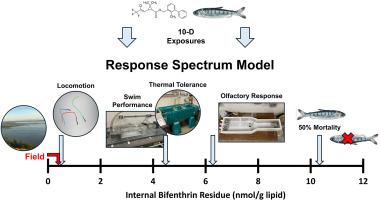
Long-term declines in salmonid populations observed in California Central Valley have prompted efforts to enhance the understanding of how environmental stressors impact sensitive species. Bifenthrin, a current-use insecticide, has been consistently detected throughout the Sacramento-San Joaquin River Delta (Delta) and has been linked to detrimental effects in salmon. Traditionally, aqueous concentration is used in toxicological studies to evaluate the effects of pesticides on aquatic organisms, which assumes that concentration of the toxicant in water is a valid surrogate for dose. The critical body residue approach was established as an improved technique for assessing toxicity of hydrophobic contaminants, but there is a lack of data to support the application of this method in assessing risk of contaminant exposure in the environment. The current study creates a response spectrum model (RSM) demonstrating the relationship between internal residue and effects observed in Chinook Salmon from laboratory-based exposures. To develop the RSM, a series of behavioral and physiological endpoints were measured using bifenthrin-dosed Chinook Salmon to use with previously generated sublethal and mortality data for incorporation in the model. The most sensitive endpoints were locomotion and shoaling behavior, followed by anxiety, growth, swim performance, upper thermal sensitivity, olfactory response, and lethality. The RSM endpoints were compared to bifenthrin residues in field-collected juvenile Chinook Salmon collected in 2019–2020 as part of our earlier studies. We found bifenthrin tissue residues were at similar levels to the most sensitive endpoints featured in the RSM, suggesting that bifenthrin exposure in the field could cause behavioral effects to salmon as they out-migrate through the Delta. The developed RSM is a tool that could be used by water quality managers to evaluate the extent to which bifenthrin exposure may impact behavior and performance in juvenile salmon, providing a field-based verification of its effects on outmigration.
期刊介绍:
Environmental Pollution is an international peer-reviewed journal that publishes high-quality research papers and review articles covering all aspects of environmental pollution and its impacts on ecosystems and human health.
Subject areas include, but are not limited to:
• Sources and occurrences of pollutants that are clearly defined and measured in environmental compartments, food and food-related items, and human bodies;
• Interlinks between contaminant exposure and biological, ecological, and human health effects, including those of climate change;
• Contaminants of emerging concerns (including but not limited to antibiotic resistant microorganisms or genes, microplastics/nanoplastics, electronic wastes, light, and noise) and/or their biological, ecological, or human health effects;
• Laboratory and field studies on the remediation/mitigation of environmental pollution via new techniques and with clear links to biological, ecological, or human health effects;
• Modeling of pollution processes, patterns, or trends that is of clear environmental and/or human health interest;
• New techniques that measure and examine environmental occurrences, transport, behavior, and effects of pollutants within the environment or the laboratory, provided that they can be clearly used to address problems within regional or global environmental compartments.




 京公网安备 11010802042870号
京ICP备2023020795号-1
京公网安备 11010802042870号
京ICP备2023020795号-1

 分享
分享
 求助内容:
求助内容: 应助结果提醒方式:
 扫码关注我们
