{"title":"超薄nife层状双氢氧化物在添加乙醇的电解液中显著降低碱性水电解阳极反应过电位","authors":"Huiying Wang, Mengtian Huo, Yu Liang, Kaichi Qin, Qianyu Li, Wei Liu, Zihao Xing, Jinfa Chang","doi":"10.1002/cctc.202401950","DOIUrl":null,"url":null,"abstract":"<p>Electrochemical alkaline water electrolysis (AWE) is regarded as an effective method for producing high-purity hydrogen without relying on platinum group metal (PGM) as catalyst. However, the oxygen evolution reaction (OER), as the anode half-reaction, involves a four-electron transfer process with slow kinetics, which significantly reduces the overall reaction efficiency of AWE. Although highly efficient catalysts can accelerate the OER rate, the high overpotential of the anode still remains an important factor hindering AWE. Herein, ultrathin NiFe-layered double hydroxide (U-NiFe LDH) nanosheet arrays were synthesized and used as anode catalysts due to their robust structure, excellent flexibility, and effective interlayer anion compensation. Only 250 mV of overpotential was required for OER to reach a current density of 10 mA cm<sup>−2</sup> in 1 M KOH. Incorporating the additive ethanol into KOH electrolyte further reduces the required overpotential of AWE to 114 mV. The anode overpotential could be decreased by 130 mV at a current density of 100 mA cm<sup>−2</sup> in a three-electrode electrolysis system with U-NiFe LDH as the anode. This work provides a possible approach for the development of low-energy and green AWE technology for electrocatalytic hydrogen production.</p>","PeriodicalId":141,"journal":{"name":"ChemCatChem","volume":"17 6","pages":""},"PeriodicalIF":3.9000,"publicationDate":"2024-12-31","publicationTypes":"Journal Article","fieldsOfStudy":null,"isOpenAccess":false,"openAccessPdf":"","citationCount":"0","resultStr":"{\"title\":\"Significant Reduction of Anode Reaction Overpotential in Alkaline Water Electrolysis by Ultrathin NiFe-Layered Double Hydroxide in Ethanol-Added Electrolyte\",\"authors\":\"Huiying Wang, Mengtian Huo, Yu Liang, Kaichi Qin, Qianyu Li, Wei Liu, Zihao Xing, Jinfa Chang\",\"doi\":\"10.1002/cctc.202401950\",\"DOIUrl\":null,\"url\":null,\"abstract\":\"<p>Electrochemical alkaline water electrolysis (AWE) is regarded as an effective method for producing high-purity hydrogen without relying on platinum group metal (PGM) as catalyst. However, the oxygen evolution reaction (OER), as the anode half-reaction, involves a four-electron transfer process with slow kinetics, which significantly reduces the overall reaction efficiency of AWE. Although highly efficient catalysts can accelerate the OER rate, the high overpotential of the anode still remains an important factor hindering AWE. Herein, ultrathin NiFe-layered double hydroxide (U-NiFe LDH) nanosheet arrays were synthesized and used as anode catalysts due to their robust structure, excellent flexibility, and effective interlayer anion compensation. Only 250 mV of overpotential was required for OER to reach a current density of 10 mA cm<sup>−2</sup> in 1 M KOH. Incorporating the additive ethanol into KOH electrolyte further reduces the required overpotential of AWE to 114 mV. The anode overpotential could be decreased by 130 mV at a current density of 100 mA cm<sup>−2</sup> in a three-electrode electrolysis system with U-NiFe LDH as the anode. This work provides a possible approach for the development of low-energy and green AWE technology for electrocatalytic hydrogen production.</p>\",\"PeriodicalId\":141,\"journal\":{\"name\":\"ChemCatChem\",\"volume\":\"17 6\",\"pages\":\"\"},\"PeriodicalIF\":3.9000,\"publicationDate\":\"2024-12-31\",\"publicationTypes\":\"Journal Article\",\"fieldsOfStudy\":null,\"isOpenAccess\":false,\"openAccessPdf\":\"\",\"citationCount\":\"0\",\"resultStr\":null,\"platform\":\"Semanticscholar\",\"paperid\":null,\"PeriodicalName\":\"ChemCatChem\",\"FirstCategoryId\":\"92\",\"ListUrlMain\":\"https://chemistry-europe.onlinelibrary.wiley.com/doi/10.1002/cctc.202401950\",\"RegionNum\":3,\"RegionCategory\":\"化学\",\"ArticlePicture\":[],\"TitleCN\":null,\"AbstractTextCN\":null,\"PMCID\":null,\"EPubDate\":\"\",\"PubModel\":\"\",\"JCR\":\"Q2\",\"JCRName\":\"CHEMISTRY, PHYSICAL\",\"Score\":null,\"Total\":0}","platform":"Semanticscholar","paperid":null,"PeriodicalName":"ChemCatChem","FirstCategoryId":"92","ListUrlMain":"https://chemistry-europe.onlinelibrary.wiley.com/doi/10.1002/cctc.202401950","RegionNum":3,"RegionCategory":"化学","ArticlePicture":[],"TitleCN":null,"AbstractTextCN":null,"PMCID":null,"EPubDate":"","PubModel":"","JCR":"Q2","JCRName":"CHEMISTRY, PHYSICAL","Score":null,"Total":0}
引用次数: 0
摘要
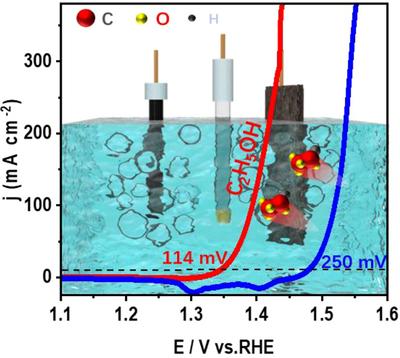
电化学碱水电解(AWE)被认为是一种不依赖铂族金属(PGM)作为催化剂生产高纯氢的有效方法。然而,析氧反应(OER)作为阳极半反应,涉及一个四电子转移过程,动力学缓慢,这大大降低了AWE的整体反应效率。虽然高效催化剂可以加快OER速率,但阳极的高过电位仍然是阻碍AWE的重要因素。本文合成了超薄nife层状双氢氧化物(U-NiFe LDH)纳米片阵列,并将其用作阳极催化剂,因为其具有坚固的结构,优异的柔韧性和有效的层间阴离子补偿。在1 M KOH条件下,OER只需要250 mV的过电位就能达到10 mA cm−2的电流密度。在KOH电解液中加入添加剂乙醇进一步降低了所需的AWE过电位至114 mV。在以U-NiFe LDH为阳极的三电极电解系统中,当电流密度为100 mA cm−2时,阳极过电位可降低130 mV。本研究为开发低能耗、绿色的电催化制氢AWE技术提供了可能的途径。
Significant Reduction of Anode Reaction Overpotential in Alkaline Water Electrolysis by Ultrathin NiFe-Layered Double Hydroxide in Ethanol-Added Electrolyte
Electrochemical alkaline water electrolysis (AWE) is regarded as an effective method for producing high-purity hydrogen without relying on platinum group metal (PGM) as catalyst. However, the oxygen evolution reaction (OER), as the anode half-reaction, involves a four-electron transfer process with slow kinetics, which significantly reduces the overall reaction efficiency of AWE. Although highly efficient catalysts can accelerate the OER rate, the high overpotential of the anode still remains an important factor hindering AWE. Herein, ultrathin NiFe-layered double hydroxide (U-NiFe LDH) nanosheet arrays were synthesized and used as anode catalysts due to their robust structure, excellent flexibility, and effective interlayer anion compensation. Only 250 mV of overpotential was required for OER to reach a current density of 10 mA cm−2 in 1 M KOH. Incorporating the additive ethanol into KOH electrolyte further reduces the required overpotential of AWE to 114 mV. The anode overpotential could be decreased by 130 mV at a current density of 100 mA cm−2 in a three-electrode electrolysis system with U-NiFe LDH as the anode. This work provides a possible approach for the development of low-energy and green AWE technology for electrocatalytic hydrogen production.
期刊介绍:
With an impact factor of 4.495 (2018), ChemCatChem is one of the premier journals in the field of catalysis. The journal provides primary research papers and critical secondary information on heterogeneous, homogeneous and bio- and nanocatalysis. The journal is well placed to strengthen cross-communication within between these communities. Its authors and readers come from academia, the chemical industry, and government laboratories across the world. It is published on behalf of Chemistry Europe, an association of 16 European chemical societies, and is supported by the German Catalysis Society.







 京公网安备 11010802042870号
京ICP备2023020795号-1
京公网安备 11010802042870号
京ICP备2023020795号-1

 分享
分享
 求助内容:
求助内容: 应助结果提醒方式:
 扫码关注我们
