Yongkang Liu , Fulai Qi , Xinqiang Wang , Qian Zhang , Yanxia Liu , Yong Gao , Ke Wang , Wengang Cui , Fan Gao , Zhenglong Li , Yaxiong Yang , Lixian Sun , Jian Chen , Hongge Pan
{"title":"超快闪焦耳加热合成WC/W2C异质结构对界面电子结构的调控增强了Ru的析氢能力","authors":"Yongkang Liu , Fulai Qi , Xinqiang Wang , Qian Zhang , Yanxia Liu , Yong Gao , Ke Wang , Wengang Cui , Fan Gao , Zhenglong Li , Yaxiong Yang , Lixian Sun , Jian Chen , Hongge Pan","doi":"10.1016/j.apsusc.2025.163015","DOIUrl":null,"url":null,"abstract":"<div><div>Regulation of the electronic structure for ruthenium (Ru) based catalysts is critical but challenging to achieve highly active and stable performance at ampere-level current density for proton exchange membrane water electrolysis (PEMWE). In this work, two phase tungsten carbide heterostructure interface (WC/W<sub>2</sub>C) is constructed to optimize adsorption of hydrogen intermediates (H*) on Ru-based heterostructure catalyst by one-step ultrafast flash joule heating. Experimental and theoretical studies indicate the obvious charge accumulation and migration at the interface region between Ru and WC/W<sub>2</sub>C heterostructure. The H* adsorption and desorption balanced by tuning the interface electronic structure contributes synergistic effect to the HER activity of Ru-W<sub>x</sub>C/CC. Accordingly, with a trace amount of Ru, the as-synthesized Ru-W<sub>x</sub>C/CC exhibits an overpotential of 31 mV at 10 mA cm<sup>−2</sup> and 288 mV at 1 A cm<sup>−2</sup>. Furthermore, the catalyst delivers exceptional stability during at least 500 h of operation at 10 mA cm<sup>−2</sup> with negligible degradation for overall water splitting. This work will provide a guidance for regulating interfacial electronic structure of hydrogen evolution catalyst by the design of heterostructure.</div></div>","PeriodicalId":247,"journal":{"name":"Applied Surface Science","volume":"697 ","pages":"Article 163015"},"PeriodicalIF":6.9000,"publicationDate":"2025-07-15","publicationTypes":"Journal Article","fieldsOfStudy":null,"isOpenAccess":false,"openAccessPdf":"","citationCount":"0","resultStr":"{\"title\":\"Enhanced hydrogen evolution ability of Ru with regulation of interface electronic structure by WC/W2C heterostructure via ultrafast flash joule heating synthesis\",\"authors\":\"Yongkang Liu , Fulai Qi , Xinqiang Wang , Qian Zhang , Yanxia Liu , Yong Gao , Ke Wang , Wengang Cui , Fan Gao , Zhenglong Li , Yaxiong Yang , Lixian Sun , Jian Chen , Hongge Pan\",\"doi\":\"10.1016/j.apsusc.2025.163015\",\"DOIUrl\":null,\"url\":null,\"abstract\":\"<div><div>Regulation of the electronic structure for ruthenium (Ru) based catalysts is critical but challenging to achieve highly active and stable performance at ampere-level current density for proton exchange membrane water electrolysis (PEMWE). In this work, two phase tungsten carbide heterostructure interface (WC/W<sub>2</sub>C) is constructed to optimize adsorption of hydrogen intermediates (H*) on Ru-based heterostructure catalyst by one-step ultrafast flash joule heating. Experimental and theoretical studies indicate the obvious charge accumulation and migration at the interface region between Ru and WC/W<sub>2</sub>C heterostructure. The H* adsorption and desorption balanced by tuning the interface electronic structure contributes synergistic effect to the HER activity of Ru-W<sub>x</sub>C/CC. Accordingly, with a trace amount of Ru, the as-synthesized Ru-W<sub>x</sub>C/CC exhibits an overpotential of 31 mV at 10 mA cm<sup>−2</sup> and 288 mV at 1 A cm<sup>−2</sup>. Furthermore, the catalyst delivers exceptional stability during at least 500 h of operation at 10 mA cm<sup>−2</sup> with negligible degradation for overall water splitting. This work will provide a guidance for regulating interfacial electronic structure of hydrogen evolution catalyst by the design of heterostructure.</div></div>\",\"PeriodicalId\":247,\"journal\":{\"name\":\"Applied Surface Science\",\"volume\":\"697 \",\"pages\":\"Article 163015\"},\"PeriodicalIF\":6.9000,\"publicationDate\":\"2025-07-15\",\"publicationTypes\":\"Journal Article\",\"fieldsOfStudy\":null,\"isOpenAccess\":false,\"openAccessPdf\":\"\",\"citationCount\":\"0\",\"resultStr\":null,\"platform\":\"Semanticscholar\",\"paperid\":null,\"PeriodicalName\":\"Applied Surface Science\",\"FirstCategoryId\":\"88\",\"ListUrlMain\":\"https://www.sciencedirect.com/science/article/pii/S0169433225007299\",\"RegionNum\":2,\"RegionCategory\":\"材料科学\",\"ArticlePicture\":[],\"TitleCN\":null,\"AbstractTextCN\":null,\"PMCID\":null,\"EPubDate\":\"2025/3/18 0:00:00\",\"PubModel\":\"Epub\",\"JCR\":\"Q2\",\"JCRName\":\"CHEMISTRY, PHYSICAL\",\"Score\":null,\"Total\":0}","platform":"Semanticscholar","paperid":null,"PeriodicalName":"Applied Surface Science","FirstCategoryId":"88","ListUrlMain":"https://www.sciencedirect.com/science/article/pii/S0169433225007299","RegionNum":2,"RegionCategory":"材料科学","ArticlePicture":[],"TitleCN":null,"AbstractTextCN":null,"PMCID":null,"EPubDate":"2025/3/18 0:00:00","PubModel":"Epub","JCR":"Q2","JCRName":"CHEMISTRY, PHYSICAL","Score":null,"Total":0}
引用次数: 0
摘要
钌基催化剂的电子结构调控是实现质子交换膜水电解(PEMWE)在安培级电流密度下高活性和稳定性能的关键,但具有挑战性。本文通过一步超快闪焦耳加热,构建了两相碳化钨异质结构界面(WC/W2C),以优化氢中间体(H*)在钌基异质结构催化剂上的吸附。实验和理论研究表明,在Ru与WC/W2C异质结构界面区域存在明显的电荷积累和迁移。通过调整界面电子结构平衡H*吸附和解吸,对Ru-WxC/CC的HER活性产生协同效应。因此,在微量Ru的情况下,合成的Ru- wxc /CC在10 mA cm−2时的过电位为31 mV,在1 a cm−2时的过电位为288 mV。此外,该催化剂在10 mA cm−2下运行至少500 h时具有优异的稳定性,对整体水分解的降解可以忽略不计。本研究将为通过异质结构的设计来调控析氢催化剂的界面电子结构提供指导。
Enhanced hydrogen evolution ability of Ru with regulation of interface electronic structure by WC/W2C heterostructure via ultrafast flash joule heating synthesis
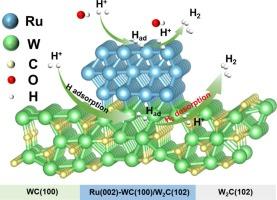
Regulation of the electronic structure for ruthenium (Ru) based catalysts is critical but challenging to achieve highly active and stable performance at ampere-level current density for proton exchange membrane water electrolysis (PEMWE). In this work, two phase tungsten carbide heterostructure interface (WC/W2C) is constructed to optimize adsorption of hydrogen intermediates (H*) on Ru-based heterostructure catalyst by one-step ultrafast flash joule heating. Experimental and theoretical studies indicate the obvious charge accumulation and migration at the interface region between Ru and WC/W2C heterostructure. The H* adsorption and desorption balanced by tuning the interface electronic structure contributes synergistic effect to the HER activity of Ru-WxC/CC. Accordingly, with a trace amount of Ru, the as-synthesized Ru-WxC/CC exhibits an overpotential of 31 mV at 10 mA cm−2 and 288 mV at 1 A cm−2. Furthermore, the catalyst delivers exceptional stability during at least 500 h of operation at 10 mA cm−2 with negligible degradation for overall water splitting. This work will provide a guidance for regulating interfacial electronic structure of hydrogen evolution catalyst by the design of heterostructure.
期刊介绍:
Applied Surface Science covers topics contributing to a better understanding of surfaces, interfaces, nanostructures and their applications. The journal is concerned with scientific research on the atomic and molecular level of material properties determined with specific surface analytical techniques and/or computational methods, as well as the processing of such structures.





 京公网安备 11010802042870号
京ICP备2023020795号-1
京公网安备 11010802042870号
京ICP备2023020795号-1

 分享
分享
 求助内容:
求助内容: 应助结果提醒方式:
 扫码关注我们
