Yuetao Ma, Likun Chen, Yuhang Li, Boyu Li, Xufei An, Xing Cheng, Hai Su, Ke Yang, Guanyou Xiao, Yang Zhao, Zhuo Han, Shaoke Guo, Jinshuo Mi, Peiran Shi, Ming Liu, Yan-Bing He and Feiyu Kang
{"title":"快速充电固态锂金属电池的中尺度聚合物调节","authors":"Yuetao Ma, Likun Chen, Yuhang Li, Boyu Li, Xufei An, Xing Cheng, Hai Su, Ke Yang, Guanyou Xiao, Yang Zhao, Zhuo Han, Shaoke Guo, Jinshuo Mi, Peiran Shi, Ming Liu, Yan-Bing He and Feiyu Kang","doi":"10.1039/D5EE00203F","DOIUrl":null,"url":null,"abstract":"<p >Developing solid-state polymer electrolytes with both high voltage and ionic conductivity is essential for practical solid-state batteries. Poly(vinylidene fluoride) (PVDF)-based solid-state electrolytes are attractive for solid-state lithium metal batteries (LMBs). However, their high mesoscale heterogeneity induced by phase separation during electrolyte preparation leads to the formation of large PVDF spherulites. Herein, we demonstrate that the mesoscale heterogeneity causes the accumulation of Li<small><sup>+</sup></small> on the surfaces of oversized PVDF spherulites. The large spherulites with low interface-bulk ratios greatly impede the efficient long-range Li<small><sup>+</sup></small> conduction within the electrolyte. We propose an efficient strategy to regulate the geometric structure of PVDF spherulites by introducing the polyvinyl alcohol (PVA) coated dielectric SrTiO<small><sub>3</sub></small> (PVA@STO) as a nucleating agent in a PVDF-based electrolyte. The excellent interfacial compatibility of the PVA coating layer with PVDF facilitates the uniform dispersion of PVA@STO nano-fillers and regulates the nucleation to form abundant finer PVDF spherulites with more interfaces, thereby providing abundant Li<small><sup>+</sup></small> transport pathways. Furthermore, the well-dispersed PVA@STO nano-fillers can effectively dissociate lithium salt to generate more mobile Li<small><sup>+</sup></small> in the PVDF–PVA@STO electrolyte that exhibits a high ionic conductivity of 8.6 × 10<small><sup>−4</sup></small> S cm<small><sup>−1</sup></small>. The Li|PVDF–PVA@STO|NCM811 batteries demonstrate excellent high rate cycling performance, retaining 80.8% and 70.5% capacity after 2000 cycles at 5C and 10C, respectively. This work clearly demonstrates the significant effect of mesoscale structure regulation on a polymer structure for high-performance fast-charging solid-state lithium metal batteries.</p>","PeriodicalId":72,"journal":{"name":"Energy & Environmental Science","volume":" 8","pages":" 3730-3739"},"PeriodicalIF":30.8000,"publicationDate":"2025-03-18","publicationTypes":"Journal Article","fieldsOfStudy":null,"isOpenAccess":false,"openAccessPdf":"","citationCount":"0","resultStr":"{\"title\":\"Mesoscale polymer regulation for fast-charging solid-state lithium metal batteries†\",\"authors\":\"Yuetao Ma, Likun Chen, Yuhang Li, Boyu Li, Xufei An, Xing Cheng, Hai Su, Ke Yang, Guanyou Xiao, Yang Zhao, Zhuo Han, Shaoke Guo, Jinshuo Mi, Peiran Shi, Ming Liu, Yan-Bing He and Feiyu Kang\",\"doi\":\"10.1039/D5EE00203F\",\"DOIUrl\":null,\"url\":null,\"abstract\":\"<p >Developing solid-state polymer electrolytes with both high voltage and ionic conductivity is essential for practical solid-state batteries. Poly(vinylidene fluoride) (PVDF)-based solid-state electrolytes are attractive for solid-state lithium metal batteries (LMBs). However, their high mesoscale heterogeneity induced by phase separation during electrolyte preparation leads to the formation of large PVDF spherulites. Herein, we demonstrate that the mesoscale heterogeneity causes the accumulation of Li<small><sup>+</sup></small> on the surfaces of oversized PVDF spherulites. The large spherulites with low interface-bulk ratios greatly impede the efficient long-range Li<small><sup>+</sup></small> conduction within the electrolyte. We propose an efficient strategy to regulate the geometric structure of PVDF spherulites by introducing the polyvinyl alcohol (PVA) coated dielectric SrTiO<small><sub>3</sub></small> (PVA@STO) as a nucleating agent in a PVDF-based electrolyte. The excellent interfacial compatibility of the PVA coating layer with PVDF facilitates the uniform dispersion of PVA@STO nano-fillers and regulates the nucleation to form abundant finer PVDF spherulites with more interfaces, thereby providing abundant Li<small><sup>+</sup></small> transport pathways. Furthermore, the well-dispersed PVA@STO nano-fillers can effectively dissociate lithium salt to generate more mobile Li<small><sup>+</sup></small> in the PVDF–PVA@STO electrolyte that exhibits a high ionic conductivity of 8.6 × 10<small><sup>−4</sup></small> S cm<small><sup>−1</sup></small>. The Li|PVDF–PVA@STO|NCM811 batteries demonstrate excellent high rate cycling performance, retaining 80.8% and 70.5% capacity after 2000 cycles at 5C and 10C, respectively. This work clearly demonstrates the significant effect of mesoscale structure regulation on a polymer structure for high-performance fast-charging solid-state lithium metal batteries.</p>\",\"PeriodicalId\":72,\"journal\":{\"name\":\"Energy & Environmental Science\",\"volume\":\" 8\",\"pages\":\" 3730-3739\"},\"PeriodicalIF\":30.8000,\"publicationDate\":\"2025-03-18\",\"publicationTypes\":\"Journal Article\",\"fieldsOfStudy\":null,\"isOpenAccess\":false,\"openAccessPdf\":\"\",\"citationCount\":\"0\",\"resultStr\":null,\"platform\":\"Semanticscholar\",\"paperid\":null,\"PeriodicalName\":\"Energy & Environmental Science\",\"FirstCategoryId\":\"88\",\"ListUrlMain\":\"https://pubs.rsc.org/en/content/articlelanding/2025/ee/d5ee00203f\",\"RegionNum\":1,\"RegionCategory\":\"材料科学\",\"ArticlePicture\":[],\"TitleCN\":null,\"AbstractTextCN\":null,\"PMCID\":null,\"EPubDate\":\"\",\"PubModel\":\"\",\"JCR\":\"Q1\",\"JCRName\":\"CHEMISTRY, MULTIDISCIPLINARY\",\"Score\":null,\"Total\":0}","platform":"Semanticscholar","paperid":null,"PeriodicalName":"Energy & Environmental Science","FirstCategoryId":"88","ListUrlMain":"https://pubs.rsc.org/en/content/articlelanding/2025/ee/d5ee00203f","RegionNum":1,"RegionCategory":"材料科学","ArticlePicture":[],"TitleCN":null,"AbstractTextCN":null,"PMCID":null,"EPubDate":"","PubModel":"","JCR":"Q1","JCRName":"CHEMISTRY, MULTIDISCIPLINARY","Score":null,"Total":0}
引用次数: 0
摘要
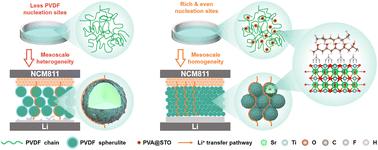
开发具有高电压和离子导电性的固态聚合物电解质是实用固态电池的必要条件。聚偏氟乙烯(PVDF)基固态电解质对固态锂金属电池(lmb)具有吸引力。然而,在电解质制备过程中,由于相分离引起的高度中尺度非均质性导致了PVDF大球粒的形成。本文证明了中尺度非均质性导致了超大PVDF球晶表面Li+的积累。界面体积比低的大球晶极大地阻碍了锂离子在电解质内的高效远程传导。我们提出了一种有效的策略,通过在PVDF基电解质中引入聚乙烯醇(PVA)涂层的电介质SrTiO3 (PVA@STO)作为成核剂来调节PVDF球粒的几何结构。PVA涂层与PVDF良好的界面相容性,有利于PVA@STO纳米填料的均匀分散,调控成核形成丰富的更细的PVDF球晶和更多的界面,从而提供丰富的Li+输运途径。此外,分散良好的PVA@STO纳米填料可以有效地解离锂盐,在PVDF - PVA@STO电解质中产生更多的移动Li+,其离子电导率高达8.6 × 10⁻⁴ S cm−1。Li|PVDF - PVA@STO|NCM811电池表现出优异的高倍率循环性能,在5C和10C下循环2000次后容量分别保持80.8%和70.5%。这项工作清楚地证明了中尺度结构调节对高性能快速充电固态锂金属电池聚合物结构的重要影响。
Mesoscale polymer regulation for fast-charging solid-state lithium metal batteries†
Developing solid-state polymer electrolytes with both high voltage and ionic conductivity is essential for practical solid-state batteries. Poly(vinylidene fluoride) (PVDF)-based solid-state electrolytes are attractive for solid-state lithium metal batteries (LMBs). However, their high mesoscale heterogeneity induced by phase separation during electrolyte preparation leads to the formation of large PVDF spherulites. Herein, we demonstrate that the mesoscale heterogeneity causes the accumulation of Li+ on the surfaces of oversized PVDF spherulites. The large spherulites with low interface-bulk ratios greatly impede the efficient long-range Li+ conduction within the electrolyte. We propose an efficient strategy to regulate the geometric structure of PVDF spherulites by introducing the polyvinyl alcohol (PVA) coated dielectric SrTiO3 (PVA@STO) as a nucleating agent in a PVDF-based electrolyte. The excellent interfacial compatibility of the PVA coating layer with PVDF facilitates the uniform dispersion of PVA@STO nano-fillers and regulates the nucleation to form abundant finer PVDF spherulites with more interfaces, thereby providing abundant Li+ transport pathways. Furthermore, the well-dispersed PVA@STO nano-fillers can effectively dissociate lithium salt to generate more mobile Li+ in the PVDF–PVA@STO electrolyte that exhibits a high ionic conductivity of 8.6 × 10⁻⁴ S cm−1. The Li|PVDF–PVA@STO|NCM811 batteries demonstrate excellent high rate cycling performance, retaining 80.8% and 70.5% capacity after 2000 cycles at 5C and 10C, respectively. This work clearly demonstrates the significant effect of mesoscale structure regulation on a polymer structure for high-performance fast-charging solid-state lithium metal batteries.
期刊介绍:
Energy & Environmental Science, a peer-reviewed scientific journal, publishes original research and review articles covering interdisciplinary topics in the (bio)chemical and (bio)physical sciences, as well as chemical engineering disciplines. Published monthly by the Royal Society of Chemistry (RSC), a not-for-profit publisher, Energy & Environmental Science is recognized as a leading journal. It boasts an impressive impact factor of 8.500 as of 2009, ranking 8th among 140 journals in the category "Chemistry, Multidisciplinary," second among 71 journals in "Energy & Fuels," second among 128 journals in "Engineering, Chemical," and first among 181 scientific journals in "Environmental Sciences."
Energy & Environmental Science publishes various types of articles, including Research Papers (original scientific work), Review Articles, Perspectives, and Minireviews (feature review-type articles of broad interest), Communications (original scientific work of an urgent nature), Opinions (personal, often speculative viewpoints or hypotheses on current topics), and Analysis Articles (in-depth examination of energy-related issues).





 京公网安备 11010802042870号
京ICP备2023020795号-1
京公网安备 11010802042870号
京ICP备2023020795号-1

 分享
分享
 求助内容:
求助内容: 应助结果提醒方式:
 扫码关注我们
