Junru Wu, Ziyao Gao, Zhiqiang Fu, Lili Lin, Xianshu Wang, Yun Zhao, Lele Peng, Feiyu Kang, Zhenyu Guo, Maria-Magdalena Titirici, Yunlong Zhao, Xiulin Fan and Baohua Li
{"title":"高压锂金属电池用电场响应溶剂对稀醚电解质中阴极内亥姆霍兹平面的调节","authors":"Junru Wu, Ziyao Gao, Zhiqiang Fu, Lili Lin, Xianshu Wang, Yun Zhao, Lele Peng, Feiyu Kang, Zhenyu Guo, Maria-Magdalena Titirici, Yunlong Zhao, Xiulin Fan and Baohua Li","doi":"10.1039/D4EE05818F","DOIUrl":null,"url":null,"abstract":"<p >Raising the cut-off voltage to 4.6 V can boost the energy density of lithium metal batteries (LMBs) with the LiCoO<small><sub>2</sub></small> cathode. However, the unfavorable cathode electrolyte interphase (CEI) formed on the high-voltage cathode when using Li metal-compatible ether electrolytes leads to a short lifespan of batteries. Here, we harness the battery intrinsic electric field to manipulate the cathode inner Helmholtz plane (IHP) during the battery's charge by simply introducing an electric-field-responsive solvent into an ether electrolyte. Specifically, 2,2-difluoroethyl trifluoromethanesulfonate (DTS) as a weak solvated co-solvent preferentially adsorbs on the cathode surface under electric field activation. Owing to the majority of “high-voltage fragile” 1,2-dimethoxyethane ether molecules squeezed out from the IHP by DTS, a LiF-rich and organics-less stable CEI film is formed, which minimizes cathode cracking and structure degradation under high-voltage. The DTS-containing electrolyte shows superior cycling stability of LMBs under harsh conditions of 4.6 V, 4.2 mA h cm<small><sup>−2</sup></small> cathode loading and 15 μL less electrolyte. Furthermore, the feasibility of this concept is validated in practical A h-level pouch full cells. This work highlights the significance of the IHP modulation and interfacial chemistry, providing an alternative pathway towards ether-based electrolyte engineering for high-voltage LMBs.</p>","PeriodicalId":72,"journal":{"name":"Energy & Environmental Science","volume":" 10","pages":" 4677-4689"},"PeriodicalIF":30.8000,"publicationDate":"2025-03-18","publicationTypes":"Journal Article","fieldsOfStudy":null,"isOpenAccess":false,"openAccessPdf":"","citationCount":"0","resultStr":"{\"title\":\"Regulation of the cathode inner Helmholtz plane in dilute ether electrolytes using an electric-field-responsive solvent for high-voltage lithium metal batteries†\",\"authors\":\"Junru Wu, Ziyao Gao, Zhiqiang Fu, Lili Lin, Xianshu Wang, Yun Zhao, Lele Peng, Feiyu Kang, Zhenyu Guo, Maria-Magdalena Titirici, Yunlong Zhao, Xiulin Fan and Baohua Li\",\"doi\":\"10.1039/D4EE05818F\",\"DOIUrl\":null,\"url\":null,\"abstract\":\"<p >Raising the cut-off voltage to 4.6 V can boost the energy density of lithium metal batteries (LMBs) with the LiCoO<small><sub>2</sub></small> cathode. However, the unfavorable cathode electrolyte interphase (CEI) formed on the high-voltage cathode when using Li metal-compatible ether electrolytes leads to a short lifespan of batteries. Here, we harness the battery intrinsic electric field to manipulate the cathode inner Helmholtz plane (IHP) during the battery's charge by simply introducing an electric-field-responsive solvent into an ether electrolyte. Specifically, 2,2-difluoroethyl trifluoromethanesulfonate (DTS) as a weak solvated co-solvent preferentially adsorbs on the cathode surface under electric field activation. Owing to the majority of “high-voltage fragile” 1,2-dimethoxyethane ether molecules squeezed out from the IHP by DTS, a LiF-rich and organics-less stable CEI film is formed, which minimizes cathode cracking and structure degradation under high-voltage. The DTS-containing electrolyte shows superior cycling stability of LMBs under harsh conditions of 4.6 V, 4.2 mA h cm<small><sup>−2</sup></small> cathode loading and 15 μL less electrolyte. Furthermore, the feasibility of this concept is validated in practical A h-level pouch full cells. This work highlights the significance of the IHP modulation and interfacial chemistry, providing an alternative pathway towards ether-based electrolyte engineering for high-voltage LMBs.</p>\",\"PeriodicalId\":72,\"journal\":{\"name\":\"Energy & Environmental Science\",\"volume\":\" 10\",\"pages\":\" 4677-4689\"},\"PeriodicalIF\":30.8000,\"publicationDate\":\"2025-03-18\",\"publicationTypes\":\"Journal Article\",\"fieldsOfStudy\":null,\"isOpenAccess\":false,\"openAccessPdf\":\"\",\"citationCount\":\"0\",\"resultStr\":null,\"platform\":\"Semanticscholar\",\"paperid\":null,\"PeriodicalName\":\"Energy & Environmental Science\",\"FirstCategoryId\":\"88\",\"ListUrlMain\":\"https://pubs.rsc.org/en/content/articlelanding/2025/ee/d4ee05818f\",\"RegionNum\":1,\"RegionCategory\":\"材料科学\",\"ArticlePicture\":[],\"TitleCN\":null,\"AbstractTextCN\":null,\"PMCID\":null,\"EPubDate\":\"\",\"PubModel\":\"\",\"JCR\":\"Q1\",\"JCRName\":\"CHEMISTRY, MULTIDISCIPLINARY\",\"Score\":null,\"Total\":0}","platform":"Semanticscholar","paperid":null,"PeriodicalName":"Energy & Environmental Science","FirstCategoryId":"88","ListUrlMain":"https://pubs.rsc.org/en/content/articlelanding/2025/ee/d4ee05818f","RegionNum":1,"RegionCategory":"材料科学","ArticlePicture":[],"TitleCN":null,"AbstractTextCN":null,"PMCID":null,"EPubDate":"","PubModel":"","JCR":"Q1","JCRName":"CHEMISTRY, MULTIDISCIPLINARY","Score":null,"Total":0}
引用次数: 0
摘要
将截止电压提高到4.6 V,可以提高LiCoO2阴极锂金属电池的能量密度。然而,使用与锂金属相容的醚电解质时,在高压阴极上形成不利的阴极电解质界面,导致电池寿命短。在这里,我们利用电池的本征电场来控制电池充电过程中的阴极内亥姆霍兹平面(IHP),方法是在乙醚电解质中引入一种电场响应溶剂。其中,2,2-二氟乙基三氟甲烷磺酸盐(DTS)作为弱溶剂在电场激活下优先吸附在阴极表面。由于DTS从IHP中挤出了大部分“高压易碎”的1,2-二甲氧基乙烷分子,形成了一种富liff且有机物稳定性较差的CEI膜,从而最大限度地减少了高压下阴极开裂和结构降解。在4.6 V、4.2 mAh cm-2负极负载和15 μL贫电解液的恶劣条件下,含dts电解质表现出优异的lmb循环稳定性。此外,该概念的可行性在实际的ah级袋式满电池中得到验证。这项工作强调了IHP调制和界面化学的重要性,为高压lmb的醚基电解质工程提供了另一种途径。
Regulation of the cathode inner Helmholtz plane in dilute ether electrolytes using an electric-field-responsive solvent for high-voltage lithium metal batteries†
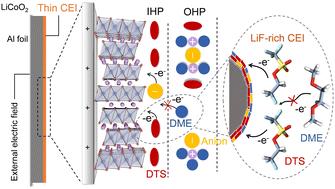
Raising the cut-off voltage to 4.6 V can boost the energy density of lithium metal batteries (LMBs) with the LiCoO2 cathode. However, the unfavorable cathode electrolyte interphase (CEI) formed on the high-voltage cathode when using Li metal-compatible ether electrolytes leads to a short lifespan of batteries. Here, we harness the battery intrinsic electric field to manipulate the cathode inner Helmholtz plane (IHP) during the battery's charge by simply introducing an electric-field-responsive solvent into an ether electrolyte. Specifically, 2,2-difluoroethyl trifluoromethanesulfonate (DTS) as a weak solvated co-solvent preferentially adsorbs on the cathode surface under electric field activation. Owing to the majority of “high-voltage fragile” 1,2-dimethoxyethane ether molecules squeezed out from the IHP by DTS, a LiF-rich and organics-less stable CEI film is formed, which minimizes cathode cracking and structure degradation under high-voltage. The DTS-containing electrolyte shows superior cycling stability of LMBs under harsh conditions of 4.6 V, 4.2 mA h cm−2 cathode loading and 15 μL less electrolyte. Furthermore, the feasibility of this concept is validated in practical A h-level pouch full cells. This work highlights the significance of the IHP modulation and interfacial chemistry, providing an alternative pathway towards ether-based electrolyte engineering for high-voltage LMBs.
期刊介绍:
Energy & Environmental Science, a peer-reviewed scientific journal, publishes original research and review articles covering interdisciplinary topics in the (bio)chemical and (bio)physical sciences, as well as chemical engineering disciplines. Published monthly by the Royal Society of Chemistry (RSC), a not-for-profit publisher, Energy & Environmental Science is recognized as a leading journal. It boasts an impressive impact factor of 8.500 as of 2009, ranking 8th among 140 journals in the category "Chemistry, Multidisciplinary," second among 71 journals in "Energy & Fuels," second among 128 journals in "Engineering, Chemical," and first among 181 scientific journals in "Environmental Sciences."
Energy & Environmental Science publishes various types of articles, including Research Papers (original scientific work), Review Articles, Perspectives, and Minireviews (feature review-type articles of broad interest), Communications (original scientific work of an urgent nature), Opinions (personal, often speculative viewpoints or hypotheses on current topics), and Analysis Articles (in-depth examination of energy-related issues).




 京公网安备 11010802042870号
京ICP备2023020795号-1
京公网安备 11010802042870号
京ICP备2023020795号-1

 分享
分享
 求助内容:
求助内容: 应助结果提醒方式:
 扫码关注我们
