Jiancheng You, Haimao Zhu, Jin Ye, Cunyun Xu, Gaobo Xu, Zezhuan Jiang, Xiaofeng He, Zhongjun Dai, Rathes Kannan R, Na Zheng, Shujun Zhang, Zuoti Xie, Qunliang Song
{"title":"定制氧化锡优化钙钛矿太阳能电池的抗紫外线性能和缺陷钝化","authors":"Jiancheng You, Haimao Zhu, Jin Ye, Cunyun Xu, Gaobo Xu, Zezhuan Jiang, Xiaofeng He, Zhongjun Dai, Rathes Kannan R, Na Zheng, Shujun Zhang, Zuoti Xie, Qunliang Song","doi":"10.1002/smll.202500695","DOIUrl":null,"url":null,"abstract":"<p>Tin oxide (SnO<sub>2</sub>) as an electron transport layer (ETL) has garnered significant attention in planar perovskite solar cells (PSCs) for its excellent physical and chemical properties, paving its commercial potential. However, its drawbacks, such as surface defects and photocatalytic properties due to its wide band gap, remain unresolved. Under ultraviolet (UV) light, photocatalytic SnO<sub>2</sub> induces perovskite phase transitions at the interface, compromising device stability. In this study, the fluorescent dopant sodium 2,2′-([1,1′-Biphenyl]-4,4′-Diylbis (Ethene-2,1-Diyl)) Dibenzenesulfonate (CF351) is introduced into SnO<sub>2</sub> Solution for the first time. With excellent UV absorption, CF351 effectively blocks UV light, reducing SnO<sub>2</sub>-induced perovskite degradation. Perovskite films on CF351-doped SnO<sub>2</sub> show remarkable stability under continuous UV irradiation (365 nm) for 32 days, the resistance to phase transition is improved by 100%. PSCs retaining 80.8% of their initial power conversion efficiency (PCE) after ≈1000 h of UV exposure, compared to only 18.7% for control. Additionally, CF351 passivates interfacial defects, regulates crystallization, and optimizes energy levels. It's down-conversion capability also enhances photocurrent by generating extra visible photons. As a result, CF351-doped PSCs achieve a PCE of 22.59%, significantly surpassing the 20.42% of control devices. This work provides an effective strategy for preparing highly efficient and UV stable PSCs.</p>","PeriodicalId":228,"journal":{"name":"Small","volume":"21 16","pages":""},"PeriodicalIF":11.8000,"publicationDate":"2025-03-18","publicationTypes":"Journal Article","fieldsOfStudy":null,"isOpenAccess":false,"openAccessPdf":"","citationCount":"0","resultStr":"{\"title\":\"Optimizing UV Resistance and Defect Passivation in Perovskite Solar Cells with Tailored Tin Oxide\",\"authors\":\"Jiancheng You, Haimao Zhu, Jin Ye, Cunyun Xu, Gaobo Xu, Zezhuan Jiang, Xiaofeng He, Zhongjun Dai, Rathes Kannan R, Na Zheng, Shujun Zhang, Zuoti Xie, Qunliang Song\",\"doi\":\"10.1002/smll.202500695\",\"DOIUrl\":null,\"url\":null,\"abstract\":\"<p>Tin oxide (SnO<sub>2</sub>) as an electron transport layer (ETL) has garnered significant attention in planar perovskite solar cells (PSCs) for its excellent physical and chemical properties, paving its commercial potential. However, its drawbacks, such as surface defects and photocatalytic properties due to its wide band gap, remain unresolved. Under ultraviolet (UV) light, photocatalytic SnO<sub>2</sub> induces perovskite phase transitions at the interface, compromising device stability. In this study, the fluorescent dopant sodium 2,2′-([1,1′-Biphenyl]-4,4′-Diylbis (Ethene-2,1-Diyl)) Dibenzenesulfonate (CF351) is introduced into SnO<sub>2</sub> Solution for the first time. With excellent UV absorption, CF351 effectively blocks UV light, reducing SnO<sub>2</sub>-induced perovskite degradation. Perovskite films on CF351-doped SnO<sub>2</sub> show remarkable stability under continuous UV irradiation (365 nm) for 32 days, the resistance to phase transition is improved by 100%. PSCs retaining 80.8% of their initial power conversion efficiency (PCE) after ≈1000 h of UV exposure, compared to only 18.7% for control. Additionally, CF351 passivates interfacial defects, regulates crystallization, and optimizes energy levels. It's down-conversion capability also enhances photocurrent by generating extra visible photons. As a result, CF351-doped PSCs achieve a PCE of 22.59%, significantly surpassing the 20.42% of control devices. This work provides an effective strategy for preparing highly efficient and UV stable PSCs.</p>\",\"PeriodicalId\":228,\"journal\":{\"name\":\"Small\",\"volume\":\"21 16\",\"pages\":\"\"},\"PeriodicalIF\":11.8000,\"publicationDate\":\"2025-03-18\",\"publicationTypes\":\"Journal Article\",\"fieldsOfStudy\":null,\"isOpenAccess\":false,\"openAccessPdf\":\"\",\"citationCount\":\"0\",\"resultStr\":null,\"platform\":\"Semanticscholar\",\"paperid\":null,\"PeriodicalName\":\"Small\",\"FirstCategoryId\":\"88\",\"ListUrlMain\":\"https://onlinelibrary.wiley.com/doi/10.1002/smll.202500695\",\"RegionNum\":2,\"RegionCategory\":\"材料科学\",\"ArticlePicture\":[],\"TitleCN\":null,\"AbstractTextCN\":null,\"PMCID\":null,\"EPubDate\":\"\",\"PubModel\":\"\",\"JCR\":\"Q1\",\"JCRName\":\"CHEMISTRY, MULTIDISCIPLINARY\",\"Score\":null,\"Total\":0}","platform":"Semanticscholar","paperid":null,"PeriodicalName":"Small","FirstCategoryId":"88","ListUrlMain":"https://onlinelibrary.wiley.com/doi/10.1002/smll.202500695","RegionNum":2,"RegionCategory":"材料科学","ArticlePicture":[],"TitleCN":null,"AbstractTextCN":null,"PMCID":null,"EPubDate":"","PubModel":"","JCR":"Q1","JCRName":"CHEMISTRY, MULTIDISCIPLINARY","Score":null,"Total":0}
Optimizing UV Resistance and Defect Passivation in Perovskite Solar Cells with Tailored Tin Oxide
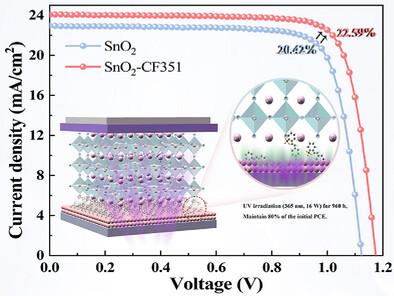
Tin oxide (SnO2) as an electron transport layer (ETL) has garnered significant attention in planar perovskite solar cells (PSCs) for its excellent physical and chemical properties, paving its commercial potential. However, its drawbacks, such as surface defects and photocatalytic properties due to its wide band gap, remain unresolved. Under ultraviolet (UV) light, photocatalytic SnO2 induces perovskite phase transitions at the interface, compromising device stability. In this study, the fluorescent dopant sodium 2,2′-([1,1′-Biphenyl]-4,4′-Diylbis (Ethene-2,1-Diyl)) Dibenzenesulfonate (CF351) is introduced into SnO2 Solution for the first time. With excellent UV absorption, CF351 effectively blocks UV light, reducing SnO2-induced perovskite degradation. Perovskite films on CF351-doped SnO2 show remarkable stability under continuous UV irradiation (365 nm) for 32 days, the resistance to phase transition is improved by 100%. PSCs retaining 80.8% of their initial power conversion efficiency (PCE) after ≈1000 h of UV exposure, compared to only 18.7% for control. Additionally, CF351 passivates interfacial defects, regulates crystallization, and optimizes energy levels. It's down-conversion capability also enhances photocurrent by generating extra visible photons. As a result, CF351-doped PSCs achieve a PCE of 22.59%, significantly surpassing the 20.42% of control devices. This work provides an effective strategy for preparing highly efficient and UV stable PSCs.
期刊介绍:
Small serves as an exceptional platform for both experimental and theoretical studies in fundamental and applied interdisciplinary research at the nano- and microscale. The journal offers a compelling mix of peer-reviewed Research Articles, Reviews, Perspectives, and Comments.
With a remarkable 2022 Journal Impact Factor of 13.3 (Journal Citation Reports from Clarivate Analytics, 2023), Small remains among the top multidisciplinary journals, covering a wide range of topics at the interface of materials science, chemistry, physics, engineering, medicine, and biology.
Small's readership includes biochemists, biologists, biomedical scientists, chemists, engineers, information technologists, materials scientists, physicists, and theoreticians alike.





 京公网安备 11010802042870号
京ICP备2023020795号-1
京公网安备 11010802042870号
京ICP备2023020795号-1

 分享
分享
 求助内容:
求助内容: 应助结果提醒方式:
 扫码关注我们
