JaeHwan Park, My−Van Tieu, Thi Xoan Hoang, Duc−Trung Pham, Sungho Park, Phu Chi Vu, Hieu Man Tran, Sungbo Cho
{"title":"利用夹心肽功能化AuNPs@Ti3C2Tz的新型高通量电化学检测金黄色葡萄球菌、蜡样芽孢杆菌或黄体微球菌","authors":"JaeHwan Park, My−Van Tieu, Thi Xoan Hoang, Duc−Trung Pham, Sungho Park, Phu Chi Vu, Hieu Man Tran, Sungbo Cho","doi":"10.1002/smll.202411486","DOIUrl":null,"url":null,"abstract":"<p>Affinity-based electrochemical biosensors hold promise for detecting pathogenic bacteria in environmental applications. This study focuses on detecting gram-positive bacteria, which can cause fatal infections and are a major global mortality factor. An electrochemical biosensor platform using high-throughput 16-channel gold disk electrodes (16-GDEs) inspired by bio-microelectromechanical systems (BioMEMS) is developed, it incorporates a nanocomposite (AuNPs@Ti<sub>3</sub>C<sub>2</sub>T<sub>z</sub>) with sandwich peptide structures to enhance electroconductivity and biological antifouling. Using AuNPs@Ti<sub>3</sub>C<sub>2</sub>T<sub>z</sub>-coated 16-GDEs, sensitive biosensors for gram-positive bacteria (<i>Staphylococcus aureus</i>, <i>Bacillus cereus</i>, or <i>Micrococcus luteus</i>) are constructed and validated in fresh-water samples by spiking with bacteria, which showed linear correlations between normalized peak current and logarithmic concentrations of the target bacteria (adjusted R-square ≥ 0.93). A single high-throughput platform containing biosensors for <i>S. aureus</i>, <i>M. luteus</i>, or <i>B. cereus</i> is also developed, exhibiting specific responses without any cross-reactivity in real samples. This platform enabled sensitive simultaneous detection of multiple analytes in environmental samples (500 CFU mL⁻¹) and can be applied to detect any target analyte with a suitable peptide pair. The strategy is to implement a quantitative real-time polymerase chain reaction (RT-qPCR) adaptive sensing device to successfully detect gram-positive bacteria. The nanocomposite-enabled electrochemical biosensor platform on 16-GDEs offers a valuable tool for environmental and clinical diagnostics.</p>","PeriodicalId":228,"journal":{"name":"Small","volume":"21 29","pages":""},"PeriodicalIF":12.1000,"publicationDate":"2025-03-18","publicationTypes":"Journal Article","fieldsOfStudy":null,"isOpenAccess":false,"openAccessPdf":"https://onlinelibrary.wiley.com/doi/epdf/10.1002/smll.202411486","citationCount":"0","resultStr":"{\"title\":\"Novel High-Throughput Electrochemical Detection of Staphylococcus Aureus, Bacillus Cereus, or Micrococcus Luteus Using AuNPs@Ti3C2Tz Functionalized with Sandwich Peptides\",\"authors\":\"JaeHwan Park, My−Van Tieu, Thi Xoan Hoang, Duc−Trung Pham, Sungho Park, Phu Chi Vu, Hieu Man Tran, Sungbo Cho\",\"doi\":\"10.1002/smll.202411486\",\"DOIUrl\":null,\"url\":null,\"abstract\":\"<p>Affinity-based electrochemical biosensors hold promise for detecting pathogenic bacteria in environmental applications. This study focuses on detecting gram-positive bacteria, which can cause fatal infections and are a major global mortality factor. An electrochemical biosensor platform using high-throughput 16-channel gold disk electrodes (16-GDEs) inspired by bio-microelectromechanical systems (BioMEMS) is developed, it incorporates a nanocomposite (AuNPs@Ti<sub>3</sub>C<sub>2</sub>T<sub>z</sub>) with sandwich peptide structures to enhance electroconductivity and biological antifouling. Using AuNPs@Ti<sub>3</sub>C<sub>2</sub>T<sub>z</sub>-coated 16-GDEs, sensitive biosensors for gram-positive bacteria (<i>Staphylococcus aureus</i>, <i>Bacillus cereus</i>, or <i>Micrococcus luteus</i>) are constructed and validated in fresh-water samples by spiking with bacteria, which showed linear correlations between normalized peak current and logarithmic concentrations of the target bacteria (adjusted R-square ≥ 0.93). A single high-throughput platform containing biosensors for <i>S. aureus</i>, <i>M. luteus</i>, or <i>B. cereus</i> is also developed, exhibiting specific responses without any cross-reactivity in real samples. This platform enabled sensitive simultaneous detection of multiple analytes in environmental samples (500 CFU mL⁻¹) and can be applied to detect any target analyte with a suitable peptide pair. The strategy is to implement a quantitative real-time polymerase chain reaction (RT-qPCR) adaptive sensing device to successfully detect gram-positive bacteria. The nanocomposite-enabled electrochemical biosensor platform on 16-GDEs offers a valuable tool for environmental and clinical diagnostics.</p>\",\"PeriodicalId\":228,\"journal\":{\"name\":\"Small\",\"volume\":\"21 29\",\"pages\":\"\"},\"PeriodicalIF\":12.1000,\"publicationDate\":\"2025-03-18\",\"publicationTypes\":\"Journal Article\",\"fieldsOfStudy\":null,\"isOpenAccess\":false,\"openAccessPdf\":\"https://onlinelibrary.wiley.com/doi/epdf/10.1002/smll.202411486\",\"citationCount\":\"0\",\"resultStr\":null,\"platform\":\"Semanticscholar\",\"paperid\":null,\"PeriodicalName\":\"Small\",\"FirstCategoryId\":\"88\",\"ListUrlMain\":\"https://onlinelibrary.wiley.com/doi/10.1002/smll.202411486\",\"RegionNum\":2,\"RegionCategory\":\"材料科学\",\"ArticlePicture\":[],\"TitleCN\":null,\"AbstractTextCN\":null,\"PMCID\":null,\"EPubDate\":\"\",\"PubModel\":\"\",\"JCR\":\"Q1\",\"JCRName\":\"CHEMISTRY, MULTIDISCIPLINARY\",\"Score\":null,\"Total\":0}","platform":"Semanticscholar","paperid":null,"PeriodicalName":"Small","FirstCategoryId":"88","ListUrlMain":"https://onlinelibrary.wiley.com/doi/10.1002/smll.202411486","RegionNum":2,"RegionCategory":"材料科学","ArticlePicture":[],"TitleCN":null,"AbstractTextCN":null,"PMCID":null,"EPubDate":"","PubModel":"","JCR":"Q1","JCRName":"CHEMISTRY, MULTIDISCIPLINARY","Score":null,"Total":0}
引用次数: 0
摘要
基于亲和的电化学生物传感器有望在环境应用中检测致病菌。这项研究的重点是检测革兰氏阳性细菌,这种细菌可引起致命感染,是全球主要的死亡因素。基于生物微电子机械系统(BioMEMS),设计了一种基于高通量16通道金盘电极(16-GDEs)的电化学生物传感器平台,该平台结合了具有夹心肽结构的纳米复合材料(AuNPs@Ti3C2Tz),以提高电导率和生物防污性能。利用AuNPs@Ti3C2Tz-coated 16-GDEs,构建了革兰氏阳性细菌(金黄色葡萄球菌、蜡样芽孢杆菌或黄体微球菌)的敏感生物传感器,并在淡水样品中进行了细菌峰值检测,结果表明归一化峰值电流与目标细菌的对数浓度呈线性相关(调整后r方≥0.93)。一个包含金黄色葡萄球菌、黄体芽孢杆菌或蜡样芽孢杆菌生物传感器的单一高通量平台也被开发出来,在真实样品中表现出特异性反应而没有任何交叉反应性。该平台可以灵敏地同时检测环境样品中的多种分析物(500 CFU mL - 1),并可用于检测具有合适肽对的任何目标分析物。该策略是实施定量实时聚合酶链反应(RT-qPCR)自适应传感装置,以成功检测革兰氏阳性菌。基于16-GDEs的纳米复合材料电化学生物传感器平台为环境和临床诊断提供了有价值的工具。
Novel High-Throughput Electrochemical Detection of Staphylococcus Aureus, Bacillus Cereus, or Micrococcus Luteus Using AuNPs@Ti3C2Tz Functionalized with Sandwich Peptides
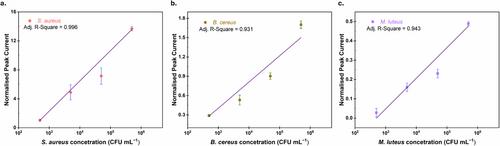
Affinity-based electrochemical biosensors hold promise for detecting pathogenic bacteria in environmental applications. This study focuses on detecting gram-positive bacteria, which can cause fatal infections and are a major global mortality factor. An electrochemical biosensor platform using high-throughput 16-channel gold disk electrodes (16-GDEs) inspired by bio-microelectromechanical systems (BioMEMS) is developed, it incorporates a nanocomposite (AuNPs@Ti3C2Tz) with sandwich peptide structures to enhance electroconductivity and biological antifouling. Using AuNPs@Ti3C2Tz-coated 16-GDEs, sensitive biosensors for gram-positive bacteria (Staphylococcus aureus, Bacillus cereus, or Micrococcus luteus) are constructed and validated in fresh-water samples by spiking with bacteria, which showed linear correlations between normalized peak current and logarithmic concentrations of the target bacteria (adjusted R-square ≥ 0.93). A single high-throughput platform containing biosensors for S. aureus, M. luteus, or B. cereus is also developed, exhibiting specific responses without any cross-reactivity in real samples. This platform enabled sensitive simultaneous detection of multiple analytes in environmental samples (500 CFU mL⁻¹) and can be applied to detect any target analyte with a suitable peptide pair. The strategy is to implement a quantitative real-time polymerase chain reaction (RT-qPCR) adaptive sensing device to successfully detect gram-positive bacteria. The nanocomposite-enabled electrochemical biosensor platform on 16-GDEs offers a valuable tool for environmental and clinical diagnostics.
期刊介绍:
Small serves as an exceptional platform for both experimental and theoretical studies in fundamental and applied interdisciplinary research at the nano- and microscale. The journal offers a compelling mix of peer-reviewed Research Articles, Reviews, Perspectives, and Comments.
With a remarkable 2022 Journal Impact Factor of 13.3 (Journal Citation Reports from Clarivate Analytics, 2023), Small remains among the top multidisciplinary journals, covering a wide range of topics at the interface of materials science, chemistry, physics, engineering, medicine, and biology.
Small's readership includes biochemists, biologists, biomedical scientists, chemists, engineers, information technologists, materials scientists, physicists, and theoreticians alike.





 京公网安备 11010802042870号
京ICP备2023020795号-1
京公网安备 11010802042870号
京ICP备2023020795号-1

 分享
分享
 求助内容:
求助内容: 应助结果提醒方式:
 扫码关注我们
