{"title":"钛酸铝基纳米复合材料层在可见光下的光电化学水分解","authors":"Shima Kashani , Hamid Reza Madaah Hosseini","doi":"10.1016/j.matchemphys.2025.130652","DOIUrl":null,"url":null,"abstract":"<div><div>Although Al<sub>2</sub>TiO<sub>5</sub>-based nanocomposites are known to be promising photocatalysts, their potential application in photoelectrochemical (PEC) water splitting has not yet been explored. In this study, innovative photoanodes composed of TiO<sub>2</sub>/Al<sub>2</sub>TiO<sub>5</sub>/Al<sub>2</sub>O<sub>3</sub> nanocomposite powders were developed. These powders were synthesized via sol-gel method and deposited on fluorine-doped tin oxide (FTO) substrates. The crystalline phase ratio in these nanocomposites was controlled by adjusting the calcination temperature between 800 and 1000 °C, and then identified by the X-ray diffraction analysis. The microstructure properties of the samples were examined by Field-emission scanning electron microscopy. UV–Vis spectroscopy and Mott-Schottky analyses were employed to determine the bandgap energies and band edge positions of the materials. For the TiO<sub>2</sub>/Al<sub>2</sub>TiO<sub>5</sub>/Al<sub>2</sub>O<sub>3</sub> nanocomposites, the bandgap values were found to range from 2.9 to 3.1 eV. Photoluminescence analysis indicated a reduced electron-hole pair recombination rate in tialite-based photoanodes compared to TiO<sub>2</sub> films. Electrochemical impedance spectroscopy (EIS) showed that the sample with the highest tialite (Al<sub>2</sub>TiO<sub>5</sub>) concentration had significantly lower charge transfer resistance. Due to the relative positions of the band edges in this composite, photogenerated holes can be injected from the valence band of other photocatalyst phases into the valence band of Al<sub>2</sub>TiO<sub>5</sub> and then transferred to the electrolyte, contributing to the photoelectrochemical water oxidation reaction. Under illumination of 100 mW cm<sup>−2</sup>, the photocurrent density of the AT-based photoelectrodes reached 0.42 mA cm<sup>−2</sup> at 1.23 V versus the reversible hydrogen electrode, which was approximately 2.5 times higher than that of the TiO<sub>2</sub> sample.</div></div>","PeriodicalId":18227,"journal":{"name":"Materials Chemistry and Physics","volume":"339 ","pages":"Article 130652"},"PeriodicalIF":4.7000,"publicationDate":"2025-07-15","publicationTypes":"Journal Article","fieldsOfStudy":null,"isOpenAccess":false,"openAccessPdf":"","citationCount":"0","resultStr":"{\"title\":\"Aluminum titanate-based nanocomposite layers in photoelectrochemical water splitting under visible light\",\"authors\":\"Shima Kashani , Hamid Reza Madaah Hosseini\",\"doi\":\"10.1016/j.matchemphys.2025.130652\",\"DOIUrl\":null,\"url\":null,\"abstract\":\"<div><div>Although Al<sub>2</sub>TiO<sub>5</sub>-based nanocomposites are known to be promising photocatalysts, their potential application in photoelectrochemical (PEC) water splitting has not yet been explored. In this study, innovative photoanodes composed of TiO<sub>2</sub>/Al<sub>2</sub>TiO<sub>5</sub>/Al<sub>2</sub>O<sub>3</sub> nanocomposite powders were developed. These powders were synthesized via sol-gel method and deposited on fluorine-doped tin oxide (FTO) substrates. The crystalline phase ratio in these nanocomposites was controlled by adjusting the calcination temperature between 800 and 1000 °C, and then identified by the X-ray diffraction analysis. The microstructure properties of the samples were examined by Field-emission scanning electron microscopy. UV–Vis spectroscopy and Mott-Schottky analyses were employed to determine the bandgap energies and band edge positions of the materials. For the TiO<sub>2</sub>/Al<sub>2</sub>TiO<sub>5</sub>/Al<sub>2</sub>O<sub>3</sub> nanocomposites, the bandgap values were found to range from 2.9 to 3.1 eV. Photoluminescence analysis indicated a reduced electron-hole pair recombination rate in tialite-based photoanodes compared to TiO<sub>2</sub> films. Electrochemical impedance spectroscopy (EIS) showed that the sample with the highest tialite (Al<sub>2</sub>TiO<sub>5</sub>) concentration had significantly lower charge transfer resistance. Due to the relative positions of the band edges in this composite, photogenerated holes can be injected from the valence band of other photocatalyst phases into the valence band of Al<sub>2</sub>TiO<sub>5</sub> and then transferred to the electrolyte, contributing to the photoelectrochemical water oxidation reaction. Under illumination of 100 mW cm<sup>−2</sup>, the photocurrent density of the AT-based photoelectrodes reached 0.42 mA cm<sup>−2</sup> at 1.23 V versus the reversible hydrogen electrode, which was approximately 2.5 times higher than that of the TiO<sub>2</sub> sample.</div></div>\",\"PeriodicalId\":18227,\"journal\":{\"name\":\"Materials Chemistry and Physics\",\"volume\":\"339 \",\"pages\":\"Article 130652\"},\"PeriodicalIF\":4.7000,\"publicationDate\":\"2025-07-15\",\"publicationTypes\":\"Journal Article\",\"fieldsOfStudy\":null,\"isOpenAccess\":false,\"openAccessPdf\":\"\",\"citationCount\":\"0\",\"resultStr\":null,\"platform\":\"Semanticscholar\",\"paperid\":null,\"PeriodicalName\":\"Materials Chemistry and Physics\",\"FirstCategoryId\":\"88\",\"ListUrlMain\":\"https://www.sciencedirect.com/science/article/pii/S0254058425002986\",\"RegionNum\":3,\"RegionCategory\":\"材料科学\",\"ArticlePicture\":[],\"TitleCN\":null,\"AbstractTextCN\":null,\"PMCID\":null,\"EPubDate\":\"2025/3/8 0:00:00\",\"PubModel\":\"Epub\",\"JCR\":\"Q2\",\"JCRName\":\"MATERIALS SCIENCE, MULTIDISCIPLINARY\",\"Score\":null,\"Total\":0}","platform":"Semanticscholar","paperid":null,"PeriodicalName":"Materials Chemistry and Physics","FirstCategoryId":"88","ListUrlMain":"https://www.sciencedirect.com/science/article/pii/S0254058425002986","RegionNum":3,"RegionCategory":"材料科学","ArticlePicture":[],"TitleCN":null,"AbstractTextCN":null,"PMCID":null,"EPubDate":"2025/3/8 0:00:00","PubModel":"Epub","JCR":"Q2","JCRName":"MATERIALS SCIENCE, MULTIDISCIPLINARY","Score":null,"Total":0}
引用次数: 0
摘要
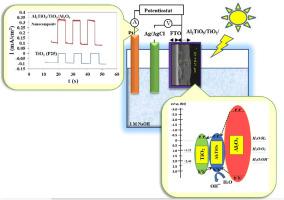
虽然al2tio5基纳米复合材料是一种很有前途的光催化剂,但其在光电化学(PEC)水分解方面的潜在应用尚未得到探索。在本研究中,开发了由TiO2/Al2TiO5/Al2O3纳米复合粉末组成的新型光阳极。采用溶胶-凝胶法制备了这些粉末,并将其沉积在掺氟氧化锡(FTO)衬底上。通过在800 ~ 1000℃范围内调节煅烧温度来控制纳米复合材料的晶相比,然后通过x射线衍射分析对其进行鉴定。采用场发射扫描电镜对样品的微观结构进行了表征。利用紫外可见光谱和莫特-肖特基分析确定了材料的带隙能量和带边位置。TiO2/Al2TiO5/Al2O3纳米复合材料的带隙值在2.9 ~ 3.1 eV之间。光致发光分析表明,与TiO2薄膜相比,钛酸盐基光阳极的电子-空穴对复合率降低。电化学阻抗谱(EIS)表明,钛酸石(Al2TiO5)浓度最高的样品具有较低的电荷转移电阻。由于该复合材料中带边的相对位置,光生空穴可以从其他光催化剂相的价带注入到Al2TiO5的价带中,然后转移到电解质中,从而促进了光电化学水氧化反应。在100mw cm−2的光照下,at基光电极在1.23 V下的光电流密度达到0.42 mA cm−2,比可逆氢电极高约2.5倍。
Aluminum titanate-based nanocomposite layers in photoelectrochemical water splitting under visible light
Although Al2TiO5-based nanocomposites are known to be promising photocatalysts, their potential application in photoelectrochemical (PEC) water splitting has not yet been explored. In this study, innovative photoanodes composed of TiO2/Al2TiO5/Al2O3 nanocomposite powders were developed. These powders were synthesized via sol-gel method and deposited on fluorine-doped tin oxide (FTO) substrates. The crystalline phase ratio in these nanocomposites was controlled by adjusting the calcination temperature between 800 and 1000 °C, and then identified by the X-ray diffraction analysis. The microstructure properties of the samples were examined by Field-emission scanning electron microscopy. UV–Vis spectroscopy and Mott-Schottky analyses were employed to determine the bandgap energies and band edge positions of the materials. For the TiO2/Al2TiO5/Al2O3 nanocomposites, the bandgap values were found to range from 2.9 to 3.1 eV. Photoluminescence analysis indicated a reduced electron-hole pair recombination rate in tialite-based photoanodes compared to TiO2 films. Electrochemical impedance spectroscopy (EIS) showed that the sample with the highest tialite (Al2TiO5) concentration had significantly lower charge transfer resistance. Due to the relative positions of the band edges in this composite, photogenerated holes can be injected from the valence band of other photocatalyst phases into the valence band of Al2TiO5 and then transferred to the electrolyte, contributing to the photoelectrochemical water oxidation reaction. Under illumination of 100 mW cm−2, the photocurrent density of the AT-based photoelectrodes reached 0.42 mA cm−2 at 1.23 V versus the reversible hydrogen electrode, which was approximately 2.5 times higher than that of the TiO2 sample.
期刊介绍:
Materials Chemistry and Physics is devoted to short communications, full-length research papers and feature articles on interrelationships among structure, properties, processing and performance of materials. The Editors welcome manuscripts on thin films, surface and interface science, materials degradation and reliability, metallurgy, semiconductors and optoelectronic materials, fine ceramics, magnetics, superconductors, specialty polymers, nano-materials and composite materials.




 京公网安备 11010802042870号
京ICP备2023020795号-1
京公网安备 11010802042870号
京ICP备2023020795号-1

 分享
分享
 求助内容:
求助内容: 应助结果提醒方式:
 扫码关注我们
