Xiaoyun Sun , Wenjun Wang , Xuesong Mei , Chuanwei Zhang , Feiyan Han , Peng Zhang
{"title":"用飞秒激光在聚酰亚胺薄膜上制备耐高温打标图案","authors":"Xiaoyun Sun , Wenjun Wang , Xuesong Mei , Chuanwei Zhang , Feiyan Han , Peng Zhang","doi":"10.1016/j.optlastec.2025.112801","DOIUrl":null,"url":null,"abstract":"<div><div>This study investigates the preparation and recognition of marking patterns on high-temperature-resistant polyimide (PI) film surfaces using femtosecond laser. By optimizing laser processing parameters, PI surfaces with anti-reflective micro/nano structures and diffractive laser-induced periodic surface structures (LIPSSs) were obtained. Moreover, the traditional two-dimensional code and color code were fabricated based on the optimal laser processing parameters. Subsequently, after laser processing, Raman spectroscopy indicated carbonization on the PI surface. An analysis of the atomic ratios and group content on the PI surface revealed that the alteration of chemical groups was dependent on the generation and removal processes. High-temperature testing demonstrated that the marking patterns on the PI surface remained stable in environments up to 300 ℃, with no significant changes observed in the traditional two-dimensional code after exposure to high temperatures. The color code comprised four colors: the inherent brown-yellow of the PI substrate, black from ablation, and two additional colors induced during processing. Furthermore, the color code was recognized by separately extracting the black, yellow, and purple parts. Therefore, this research further achieved the marking patterns with easy identification, high capacity, and high-temperature resistance on PI film.</div></div>","PeriodicalId":19511,"journal":{"name":"Optics and Laser Technology","volume":"187 ","pages":"Article 112801"},"PeriodicalIF":5.0000,"publicationDate":"2025-09-01","publicationTypes":"Journal Article","fieldsOfStudy":null,"isOpenAccess":false,"openAccessPdf":"","citationCount":"0","resultStr":"{\"title\":\"High-temperature resistant marking patterns prepared on polyimide film using femtosecond laser\",\"authors\":\"Xiaoyun Sun , Wenjun Wang , Xuesong Mei , Chuanwei Zhang , Feiyan Han , Peng Zhang\",\"doi\":\"10.1016/j.optlastec.2025.112801\",\"DOIUrl\":null,\"url\":null,\"abstract\":\"<div><div>This study investigates the preparation and recognition of marking patterns on high-temperature-resistant polyimide (PI) film surfaces using femtosecond laser. By optimizing laser processing parameters, PI surfaces with anti-reflective micro/nano structures and diffractive laser-induced periodic surface structures (LIPSSs) were obtained. Moreover, the traditional two-dimensional code and color code were fabricated based on the optimal laser processing parameters. Subsequently, after laser processing, Raman spectroscopy indicated carbonization on the PI surface. An analysis of the atomic ratios and group content on the PI surface revealed that the alteration of chemical groups was dependent on the generation and removal processes. High-temperature testing demonstrated that the marking patterns on the PI surface remained stable in environments up to 300 ℃, with no significant changes observed in the traditional two-dimensional code after exposure to high temperatures. The color code comprised four colors: the inherent brown-yellow of the PI substrate, black from ablation, and two additional colors induced during processing. Furthermore, the color code was recognized by separately extracting the black, yellow, and purple parts. Therefore, this research further achieved the marking patterns with easy identification, high capacity, and high-temperature resistance on PI film.</div></div>\",\"PeriodicalId\":19511,\"journal\":{\"name\":\"Optics and Laser Technology\",\"volume\":\"187 \",\"pages\":\"Article 112801\"},\"PeriodicalIF\":5.0000,\"publicationDate\":\"2025-09-01\",\"publicationTypes\":\"Journal Article\",\"fieldsOfStudy\":null,\"isOpenAccess\":false,\"openAccessPdf\":\"\",\"citationCount\":\"0\",\"resultStr\":null,\"platform\":\"Semanticscholar\",\"paperid\":null,\"PeriodicalName\":\"Optics and Laser Technology\",\"FirstCategoryId\":\"101\",\"ListUrlMain\":\"https://www.sciencedirect.com/science/article/pii/S0030399225003925\",\"RegionNum\":2,\"RegionCategory\":\"物理与天体物理\",\"ArticlePicture\":[],\"TitleCN\":null,\"AbstractTextCN\":null,\"PMCID\":null,\"EPubDate\":\"2025/3/18 0:00:00\",\"PubModel\":\"Epub\",\"JCR\":\"Q1\",\"JCRName\":\"OPTICS\",\"Score\":null,\"Total\":0}","platform":"Semanticscholar","paperid":null,"PeriodicalName":"Optics and Laser Technology","FirstCategoryId":"101","ListUrlMain":"https://www.sciencedirect.com/science/article/pii/S0030399225003925","RegionNum":2,"RegionCategory":"物理与天体物理","ArticlePicture":[],"TitleCN":null,"AbstractTextCN":null,"PMCID":null,"EPubDate":"2025/3/18 0:00:00","PubModel":"Epub","JCR":"Q1","JCRName":"OPTICS","Score":null,"Total":0}
High-temperature resistant marking patterns prepared on polyimide film using femtosecond laser
This study investigates the preparation and recognition of marking patterns on high-temperature-resistant polyimide (PI) film surfaces using femtosecond laser. By optimizing laser processing parameters, PI surfaces with anti-reflective micro/nano structures and diffractive laser-induced periodic surface structures (LIPSSs) were obtained. Moreover, the traditional two-dimensional code and color code were fabricated based on the optimal laser processing parameters. Subsequently, after laser processing, Raman spectroscopy indicated carbonization on the PI surface. An analysis of the atomic ratios and group content on the PI surface revealed that the alteration of chemical groups was dependent on the generation and removal processes. High-temperature testing demonstrated that the marking patterns on the PI surface remained stable in environments up to 300 ℃, with no significant changes observed in the traditional two-dimensional code after exposure to high temperatures. The color code comprised four colors: the inherent brown-yellow of the PI substrate, black from ablation, and two additional colors induced during processing. Furthermore, the color code was recognized by separately extracting the black, yellow, and purple parts. Therefore, this research further achieved the marking patterns with easy identification, high capacity, and high-temperature resistance on PI film.
期刊介绍:
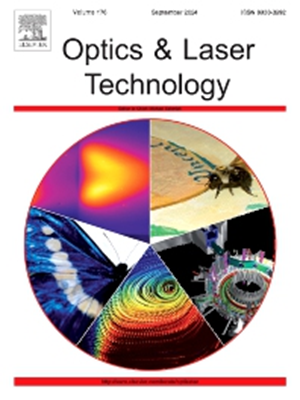
Optics & Laser Technology aims to provide a vehicle for the publication of a broad range of high quality research and review papers in those fields of scientific and engineering research appertaining to the development and application of the technology of optics and lasers. Papers describing original work in these areas are submitted to rigorous refereeing prior to acceptance for publication.
The scope of Optics & Laser Technology encompasses, but is not restricted to, the following areas:
•development in all types of lasers
•developments in optoelectronic devices and photonics
•developments in new photonics and optical concepts
•developments in conventional optics, optical instruments and components
•techniques of optical metrology, including interferometry and optical fibre sensors
•LIDAR and other non-contact optical measurement techniques, including optical methods in heat and fluid flow
•applications of lasers to materials processing, optical NDT display (including holography) and optical communication
•research and development in the field of laser safety including studies of hazards resulting from the applications of lasers (laser safety, hazards of laser fume)
•developments in optical computing and optical information processing
•developments in new optical materials
•developments in new optical characterization methods and techniques
•developments in quantum optics
•developments in light assisted micro and nanofabrication methods and techniques
•developments in nanophotonics and biophotonics
•developments in imaging processing and systems




 京公网安备 11010802042870号
京ICP备2023020795号-1
京公网安备 11010802042870号
京ICP备2023020795号-1

 分享
分享
 求助内容:
求助内容: 应助结果提醒方式:
 扫码关注我们
