Pengren Zou , Carla Cameselle , Antía Torres , Honória S. Chipaca-Domingos , Paulina G. Gonçalves , Hui Cao , Jesus Simal-Gandara , Paz Otero
{"title":"UPLC-ESI-TSQ-MS/MS结合化学计量学分析对安哥拉6种植物中酚类物质进行了鉴定、定量及分布规律研究","authors":"Pengren Zou , Carla Cameselle , Antía Torres , Honória S. Chipaca-Domingos , Paulina G. Gonçalves , Hui Cao , Jesus Simal-Gandara , Paz Otero","doi":"10.1016/j.fbio.2025.106356","DOIUrl":null,"url":null,"abstract":"<div><div>Two roots (<em>Heinsia crinite</em>, <em>Dorstenia convexa</em>), two seeds (<em>Piper guineense</em>, <em>Monodora myristica</em>) and pods of <em>Xylopia aethiopica</em> are extremely popular in Angola as traditional medicine and culinary applications. This study purpose is to obtain a comprehensive phenolic compound characterization of these plants by UPLC-ESI-TSQ-MS/MS due to that few information is known about their composition. Some different types of flavonoids were investigated to get distinctive ions to recognize some phenolics from which standards are not available, including bound complex acids and containing glucosides. As a result, a total of 134 phenolic compounds were identified, of which protocatechuic, p-coumaric acid, quercetin and rutin in all plants. In addition, luteolin, kaempferol, isorhamnetin, apigenin and quercitrin were also found as major flavonoids, but most of them were in the form of flavonoid glycosides. Some chemometrics analysis of quantitative phenolics revealed great variability in the phenolic composition about these plant parts. According to hierarchical clustered heatmap, roots contained more phenolic acids, seeds more poly-methylated flavonoids, pods more isorhamnetin and catechin analogs. Furthermore, principal components and orthogonal partial least squares-discriminant analysis confirmed the prevalence of vanillin, kaempferol, luteolin, quercetin and isorhamnetin in these plants. Correlation coefficient analysis demonstrated that phenolic acid type showed significant positive correlation with DPPH and FRAP, while quercetin and luteolin flavonoids played an important role in TEAC, indicating they are main antioxidant compounds. To conclude, these data will help optimize the use of these resources and enhance their commercialization potential.</div></div>","PeriodicalId":12409,"journal":{"name":"Food Bioscience","volume":"67 ","pages":"Article 106356"},"PeriodicalIF":5.9000,"publicationDate":"2025-05-01","publicationTypes":"Journal Article","fieldsOfStudy":null,"isOpenAccess":false,"openAccessPdf":"","citationCount":"0","resultStr":"{\"title\":\"Identification, quantification and distribution regularities of phenolics from six parts of Angolan plants by UPLC-ESI-TSQ-MS/MS with chemometrics analysis\",\"authors\":\"Pengren Zou , Carla Cameselle , Antía Torres , Honória S. Chipaca-Domingos , Paulina G. Gonçalves , Hui Cao , Jesus Simal-Gandara , Paz Otero\",\"doi\":\"10.1016/j.fbio.2025.106356\",\"DOIUrl\":null,\"url\":null,\"abstract\":\"<div><div>Two roots (<em>Heinsia crinite</em>, <em>Dorstenia convexa</em>), two seeds (<em>Piper guineense</em>, <em>Monodora myristica</em>) and pods of <em>Xylopia aethiopica</em> are extremely popular in Angola as traditional medicine and culinary applications. This study purpose is to obtain a comprehensive phenolic compound characterization of these plants by UPLC-ESI-TSQ-MS/MS due to that few information is known about their composition. Some different types of flavonoids were investigated to get distinctive ions to recognize some phenolics from which standards are not available, including bound complex acids and containing glucosides. As a result, a total of 134 phenolic compounds were identified, of which protocatechuic, p-coumaric acid, quercetin and rutin in all plants. In addition, luteolin, kaempferol, isorhamnetin, apigenin and quercitrin were also found as major flavonoids, but most of them were in the form of flavonoid glycosides. Some chemometrics analysis of quantitative phenolics revealed great variability in the phenolic composition about these plant parts. According to hierarchical clustered heatmap, roots contained more phenolic acids, seeds more poly-methylated flavonoids, pods more isorhamnetin and catechin analogs. Furthermore, principal components and orthogonal partial least squares-discriminant analysis confirmed the prevalence of vanillin, kaempferol, luteolin, quercetin and isorhamnetin in these plants. Correlation coefficient analysis demonstrated that phenolic acid type showed significant positive correlation with DPPH and FRAP, while quercetin and luteolin flavonoids played an important role in TEAC, indicating they are main antioxidant compounds. To conclude, these data will help optimize the use of these resources and enhance their commercialization potential.</div></div>\",\"PeriodicalId\":12409,\"journal\":{\"name\":\"Food Bioscience\",\"volume\":\"67 \",\"pages\":\"Article 106356\"},\"PeriodicalIF\":5.9000,\"publicationDate\":\"2025-05-01\",\"publicationTypes\":\"Journal Article\",\"fieldsOfStudy\":null,\"isOpenAccess\":false,\"openAccessPdf\":\"\",\"citationCount\":\"0\",\"resultStr\":null,\"platform\":\"Semanticscholar\",\"paperid\":null,\"PeriodicalName\":\"Food Bioscience\",\"FirstCategoryId\":\"97\",\"ListUrlMain\":\"https://www.sciencedirect.com/science/article/pii/S2212429225005322\",\"RegionNum\":1,\"RegionCategory\":\"农林科学\",\"ArticlePicture\":[],\"TitleCN\":null,\"AbstractTextCN\":null,\"PMCID\":null,\"EPubDate\":\"2025/3/15 0:00:00\",\"PubModel\":\"Epub\",\"JCR\":\"Q1\",\"JCRName\":\"FOOD SCIENCE & TECHNOLOGY\",\"Score\":null,\"Total\":0}","platform":"Semanticscholar","paperid":null,"PeriodicalName":"Food Bioscience","FirstCategoryId":"97","ListUrlMain":"https://www.sciencedirect.com/science/article/pii/S2212429225005322","RegionNum":1,"RegionCategory":"农林科学","ArticlePicture":[],"TitleCN":null,"AbstractTextCN":null,"PMCID":null,"EPubDate":"2025/3/15 0:00:00","PubModel":"Epub","JCR":"Q1","JCRName":"FOOD SCIENCE & TECHNOLOGY","Score":null,"Total":0}
Identification, quantification and distribution regularities of phenolics from six parts of Angolan plants by UPLC-ESI-TSQ-MS/MS with chemometrics analysis
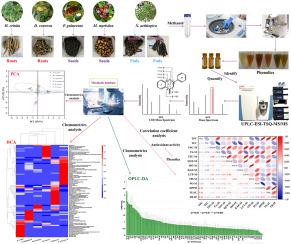
Two roots (Heinsia crinite, Dorstenia convexa), two seeds (Piper guineense, Monodora myristica) and pods of Xylopia aethiopica are extremely popular in Angola as traditional medicine and culinary applications. This study purpose is to obtain a comprehensive phenolic compound characterization of these plants by UPLC-ESI-TSQ-MS/MS due to that few information is known about their composition. Some different types of flavonoids were investigated to get distinctive ions to recognize some phenolics from which standards are not available, including bound complex acids and containing glucosides. As a result, a total of 134 phenolic compounds were identified, of which protocatechuic, p-coumaric acid, quercetin and rutin in all plants. In addition, luteolin, kaempferol, isorhamnetin, apigenin and quercitrin were also found as major flavonoids, but most of them were in the form of flavonoid glycosides. Some chemometrics analysis of quantitative phenolics revealed great variability in the phenolic composition about these plant parts. According to hierarchical clustered heatmap, roots contained more phenolic acids, seeds more poly-methylated flavonoids, pods more isorhamnetin and catechin analogs. Furthermore, principal components and orthogonal partial least squares-discriminant analysis confirmed the prevalence of vanillin, kaempferol, luteolin, quercetin and isorhamnetin in these plants. Correlation coefficient analysis demonstrated that phenolic acid type showed significant positive correlation with DPPH and FRAP, while quercetin and luteolin flavonoids played an important role in TEAC, indicating they are main antioxidant compounds. To conclude, these data will help optimize the use of these resources and enhance their commercialization potential.
Food BioscienceBiochemistry, Genetics and Molecular Biology-Biochemistry
CiteScore
6.40
自引率
5.80%
发文量
671
审稿时长
27 days
期刊介绍:
Food Bioscience is a peer-reviewed journal that aims to provide a forum for recent developments in the field of bio-related food research. The journal focuses on both fundamental and applied research worldwide, with special attention to ethnic and cultural aspects of food bioresearch.




 京公网安备 11010802042870号
京ICP备2023020795号-1
京公网安备 11010802042870号
京ICP备2023020795号-1

 分享
分享
 求助内容:
求助内容: 应助结果提醒方式:
 扫码关注我们
