Jingyang Wan , Chenyang Huang , Ziyue Chen , Jiarui Wan , Wenjing Ding , Dandan Liu , Liang Feng , Yue Meng , Menghan Li , Minzi Ju , Xin Zhang , Baoxing Shen , He Huang
{"title":"智能荧光工具:从设计原则到多步骤蛋白质聚集的可视化","authors":"Jingyang Wan , Chenyang Huang , Ziyue Chen , Jiarui Wan , Wenjing Ding , Dandan Liu , Liang Feng , Yue Meng , Menghan Li , Minzi Ju , Xin Zhang , Baoxing Shen , He Huang","doi":"10.1016/j.ccr.2025.216625","DOIUrl":null,"url":null,"abstract":"<div><div>Protein aggregation is implicated in numerous pathological conditions, including neurodegenerative diseases, cancers, and cardiovascular disorders, making it a crucial target for innovative diagnostics and therapeutics. Recent advancements in organic fluorescent probes have transformed the visualization of protein aggregation, enabling non-invasive, real-time imaging with unprecedented sensitivity and resolution. This review provides a comprehensive exploration of cutting-edge strategies for designing and applying organic fluorescent probes, with a focus on key classes such as aggregation-induced emission (AIE) probes, molecular rotors, and conjugated polyelectrolytes. These probes have significantly advanced our ability to detect distinct aggregation stages, from early oligomer formation to mature fibrils, while overcoming challenges such as fluorescence quenching and specificity. By summarizing innovations in multi-modal imaging and near-infrared (NIR) probes, we highlight their strengths and discuss how these advancements may inspire the development of next-generation probes tailored for studying protein aggregation. Finally, we identify opportunities to enhance probe design for improved biocompatibility, quantitative capabilities, super-resolution imaging and therapeutic integration, positioning next-generation fluorescent probes as transformative tools in clinical and research settings.</div></div>","PeriodicalId":289,"journal":{"name":"Coordination Chemistry Reviews","volume":"535 ","pages":"Article 216625"},"PeriodicalIF":23.5000,"publicationDate":"2025-07-15","publicationTypes":"Journal Article","fieldsOfStudy":null,"isOpenAccess":false,"openAccessPdf":"","citationCount":"0","resultStr":"{\"title\":\"Smart fluorogenic tools: From designing principles to visualization of multistep protein aggregation\",\"authors\":\"Jingyang Wan , Chenyang Huang , Ziyue Chen , Jiarui Wan , Wenjing Ding , Dandan Liu , Liang Feng , Yue Meng , Menghan Li , Minzi Ju , Xin Zhang , Baoxing Shen , He Huang\",\"doi\":\"10.1016/j.ccr.2025.216625\",\"DOIUrl\":null,\"url\":null,\"abstract\":\"<div><div>Protein aggregation is implicated in numerous pathological conditions, including neurodegenerative diseases, cancers, and cardiovascular disorders, making it a crucial target for innovative diagnostics and therapeutics. Recent advancements in organic fluorescent probes have transformed the visualization of protein aggregation, enabling non-invasive, real-time imaging with unprecedented sensitivity and resolution. This review provides a comprehensive exploration of cutting-edge strategies for designing and applying organic fluorescent probes, with a focus on key classes such as aggregation-induced emission (AIE) probes, molecular rotors, and conjugated polyelectrolytes. These probes have significantly advanced our ability to detect distinct aggregation stages, from early oligomer formation to mature fibrils, while overcoming challenges such as fluorescence quenching and specificity. By summarizing innovations in multi-modal imaging and near-infrared (NIR) probes, we highlight their strengths and discuss how these advancements may inspire the development of next-generation probes tailored for studying protein aggregation. Finally, we identify opportunities to enhance probe design for improved biocompatibility, quantitative capabilities, super-resolution imaging and therapeutic integration, positioning next-generation fluorescent probes as transformative tools in clinical and research settings.</div></div>\",\"PeriodicalId\":289,\"journal\":{\"name\":\"Coordination Chemistry Reviews\",\"volume\":\"535 \",\"pages\":\"Article 216625\"},\"PeriodicalIF\":23.5000,\"publicationDate\":\"2025-07-15\",\"publicationTypes\":\"Journal Article\",\"fieldsOfStudy\":null,\"isOpenAccess\":false,\"openAccessPdf\":\"\",\"citationCount\":\"0\",\"resultStr\":null,\"platform\":\"Semanticscholar\",\"paperid\":null,\"PeriodicalName\":\"Coordination Chemistry Reviews\",\"FirstCategoryId\":\"92\",\"ListUrlMain\":\"https://www.sciencedirect.com/science/article/pii/S001085452500195X\",\"RegionNum\":1,\"RegionCategory\":\"化学\",\"ArticlePicture\":[],\"TitleCN\":null,\"AbstractTextCN\":null,\"PMCID\":null,\"EPubDate\":\"2025/3/19 0:00:00\",\"PubModel\":\"Epub\",\"JCR\":\"Q1\",\"JCRName\":\"CHEMISTRY, INORGANIC & NUCLEAR\",\"Score\":null,\"Total\":0}","platform":"Semanticscholar","paperid":null,"PeriodicalName":"Coordination Chemistry Reviews","FirstCategoryId":"92","ListUrlMain":"https://www.sciencedirect.com/science/article/pii/S001085452500195X","RegionNum":1,"RegionCategory":"化学","ArticlePicture":[],"TitleCN":null,"AbstractTextCN":null,"PMCID":null,"EPubDate":"2025/3/19 0:00:00","PubModel":"Epub","JCR":"Q1","JCRName":"CHEMISTRY, INORGANIC & NUCLEAR","Score":null,"Total":0}
Smart fluorogenic tools: From designing principles to visualization of multistep protein aggregation
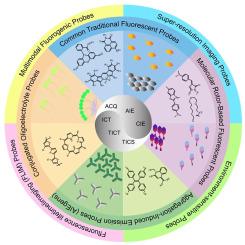
Protein aggregation is implicated in numerous pathological conditions, including neurodegenerative diseases, cancers, and cardiovascular disorders, making it a crucial target for innovative diagnostics and therapeutics. Recent advancements in organic fluorescent probes have transformed the visualization of protein aggregation, enabling non-invasive, real-time imaging with unprecedented sensitivity and resolution. This review provides a comprehensive exploration of cutting-edge strategies for designing and applying organic fluorescent probes, with a focus on key classes such as aggregation-induced emission (AIE) probes, molecular rotors, and conjugated polyelectrolytes. These probes have significantly advanced our ability to detect distinct aggregation stages, from early oligomer formation to mature fibrils, while overcoming challenges such as fluorescence quenching and specificity. By summarizing innovations in multi-modal imaging and near-infrared (NIR) probes, we highlight their strengths and discuss how these advancements may inspire the development of next-generation probes tailored for studying protein aggregation. Finally, we identify opportunities to enhance probe design for improved biocompatibility, quantitative capabilities, super-resolution imaging and therapeutic integration, positioning next-generation fluorescent probes as transformative tools in clinical and research settings.
期刊介绍:
Coordination Chemistry Reviews offers rapid publication of review articles on current and significant topics in coordination chemistry, encompassing organometallic, supramolecular, theoretical, and bioinorganic chemistry. It also covers catalysis, materials chemistry, and metal-organic frameworks from a coordination chemistry perspective. Reviews summarize recent developments or discuss specific techniques, welcoming contributions from both established and emerging researchers.
The journal releases special issues on timely subjects, including those featuring contributions from specific regions or conferences. Occasional full-length book articles are also featured. Additionally, special volumes cover annual reviews of main group chemistry, transition metal group chemistry, and organometallic chemistry. These comprehensive reviews are vital resources for those engaged in coordination chemistry, further establishing Coordination Chemistry Reviews as a hub for insightful surveys in inorganic and physical inorganic chemistry.




 京公网安备 11010802042870号
京ICP备2023020795号-1
京公网安备 11010802042870号
京ICP备2023020795号-1

 分享
分享
 求助内容:
求助内容: 应助结果提醒方式:
 扫码关注我们
