Shuqi Hao , Zeyu Lu , Mengyu Ye , Na Li , Jiayi Hu , Wei Quan , Jiwen Cheng , Huaide Xu , Mei Li
{"title":"肌纤维蛋白结合的Nε-(羧甲基)赖氨酸在胃肠道消化后存在于人类结肠微生物群中的命运","authors":"Shuqi Hao , Zeyu Lu , Mengyu Ye , Na Li , Jiayi Hu , Wei Quan , Jiwen Cheng , Huaide Xu , Mei Li","doi":"10.1016/j.fbio.2025.106380","DOIUrl":null,"url":null,"abstract":"<div><div>N<sup>ε</sup>-(carboxymethyl)lysine (CML), an advanced glycation end product (AGE), is abundant and stable in foods rich in protein, which is considered as a possible threat for human health. Our previous study found that only 35.06 % of myofibrillar protein-bound N<sup>ε</sup>-(carboxymethyl)lysine (MP-bound CML) was absorbed by small intestine <em>in vitro</em>, while the fate of the rest 2/3 CML was still not clear. This study aimed to investigate the dynamic change (micromorphology, content, and absorption) of MP-bound CML gastrointestinal digests during <em>in vitro</em> simulation colon fermentation by sampling at ten time points (0, 2, 4, 8, 12, 18, 24, 36, 48, 72 h) and establishing co-culture models of Caco-2 and HT29 cells. The results showed that the particle size of MP-bound CML digests gradually became smaller during 72 h colon fermentation. Meanwhile, the total CML level was reduced by 86.94 %, especially during the 12 h of fermentation from 36 h to 48 h, the CML content decreased by 52.83 %. Moreover, the absorption rate of total CML during the whole fermentation was in the range of 0.246 %–0.627 % and the apparent permeability coefficient was between 1.524 × 10<sup>−7</sup> cm/s and 3.889 × 10<sup>−7</sup> cm/s, indicating that the absorption of CML was negligible in colon. This study demonstrated that MP-bound CML could be metabolized by gut microbiota, but is hardly to be absorbed in colon, which provides a new perspective into comprehensive evaluation of the potential risk of dietary protein-bound AGEs on human health.</div></div>","PeriodicalId":12409,"journal":{"name":"Food Bioscience","volume":"68 ","pages":"Article 106380"},"PeriodicalIF":5.9000,"publicationDate":"2025-06-01","publicationTypes":"Journal Article","fieldsOfStudy":null,"isOpenAccess":false,"openAccessPdf":"","citationCount":"0","resultStr":"{\"title\":\"Fate of myofibrillar protein-bound Nε-(carboxymethyl)lysine in the presence of the human colonic microbiota after gastrointestinal digestion\",\"authors\":\"Shuqi Hao , Zeyu Lu , Mengyu Ye , Na Li , Jiayi Hu , Wei Quan , Jiwen Cheng , Huaide Xu , Mei Li\",\"doi\":\"10.1016/j.fbio.2025.106380\",\"DOIUrl\":null,\"url\":null,\"abstract\":\"<div><div>N<sup>ε</sup>-(carboxymethyl)lysine (CML), an advanced glycation end product (AGE), is abundant and stable in foods rich in protein, which is considered as a possible threat for human health. Our previous study found that only 35.06 % of myofibrillar protein-bound N<sup>ε</sup>-(carboxymethyl)lysine (MP-bound CML) was absorbed by small intestine <em>in vitro</em>, while the fate of the rest 2/3 CML was still not clear. This study aimed to investigate the dynamic change (micromorphology, content, and absorption) of MP-bound CML gastrointestinal digests during <em>in vitro</em> simulation colon fermentation by sampling at ten time points (0, 2, 4, 8, 12, 18, 24, 36, 48, 72 h) and establishing co-culture models of Caco-2 and HT29 cells. The results showed that the particle size of MP-bound CML digests gradually became smaller during 72 h colon fermentation. Meanwhile, the total CML level was reduced by 86.94 %, especially during the 12 h of fermentation from 36 h to 48 h, the CML content decreased by 52.83 %. Moreover, the absorption rate of total CML during the whole fermentation was in the range of 0.246 %–0.627 % and the apparent permeability coefficient was between 1.524 × 10<sup>−7</sup> cm/s and 3.889 × 10<sup>−7</sup> cm/s, indicating that the absorption of CML was negligible in colon. This study demonstrated that MP-bound CML could be metabolized by gut microbiota, but is hardly to be absorbed in colon, which provides a new perspective into comprehensive evaluation of the potential risk of dietary protein-bound AGEs on human health.</div></div>\",\"PeriodicalId\":12409,\"journal\":{\"name\":\"Food Bioscience\",\"volume\":\"68 \",\"pages\":\"Article 106380\"},\"PeriodicalIF\":5.9000,\"publicationDate\":\"2025-06-01\",\"publicationTypes\":\"Journal Article\",\"fieldsOfStudy\":null,\"isOpenAccess\":false,\"openAccessPdf\":\"\",\"citationCount\":\"0\",\"resultStr\":null,\"platform\":\"Semanticscholar\",\"paperid\":null,\"PeriodicalName\":\"Food Bioscience\",\"FirstCategoryId\":\"97\",\"ListUrlMain\":\"https://www.sciencedirect.com/science/article/pii/S2212429225005565\",\"RegionNum\":1,\"RegionCategory\":\"农林科学\",\"ArticlePicture\":[],\"TitleCN\":null,\"AbstractTextCN\":null,\"PMCID\":null,\"EPubDate\":\"2025/3/17 0:00:00\",\"PubModel\":\"Epub\",\"JCR\":\"Q1\",\"JCRName\":\"FOOD SCIENCE & TECHNOLOGY\",\"Score\":null,\"Total\":0}","platform":"Semanticscholar","paperid":null,"PeriodicalName":"Food Bioscience","FirstCategoryId":"97","ListUrlMain":"https://www.sciencedirect.com/science/article/pii/S2212429225005565","RegionNum":1,"RegionCategory":"农林科学","ArticlePicture":[],"TitleCN":null,"AbstractTextCN":null,"PMCID":null,"EPubDate":"2025/3/17 0:00:00","PubModel":"Epub","JCR":"Q1","JCRName":"FOOD SCIENCE & TECHNOLOGY","Score":null,"Total":0}
Fate of myofibrillar protein-bound Nε-(carboxymethyl)lysine in the presence of the human colonic microbiota after gastrointestinal digestion
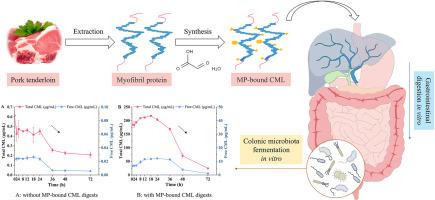
Nε-(carboxymethyl)lysine (CML), an advanced glycation end product (AGE), is abundant and stable in foods rich in protein, which is considered as a possible threat for human health. Our previous study found that only 35.06 % of myofibrillar protein-bound Nε-(carboxymethyl)lysine (MP-bound CML) was absorbed by small intestine in vitro, while the fate of the rest 2/3 CML was still not clear. This study aimed to investigate the dynamic change (micromorphology, content, and absorption) of MP-bound CML gastrointestinal digests during in vitro simulation colon fermentation by sampling at ten time points (0, 2, 4, 8, 12, 18, 24, 36, 48, 72 h) and establishing co-culture models of Caco-2 and HT29 cells. The results showed that the particle size of MP-bound CML digests gradually became smaller during 72 h colon fermentation. Meanwhile, the total CML level was reduced by 86.94 %, especially during the 12 h of fermentation from 36 h to 48 h, the CML content decreased by 52.83 %. Moreover, the absorption rate of total CML during the whole fermentation was in the range of 0.246 %–0.627 % and the apparent permeability coefficient was between 1.524 × 10⁻⁷ cm/s and 3.889 × 10⁻⁷ cm/s, indicating that the absorption of CML was negligible in colon. This study demonstrated that MP-bound CML could be metabolized by gut microbiota, but is hardly to be absorbed in colon, which provides a new perspective into comprehensive evaluation of the potential risk of dietary protein-bound AGEs on human health.
Food BioscienceBiochemistry, Genetics and Molecular Biology-Biochemistry
CiteScore
6.40
自引率
5.80%
发文量
671
审稿时长
27 days
期刊介绍:
Food Bioscience is a peer-reviewed journal that aims to provide a forum for recent developments in the field of bio-related food research. The journal focuses on both fundamental and applied research worldwide, with special attention to ethnic and cultural aspects of food bioresearch.




 京公网安备 11010802042870号
京ICP备2023020795号-1
京公网安备 11010802042870号
京ICP备2023020795号-1

 分享
分享
 求助内容:
求助内容: 应助结果提醒方式:
 扫码关注我们
