Daniel Ghercă , Tiberiu Roman , Dana-Georgeta Popescu , Adrian-Iulian Borhan , Daniel-Dumitru Herea , George Stoian , Horia Chiriac , Gabriel Ababei , Nicoleta Lupu
{"title":"设计TiO2@FexOy具有三维花状表面形态保存的磁性核壳催化剂,以增强光催化性能","authors":"Daniel Ghercă , Tiberiu Roman , Dana-Georgeta Popescu , Adrian-Iulian Borhan , Daniel-Dumitru Herea , George Stoian , Horia Chiriac , Gabriel Ababei , Nicoleta Lupu","doi":"10.1016/j.apsusc.2025.163003","DOIUrl":null,"url":null,"abstract":"<div><div>A synthetic rational design of core–shell magnetic nanomaterials has garnered significant attention for their potential in photocatalysis and adsorption applications. This study presents the synthesis and characterization of a TiO<sub>2</sub>-based core–shell photocatalyst functionalized with Fe<sub>x</sub>O<sub>y</sub> co-catalyst for the efficient adsorption and degradation of synthetic methylene blue dye. The chemical synthesis technique involved a three-step process consisting in the preparation of TiO<sub>2</sub> nanoparticles followed by surface nanocompartmentalization with a ferrihydrite layer exhibiting a flower-like morphology and lastly the calcination of the resulting composite at 400 °C to produce a magnetic core–shell nanomaterial. Comprehensive physicochemical characterization was performed using X-ray diffraction (XRD), X-ray photoelectron spectroscopy (XPS), and ultra-high-resolution transmission electron microscopy (UHR-TEM) to elucidate the structural and morphological properties of the synthesized materials. Photodegradation experiments were conducted under both UV and Visible light irradiation using methylene blue as a model contaminant. The results revealed remarkable photocatalytic performance, with nearly instantaneous adsorption of the dye onto the catalyst surface, followed by efficient photodegradation. Detailed investigations confirmed that the adsorption process occurred at an exceptionally rapid rate, which was attributed to the unique surface functionalization and nanocompartmentalized structure of the core–shell material.</div></div>","PeriodicalId":247,"journal":{"name":"Applied Surface Science","volume":"696 ","pages":"Article 163003"},"PeriodicalIF":6.9000,"publicationDate":"2025-07-01","publicationTypes":"Journal Article","fieldsOfStudy":null,"isOpenAccess":false,"openAccessPdf":"","citationCount":"0","resultStr":"{\"title\":\"Designing TiO2@FexOy magnetic core–shell catalyst with 3D flower-like surface morphology preservation for enhanced photocatalytic performance\",\"authors\":\"Daniel Ghercă , Tiberiu Roman , Dana-Georgeta Popescu , Adrian-Iulian Borhan , Daniel-Dumitru Herea , George Stoian , Horia Chiriac , Gabriel Ababei , Nicoleta Lupu\",\"doi\":\"10.1016/j.apsusc.2025.163003\",\"DOIUrl\":null,\"url\":null,\"abstract\":\"<div><div>A synthetic rational design of core–shell magnetic nanomaterials has garnered significant attention for their potential in photocatalysis and adsorption applications. This study presents the synthesis and characterization of a TiO<sub>2</sub>-based core–shell photocatalyst functionalized with Fe<sub>x</sub>O<sub>y</sub> co-catalyst for the efficient adsorption and degradation of synthetic methylene blue dye. The chemical synthesis technique involved a three-step process consisting in the preparation of TiO<sub>2</sub> nanoparticles followed by surface nanocompartmentalization with a ferrihydrite layer exhibiting a flower-like morphology and lastly the calcination of the resulting composite at 400 °C to produce a magnetic core–shell nanomaterial. Comprehensive physicochemical characterization was performed using X-ray diffraction (XRD), X-ray photoelectron spectroscopy (XPS), and ultra-high-resolution transmission electron microscopy (UHR-TEM) to elucidate the structural and morphological properties of the synthesized materials. Photodegradation experiments were conducted under both UV and Visible light irradiation using methylene blue as a model contaminant. The results revealed remarkable photocatalytic performance, with nearly instantaneous adsorption of the dye onto the catalyst surface, followed by efficient photodegradation. Detailed investigations confirmed that the adsorption process occurred at an exceptionally rapid rate, which was attributed to the unique surface functionalization and nanocompartmentalized structure of the core–shell material.</div></div>\",\"PeriodicalId\":247,\"journal\":{\"name\":\"Applied Surface Science\",\"volume\":\"696 \",\"pages\":\"Article 163003\"},\"PeriodicalIF\":6.9000,\"publicationDate\":\"2025-07-01\",\"publicationTypes\":\"Journal Article\",\"fieldsOfStudy\":null,\"isOpenAccess\":false,\"openAccessPdf\":\"\",\"citationCount\":\"0\",\"resultStr\":null,\"platform\":\"Semanticscholar\",\"paperid\":null,\"PeriodicalName\":\"Applied Surface Science\",\"FirstCategoryId\":\"88\",\"ListUrlMain\":\"https://www.sciencedirect.com/science/article/pii/S0169433225007172\",\"RegionNum\":2,\"RegionCategory\":\"材料科学\",\"ArticlePicture\":[],\"TitleCN\":null,\"AbstractTextCN\":null,\"PMCID\":null,\"EPubDate\":\"2025/3/18 0:00:00\",\"PubModel\":\"Epub\",\"JCR\":\"Q2\",\"JCRName\":\"CHEMISTRY, PHYSICAL\",\"Score\":null,\"Total\":0}","platform":"Semanticscholar","paperid":null,"PeriodicalName":"Applied Surface Science","FirstCategoryId":"88","ListUrlMain":"https://www.sciencedirect.com/science/article/pii/S0169433225007172","RegionNum":2,"RegionCategory":"材料科学","ArticlePicture":[],"TitleCN":null,"AbstractTextCN":null,"PMCID":null,"EPubDate":"2025/3/18 0:00:00","PubModel":"Epub","JCR":"Q2","JCRName":"CHEMISTRY, PHYSICAL","Score":null,"Total":0}
Designing TiO2@FexOy magnetic core–shell catalyst with 3D flower-like surface morphology preservation for enhanced photocatalytic performance
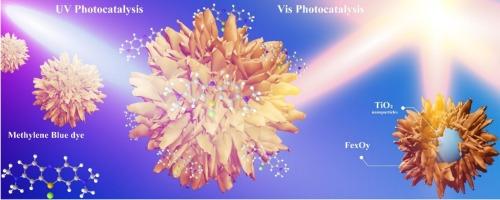
A synthetic rational design of core–shell magnetic nanomaterials has garnered significant attention for their potential in photocatalysis and adsorption applications. This study presents the synthesis and characterization of a TiO2-based core–shell photocatalyst functionalized with FexOy co-catalyst for the efficient adsorption and degradation of synthetic methylene blue dye. The chemical synthesis technique involved a three-step process consisting in the preparation of TiO2 nanoparticles followed by surface nanocompartmentalization with a ferrihydrite layer exhibiting a flower-like morphology and lastly the calcination of the resulting composite at 400 °C to produce a magnetic core–shell nanomaterial. Comprehensive physicochemical characterization was performed using X-ray diffraction (XRD), X-ray photoelectron spectroscopy (XPS), and ultra-high-resolution transmission electron microscopy (UHR-TEM) to elucidate the structural and morphological properties of the synthesized materials. Photodegradation experiments were conducted under both UV and Visible light irradiation using methylene blue as a model contaminant. The results revealed remarkable photocatalytic performance, with nearly instantaneous adsorption of the dye onto the catalyst surface, followed by efficient photodegradation. Detailed investigations confirmed that the adsorption process occurred at an exceptionally rapid rate, which was attributed to the unique surface functionalization and nanocompartmentalized structure of the core–shell material.
期刊介绍:
Applied Surface Science covers topics contributing to a better understanding of surfaces, interfaces, nanostructures and their applications. The journal is concerned with scientific research on the atomic and molecular level of material properties determined with specific surface analytical techniques and/or computational methods, as well as the processing of such structures.




 京公网安备 11010802042870号
京ICP备2023020795号-1
京公网安备 11010802042870号
京ICP备2023020795号-1

 分享
分享
 求助内容:
求助内容: 应助结果提醒方式:
 扫码关注我们
