{"title":"scNET:通过整合单细胞基因表达数据和蛋白-蛋白相互作用来学习环境特异性基因和细胞嵌入。","authors":"Ron Sheinin, Roded Sharan, Asaf Madi","doi":"10.1038/s41592-025-02627-0","DOIUrl":null,"url":null,"abstract":"Recent advances in single-cell RNA sequencing (scRNA-seq) techniques have provided unprecedented insights into the heterogeneity of various tissues. However, gene expression data alone often fails to capture and identify changes in cellular pathways and complexes, as they are more discernible at the protein level. Moreover, analyzing scRNA-seq data presents further challenges due to inherent characteristics such as high noise levels and zero inflation. In this study, we propose an approach to address these limitations by integrating scRNA-seq datasets with a protein–protein interaction network. Our method utilizes a unique dual-view architecture based on graph neural networks, enabling joint representation of gene expression and protein–protein interaction network data. This approach models gene-to-gene relationships under specific biological contexts and refines cell–cell relations using an attention mechanism. Next, through comprehensive evaluations, we demonstrate that scNET better captures gene annotation, pathway characterization and gene–gene relationship identification, while improving cell clustering and pathway analysis across diverse cell types and biological conditions. scNET combines single-cell gene expression information with protein–protein interaction networks using a dual-view architecture based on graph neural networks to better characterize changes in cellular pathways and complexes across cellular conditions.","PeriodicalId":18981,"journal":{"name":"Nature Methods","volume":"22 4","pages":"708-716"},"PeriodicalIF":32.1000,"publicationDate":"2025-03-17","publicationTypes":"Journal Article","fieldsOfStudy":null,"isOpenAccess":false,"openAccessPdf":"https://www.ncbi.nlm.nih.gov/pmc/articles/PMC11978505/pdf/","citationCount":"0","resultStr":"{\"title\":\"scNET: learning context-specific gene and cell embeddings by integrating single-cell gene expression data with protein–protein interactions\",\"authors\":\"Ron Sheinin, Roded Sharan, Asaf Madi\",\"doi\":\"10.1038/s41592-025-02627-0\",\"DOIUrl\":null,\"url\":null,\"abstract\":\"Recent advances in single-cell RNA sequencing (scRNA-seq) techniques have provided unprecedented insights into the heterogeneity of various tissues. However, gene expression data alone often fails to capture and identify changes in cellular pathways and complexes, as they are more discernible at the protein level. Moreover, analyzing scRNA-seq data presents further challenges due to inherent characteristics such as high noise levels and zero inflation. In this study, we propose an approach to address these limitations by integrating scRNA-seq datasets with a protein–protein interaction network. Our method utilizes a unique dual-view architecture based on graph neural networks, enabling joint representation of gene expression and protein–protein interaction network data. This approach models gene-to-gene relationships under specific biological contexts and refines cell–cell relations using an attention mechanism. Next, through comprehensive evaluations, we demonstrate that scNET better captures gene annotation, pathway characterization and gene–gene relationship identification, while improving cell clustering and pathway analysis across diverse cell types and biological conditions. scNET combines single-cell gene expression information with protein–protein interaction networks using a dual-view architecture based on graph neural networks to better characterize changes in cellular pathways and complexes across cellular conditions.\",\"PeriodicalId\":18981,\"journal\":{\"name\":\"Nature Methods\",\"volume\":\"22 4\",\"pages\":\"708-716\"},\"PeriodicalIF\":32.1000,\"publicationDate\":\"2025-03-17\",\"publicationTypes\":\"Journal Article\",\"fieldsOfStudy\":null,\"isOpenAccess\":false,\"openAccessPdf\":\"https://www.ncbi.nlm.nih.gov/pmc/articles/PMC11978505/pdf/\",\"citationCount\":\"0\",\"resultStr\":null,\"platform\":\"Semanticscholar\",\"paperid\":null,\"PeriodicalName\":\"Nature Methods\",\"FirstCategoryId\":\"99\",\"ListUrlMain\":\"https://www.nature.com/articles/s41592-025-02627-0\",\"RegionNum\":1,\"RegionCategory\":\"生物学\",\"ArticlePicture\":[],\"TitleCN\":null,\"AbstractTextCN\":null,\"PMCID\":null,\"EPubDate\":\"\",\"PubModel\":\"\",\"JCR\":\"Q1\",\"JCRName\":\"BIOCHEMICAL RESEARCH METHODS\",\"Score\":null,\"Total\":0}","platform":"Semanticscholar","paperid":null,"PeriodicalName":"Nature Methods","FirstCategoryId":"99","ListUrlMain":"https://www.nature.com/articles/s41592-025-02627-0","RegionNum":1,"RegionCategory":"生物学","ArticlePicture":[],"TitleCN":null,"AbstractTextCN":null,"PMCID":null,"EPubDate":"","PubModel":"","JCR":"Q1","JCRName":"BIOCHEMICAL RESEARCH METHODS","Score":null,"Total":0}
scNET: learning context-specific gene and cell embeddings by integrating single-cell gene expression data with protein–protein interactions
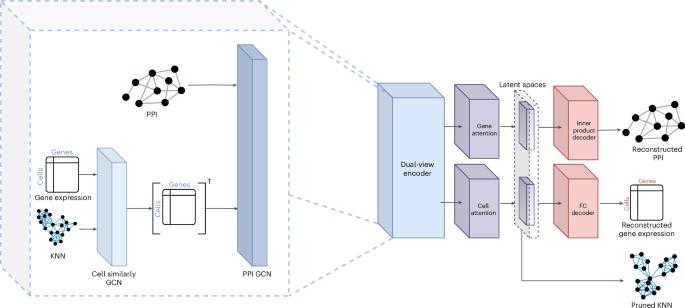
Recent advances in single-cell RNA sequencing (scRNA-seq) techniques have provided unprecedented insights into the heterogeneity of various tissues. However, gene expression data alone often fails to capture and identify changes in cellular pathways and complexes, as they are more discernible at the protein level. Moreover, analyzing scRNA-seq data presents further challenges due to inherent characteristics such as high noise levels and zero inflation. In this study, we propose an approach to address these limitations by integrating scRNA-seq datasets with a protein–protein interaction network. Our method utilizes a unique dual-view architecture based on graph neural networks, enabling joint representation of gene expression and protein–protein interaction network data. This approach models gene-to-gene relationships under specific biological contexts and refines cell–cell relations using an attention mechanism. Next, through comprehensive evaluations, we demonstrate that scNET better captures gene annotation, pathway characterization and gene–gene relationship identification, while improving cell clustering and pathway analysis across diverse cell types and biological conditions. scNET combines single-cell gene expression information with protein–protein interaction networks using a dual-view architecture based on graph neural networks to better characterize changes in cellular pathways and complexes across cellular conditions.
期刊介绍:
Nature Methods is a monthly journal that focuses on publishing innovative methods and substantial enhancements to fundamental life sciences research techniques. Geared towards a diverse, interdisciplinary readership of researchers in academia and industry engaged in laboratory work, the journal offers new tools for research and emphasizes the immediate practical significance of the featured work. It publishes primary research papers and reviews recent technical and methodological advancements, with a particular interest in primary methods papers relevant to the biological and biomedical sciences. This includes methods rooted in chemistry with practical applications for studying biological problems.




 京公网安备 11010802042870号
京ICP备2023020795号-1
京公网安备 11010802042870号
京ICP备2023020795号-1

 分享
分享
 求助内容:
求助内容: 应助结果提醒方式:
 扫码关注我们
