Kai Chen, Yong-Hua Cao, Sunny Yadav, Periyayya Uthirakumar, Gyu-Cheol Kim, Vandung Dao, Yan Li, In-Hwan Lee
{"title":"多孔氧化铁/磷化物非均相纳米球嵌入杂化石墨烯高效水氧化的合理绿色设计","authors":"Kai Chen, Yong-Hua Cao, Sunny Yadav, Periyayya Uthirakumar, Gyu-Cheol Kim, Vandung Dao, Yan Li, In-Hwan Lee","doi":"10.1016/j.seppur.2025.132574","DOIUrl":null,"url":null,"abstract":"Considering the rapidly growing energy demand, electrocatalytic decomposition of water is much promising as an ideal cleaning energy to help mankind energy conservation and emission reduction. However, the inadequate intrinsic activity and slow kinetics of precious-metal-free electrocatalysts in water oxidation processes are still limited. Herein, porous iron oxide/iron phosphide heterostructure packaged in nitrogen, sulfur co-doped graphene (labeled as p-Fe<sub>3</sub>O<sub>4</sub>/FeP@N,S-Gr) with mesoporous morphology and abundant interface is prepared using facile electronic and structural engineering for efficient electrochemical water oxidation. The catalyst of p-Fe<sub>3</sub>O<sub>4</sub>/FeP@N,S-Gr showed superior electrocatalytic activity and kinetic compared with porous iron oxide packaged in nitrogen, sulfur co-doped graphene (p-Fe<sub>3</sub>O<sub>4</sub>@N,S-Gr), and porous iron oxide (p-Fe<sub>3</sub>O<sub>4</sub>) catalyst for oxygen evolution reaction (OER). The overpotential (240 mV at 10 mA/cm<sup>2</sup>) and the tafel slope (45.1 mV dec<sup>-1</sup>) of p-Fe<sub>3</sub>O<sub>4</sub>/FeP@N,S-Gr in OER process is significantly lower than that of p-Fe<sub>3</sub>O<sub>4</sub> (289 mV at 10 mA/cm<sup>2</sup> and 63.5 mV dec<sup>-1</sup>), p-Fe<sub>3</sub>O<sub>4</sub>@N,S-Gr (257 mV at 10 mA/cm<sup>2</sup> and 61.3 mV dec<sup>-1</sup>), RuO<sub>2</sub> (308 mV at 10 mA/cm<sup>2</sup> and 99.0 mV dec<sup>-1</sup>) and other reported relevant literature. Meanwhile, theoretical calculations indicate that constructing heterojunctions can significantly increase electron transfer capability and effectively reduce the adsorption energy barrier of intermediates (OH*→O* and O*→OOH*). This work demonstrates a practical and economical strategy toward the fabrication of transition metal catalysts for water oxidation.","PeriodicalId":427,"journal":{"name":"Separation and Purification Technology","volume":"42 1","pages":""},"PeriodicalIF":9.1000,"publicationDate":"2025-03-18","publicationTypes":"Journal Article","fieldsOfStudy":null,"isOpenAccess":false,"openAccessPdf":"","citationCount":"0","resultStr":"{\"title\":\"Rational green design of porous iron oxide/phosphide heterogeneous nanospheres embedded in hybrid graphene for efficient water oxidation\",\"authors\":\"Kai Chen, Yong-Hua Cao, Sunny Yadav, Periyayya Uthirakumar, Gyu-Cheol Kim, Vandung Dao, Yan Li, In-Hwan Lee\",\"doi\":\"10.1016/j.seppur.2025.132574\",\"DOIUrl\":null,\"url\":null,\"abstract\":\"Considering the rapidly growing energy demand, electrocatalytic decomposition of water is much promising as an ideal cleaning energy to help mankind energy conservation and emission reduction. However, the inadequate intrinsic activity and slow kinetics of precious-metal-free electrocatalysts in water oxidation processes are still limited. Herein, porous iron oxide/iron phosphide heterostructure packaged in nitrogen, sulfur co-doped graphene (labeled as p-Fe<sub>3</sub>O<sub>4</sub>/FeP@N,S-Gr) with mesoporous morphology and abundant interface is prepared using facile electronic and structural engineering for efficient electrochemical water oxidation. The catalyst of p-Fe<sub>3</sub>O<sub>4</sub>/FeP@N,S-Gr showed superior electrocatalytic activity and kinetic compared with porous iron oxide packaged in nitrogen, sulfur co-doped graphene (p-Fe<sub>3</sub>O<sub>4</sub>@N,S-Gr), and porous iron oxide (p-Fe<sub>3</sub>O<sub>4</sub>) catalyst for oxygen evolution reaction (OER). The overpotential (240 mV at 10 mA/cm<sup>2</sup>) and the tafel slope (45.1 mV dec<sup>-1</sup>) of p-Fe<sub>3</sub>O<sub>4</sub>/FeP@N,S-Gr in OER process is significantly lower than that of p-Fe<sub>3</sub>O<sub>4</sub> (289 mV at 10 mA/cm<sup>2</sup> and 63.5 mV dec<sup>-1</sup>), p-Fe<sub>3</sub>O<sub>4</sub>@N,S-Gr (257 mV at 10 mA/cm<sup>2</sup> and 61.3 mV dec<sup>-1</sup>), RuO<sub>2</sub> (308 mV at 10 mA/cm<sup>2</sup> and 99.0 mV dec<sup>-1</sup>) and other reported relevant literature. Meanwhile, theoretical calculations indicate that constructing heterojunctions can significantly increase electron transfer capability and effectively reduce the adsorption energy barrier of intermediates (OH*→O* and O*→OOH*). This work demonstrates a practical and economical strategy toward the fabrication of transition metal catalysts for water oxidation.\",\"PeriodicalId\":427,\"journal\":{\"name\":\"Separation and Purification Technology\",\"volume\":\"42 1\",\"pages\":\"\"},\"PeriodicalIF\":9.1000,\"publicationDate\":\"2025-03-18\",\"publicationTypes\":\"Journal Article\",\"fieldsOfStudy\":null,\"isOpenAccess\":false,\"openAccessPdf\":\"\",\"citationCount\":\"0\",\"resultStr\":null,\"platform\":\"Semanticscholar\",\"paperid\":null,\"PeriodicalName\":\"Separation and Purification Technology\",\"FirstCategoryId\":\"5\",\"ListUrlMain\":\"https://doi.org/10.1016/j.seppur.2025.132574\",\"RegionNum\":1,\"RegionCategory\":\"工程技术\",\"ArticlePicture\":[],\"TitleCN\":null,\"AbstractTextCN\":null,\"PMCID\":null,\"EPubDate\":\"\",\"PubModel\":\"\",\"JCR\":\"Q1\",\"JCRName\":\"ENGINEERING, CHEMICAL\",\"Score\":null,\"Total\":0}","platform":"Semanticscholar","paperid":null,"PeriodicalName":"Separation and Purification Technology","FirstCategoryId":"5","ListUrlMain":"https://doi.org/10.1016/j.seppur.2025.132574","RegionNum":1,"RegionCategory":"工程技术","ArticlePicture":[],"TitleCN":null,"AbstractTextCN":null,"PMCID":null,"EPubDate":"","PubModel":"","JCR":"Q1","JCRName":"ENGINEERING, CHEMICAL","Score":null,"Total":0}
引用次数: 0
摘要
考虑到快速增长的能源需求,水的电催化分解作为一种理想的清洁能源很有希望帮助人类节能减排。然而,无贵金属电催化剂在水氧化过程中的固有活性不足和动力学缓慢仍然受到限制。本文利用简单的电子和结构工程技术,在氮、硫共掺杂石墨烯(标记为p-Fe3O4/FeP@N,S-Gr)中封装了多孔氧化铁/磷化铁异质结构,具有介孔形态和丰富的界面,用于高效的电化学水氧化。p-Fe3O4/FeP@N,S-Gr催化剂在析氧反应(OER)中的电催化活性和动力学表现优于氮、硫共掺杂石墨烯(p-Fe3O4@N,S-Gr)和多孔氧化铁(p-Fe3O4)催化剂。过电压(240 mV 10 mA / cm2)和塔菲尔斜率(45.1 mV古老文明)p-Fe3O4 / FeP@N S-Gr OER过程中显著低于p-Fe3O4(289 mV mA / cm2 10点和63.5 mV古老文明),p-Fe3O4@N, S-Gr(257 mV mA / cm2 10点和61.3 mV古老文明),RuO2(308 mV mA / cm2 10点和99.0 mV古老文明)和其他相关文献报道。同时,理论计算表明,构建异质结可以显著提高电子传递能力,有效降低中间体(OH*→O*和O*→OOH*)的吸附能垒。本研究为水氧化过渡金属催化剂的制备提供了一种实用、经济的方法。
Rational green design of porous iron oxide/phosphide heterogeneous nanospheres embedded in hybrid graphene for efficient water oxidation
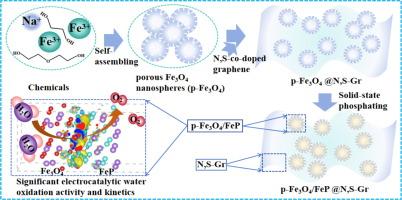
Considering the rapidly growing energy demand, electrocatalytic decomposition of water is much promising as an ideal cleaning energy to help mankind energy conservation and emission reduction. However, the inadequate intrinsic activity and slow kinetics of precious-metal-free electrocatalysts in water oxidation processes are still limited. Herein, porous iron oxide/iron phosphide heterostructure packaged in nitrogen, sulfur co-doped graphene (labeled as p-Fe3O4/FeP@N,S-Gr) with mesoporous morphology and abundant interface is prepared using facile electronic and structural engineering for efficient electrochemical water oxidation. The catalyst of p-Fe3O4/FeP@N,S-Gr showed superior electrocatalytic activity and kinetic compared with porous iron oxide packaged in nitrogen, sulfur co-doped graphene (p-Fe3O4@N,S-Gr), and porous iron oxide (p-Fe3O4) catalyst for oxygen evolution reaction (OER). The overpotential (240 mV at 10 mA/cm2) and the tafel slope (45.1 mV dec-1) of p-Fe3O4/FeP@N,S-Gr in OER process is significantly lower than that of p-Fe3O4 (289 mV at 10 mA/cm2 and 63.5 mV dec-1), p-Fe3O4@N,S-Gr (257 mV at 10 mA/cm2 and 61.3 mV dec-1), RuO2 (308 mV at 10 mA/cm2 and 99.0 mV dec-1) and other reported relevant literature. Meanwhile, theoretical calculations indicate that constructing heterojunctions can significantly increase electron transfer capability and effectively reduce the adsorption energy barrier of intermediates (OH*→O* and O*→OOH*). This work demonstrates a practical and economical strategy toward the fabrication of transition metal catalysts for water oxidation.
期刊介绍:
Separation and Purification Technology is a premier journal committed to sharing innovative methods for separation and purification in chemical and environmental engineering, encompassing both homogeneous solutions and heterogeneous mixtures. Our scope includes the separation and/or purification of liquids, vapors, and gases, as well as carbon capture and separation techniques. However, it's important to note that methods solely intended for analytical purposes are not within the scope of the journal. Additionally, disciplines such as soil science, polymer science, and metallurgy fall outside the purview of Separation and Purification Technology. Join us in advancing the field of separation and purification methods for sustainable solutions in chemical and environmental engineering.




 京公网安备 11010802042870号
京ICP备2023020795号-1
京公网安备 11010802042870号
京ICP备2023020795号-1

 分享
分享
 求助内容:
求助内容: 应助结果提醒方式:
 扫码关注我们
