{"title":"迈向更稳定的非富勒烯有机太阳能电池:进展、挑战、未来展望和人工智能时代","authors":"Nafees Ahmad, Jun Yuan and Yingping Zou","doi":"10.1039/D4EE06021K","DOIUrl":null,"url":null,"abstract":"<p >Non-fullerene acceptor-based organic solar cells (NF-OSCs) have achieved notable advancements during the past few years. Recently, their power conversion efficiency (PCE) has surpassed 20% due to the development of new photovoltaic materials and device optimization strategies; however, inferior stability is still a key obstacle that limits their commercialization, which is mainly due to a lack of understanding of the underlying degradation mechanism of NF-OSCs. In this review, we first briefly discuss the major developments in the structural design and performance of NFAs followed by their distinctive features in OSCs and stability measurement protocols. Afterward, we explain various limiting factors and different degradation mechanisms in depth for NF-OSCs. Furthermore, we highlight and discuss the recent progress in the development of highly stable NF-OSCs with a detailed discussion of various aspects and effective strategies such as the molecular design, modification of active layer materials, use of additives, third component approaches, interface engineering, electrode engineering, and other potential strategies including encapsulation techniques and single component approaches. The main challenges and the guidance for future research to overcome the existing stability issues to achieve stable OSCs are also presented. Finally, the potential role of artificial intelligence (AI) in improving the performance of NF-OSCs is highlighted in the last section of this review.</p>","PeriodicalId":72,"journal":{"name":"Energy & Environmental Science","volume":" 11","pages":" 5093-5158"},"PeriodicalIF":30.8000,"publicationDate":"2025-03-19","publicationTypes":"Journal Article","fieldsOfStudy":null,"isOpenAccess":false,"openAccessPdf":"","citationCount":"0","resultStr":"{\"title\":\"One more step towards better stability of non-fullerene organic solar cells: advances, challenges, future perspectives, and the Era of artificial intelligence\",\"authors\":\"Nafees Ahmad, Jun Yuan and Yingping Zou\",\"doi\":\"10.1039/D4EE06021K\",\"DOIUrl\":null,\"url\":null,\"abstract\":\"<p >Non-fullerene acceptor-based organic solar cells (NF-OSCs) have achieved notable advancements during the past few years. Recently, their power conversion efficiency (PCE) has surpassed 20% due to the development of new photovoltaic materials and device optimization strategies; however, inferior stability is still a key obstacle that limits their commercialization, which is mainly due to a lack of understanding of the underlying degradation mechanism of NF-OSCs. In this review, we first briefly discuss the major developments in the structural design and performance of NFAs followed by their distinctive features in OSCs and stability measurement protocols. Afterward, we explain various limiting factors and different degradation mechanisms in depth for NF-OSCs. Furthermore, we highlight and discuss the recent progress in the development of highly stable NF-OSCs with a detailed discussion of various aspects and effective strategies such as the molecular design, modification of active layer materials, use of additives, third component approaches, interface engineering, electrode engineering, and other potential strategies including encapsulation techniques and single component approaches. The main challenges and the guidance for future research to overcome the existing stability issues to achieve stable OSCs are also presented. Finally, the potential role of artificial intelligence (AI) in improving the performance of NF-OSCs is highlighted in the last section of this review.</p>\",\"PeriodicalId\":72,\"journal\":{\"name\":\"Energy & Environmental Science\",\"volume\":\" 11\",\"pages\":\" 5093-5158\"},\"PeriodicalIF\":30.8000,\"publicationDate\":\"2025-03-19\",\"publicationTypes\":\"Journal Article\",\"fieldsOfStudy\":null,\"isOpenAccess\":false,\"openAccessPdf\":\"\",\"citationCount\":\"0\",\"resultStr\":null,\"platform\":\"Semanticscholar\",\"paperid\":null,\"PeriodicalName\":\"Energy & Environmental Science\",\"FirstCategoryId\":\"88\",\"ListUrlMain\":\"https://pubs.rsc.org/en/content/articlelanding/2025/ee/d4ee06021k\",\"RegionNum\":1,\"RegionCategory\":\"材料科学\",\"ArticlePicture\":[],\"TitleCN\":null,\"AbstractTextCN\":null,\"PMCID\":null,\"EPubDate\":\"\",\"PubModel\":\"\",\"JCR\":\"Q1\",\"JCRName\":\"CHEMISTRY, MULTIDISCIPLINARY\",\"Score\":null,\"Total\":0}","platform":"Semanticscholar","paperid":null,"PeriodicalName":"Energy & Environmental Science","FirstCategoryId":"88","ListUrlMain":"https://pubs.rsc.org/en/content/articlelanding/2025/ee/d4ee06021k","RegionNum":1,"RegionCategory":"材料科学","ArticlePicture":[],"TitleCN":null,"AbstractTextCN":null,"PMCID":null,"EPubDate":"","PubModel":"","JCR":"Q1","JCRName":"CHEMISTRY, MULTIDISCIPLINARY","Score":null,"Total":0}
One more step towards better stability of non-fullerene organic solar cells: advances, challenges, future perspectives, and the Era of artificial intelligence
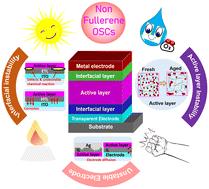
Non-fullerene acceptor-based organic solar cells (NF-OSCs) have achieved notable advancements during the past few years. Recently, their power conversion efficiency (PCE) has surpassed 20% due to the development of new photovoltaic materials and device optimization strategies; however, inferior stability is still a key obstacle that limits their commercialization, which is mainly due to a lack of understanding of the underlying degradation mechanism of NF-OSCs. In this review, we first briefly discuss the major developments in the structural design and performance of NFAs followed by their distinctive features in OSCs and stability measurement protocols. Afterward, we explain various limiting factors and different degradation mechanisms in depth for NF-OSCs. Furthermore, we highlight and discuss the recent progress in the development of highly stable NF-OSCs with a detailed discussion of various aspects and effective strategies such as the molecular design, modification of active layer materials, use of additives, third component approaches, interface engineering, electrode engineering, and other potential strategies including encapsulation techniques and single component approaches. The main challenges and the guidance for future research to overcome the existing stability issues to achieve stable OSCs are also presented. Finally, the potential role of artificial intelligence (AI) in improving the performance of NF-OSCs is highlighted in the last section of this review.
期刊介绍:
Energy & Environmental Science, a peer-reviewed scientific journal, publishes original research and review articles covering interdisciplinary topics in the (bio)chemical and (bio)physical sciences, as well as chemical engineering disciplines. Published monthly by the Royal Society of Chemistry (RSC), a not-for-profit publisher, Energy & Environmental Science is recognized as a leading journal. It boasts an impressive impact factor of 8.500 as of 2009, ranking 8th among 140 journals in the category "Chemistry, Multidisciplinary," second among 71 journals in "Energy & Fuels," second among 128 journals in "Engineering, Chemical," and first among 181 scientific journals in "Environmental Sciences."
Energy & Environmental Science publishes various types of articles, including Research Papers (original scientific work), Review Articles, Perspectives, and Minireviews (feature review-type articles of broad interest), Communications (original scientific work of an urgent nature), Opinions (personal, often speculative viewpoints or hypotheses on current topics), and Analysis Articles (in-depth examination of energy-related issues).




 京公网安备 11010802042870号
京ICP备2023020795号-1
京公网安备 11010802042870号
京ICP备2023020795号-1

 分享
分享
 求助内容:
求助内容: 应助结果提醒方式:
 扫码关注我们
