Lei Tian , Wenjie Wang , Xiaogang Ma , Hongdong Zhang , Shuchen Guo , Kai Yang , Jie Wang , Linhua Wang
{"title":"基于积雪深度和地形特征的青藏高原盆地雪流动力学研究","authors":"Lei Tian , Wenjie Wang , Xiaogang Ma , Hongdong Zhang , Shuchen Guo , Kai Yang , Jie Wang , Linhua Wang","doi":"10.1016/j.jhydrol.2025.133057","DOIUrl":null,"url":null,"abstract":"<div><div>Snow plays a crucial role in land surface hydrological and energy processes. Accurately representing the snow-streamflow relationship is important for understanding how climate change affects alpine hydrology. However, most land surface models and hydrological models’ snow schemes overlook the influences of snow depth and topography, causing uncertainties in snow and related hydrological processes simulations. This issue is more pronounced on the Tibetan Plateau (TP) due to its shallow snow and complex topography. The challenge of how inadequate snow cover parameterization affects snow and streamflow simulations is a critical scientific question. This study targets the upstream areas of the Heihe River basin on the TP. Using multi-source observational datasets and the WRF-Hydro model, we incorporated seven pre-existing snow schemes that consider snow depth and topography into the WRF-Hydro to identify the optimized scheme. Comparing the results simulated with the default and optimized schemes, we quantified the improvement in the representation of the snow-streamflow relationship by considering snow depth and topography and revealed the influencing mechanisms of these two factors. Results show that the default scheme largely overestimates snow cover fraction (<em>SCF</em>). Accounting for snow depth alone reduces the monthly <em>SCF</em> bias by 6.20%. When both snow depth and topography are considered, the monthly <em>SCF</em> bias is reduced by 20.88%. Moreover, the default scheme underestimates the cold-season streamflow and overestimates the warm-season streamflow. The optimized scheme greatly enhances the accuracy of streamflow simulation, reducing the cold-season streamflow underestimation by 12.13% and lowering the warm-season streamflow overestimation by 8.84%. Furthermore, such incorporation reduces albedo overestimation, increases absorbed shortwave radiation, and changes land surface temperature (<em>LST</em>) and surface resistance (<em>r<sub>s</sub></em>). <em>LST</em> and <em>r<sub>s</sub></em> are key variables through which snow influences evapotranspiration and snow water equivalent, eventually altering the snow-streamflow relationship. These findings highlight the importance of considering snow depth and topography in numerical simulations for alpine areas and provide valuable scientific support for understanding the response of hydrological processes to snow change under climate warming.</div></div>","PeriodicalId":362,"journal":{"name":"Journal of Hydrology","volume":"657 ","pages":"Article 133057"},"PeriodicalIF":7.3000,"publicationDate":"2025-08-01","publicationTypes":"Journal Article","fieldsOfStudy":null,"isOpenAccess":false,"openAccessPdf":"","citationCount":"0","resultStr":"{\"title\":\"Refining snow-streamflow dynamics in a Tibetan Plateau basin by incorporating snow depth and topography\",\"authors\":\"Lei Tian , Wenjie Wang , Xiaogang Ma , Hongdong Zhang , Shuchen Guo , Kai Yang , Jie Wang , Linhua Wang\",\"doi\":\"10.1016/j.jhydrol.2025.133057\",\"DOIUrl\":null,\"url\":null,\"abstract\":\"<div><div>Snow plays a crucial role in land surface hydrological and energy processes. Accurately representing the snow-streamflow relationship is important for understanding how climate change affects alpine hydrology. However, most land surface models and hydrological models’ snow schemes overlook the influences of snow depth and topography, causing uncertainties in snow and related hydrological processes simulations. This issue is more pronounced on the Tibetan Plateau (TP) due to its shallow snow and complex topography. The challenge of how inadequate snow cover parameterization affects snow and streamflow simulations is a critical scientific question. This study targets the upstream areas of the Heihe River basin on the TP. Using multi-source observational datasets and the WRF-Hydro model, we incorporated seven pre-existing snow schemes that consider snow depth and topography into the WRF-Hydro to identify the optimized scheme. Comparing the results simulated with the default and optimized schemes, we quantified the improvement in the representation of the snow-streamflow relationship by considering snow depth and topography and revealed the influencing mechanisms of these two factors. Results show that the default scheme largely overestimates snow cover fraction (<em>SCF</em>). Accounting for snow depth alone reduces the monthly <em>SCF</em> bias by 6.20%. When both snow depth and topography are considered, the monthly <em>SCF</em> bias is reduced by 20.88%. Moreover, the default scheme underestimates the cold-season streamflow and overestimates the warm-season streamflow. The optimized scheme greatly enhances the accuracy of streamflow simulation, reducing the cold-season streamflow underestimation by 12.13% and lowering the warm-season streamflow overestimation by 8.84%. Furthermore, such incorporation reduces albedo overestimation, increases absorbed shortwave radiation, and changes land surface temperature (<em>LST</em>) and surface resistance (<em>r<sub>s</sub></em>). <em>LST</em> and <em>r<sub>s</sub></em> are key variables through which snow influences evapotranspiration and snow water equivalent, eventually altering the snow-streamflow relationship. These findings highlight the importance of considering snow depth and topography in numerical simulations for alpine areas and provide valuable scientific support for understanding the response of hydrological processes to snow change under climate warming.</div></div>\",\"PeriodicalId\":362,\"journal\":{\"name\":\"Journal of Hydrology\",\"volume\":\"657 \",\"pages\":\"Article 133057\"},\"PeriodicalIF\":7.3000,\"publicationDate\":\"2025-08-01\",\"publicationTypes\":\"Journal Article\",\"fieldsOfStudy\":null,\"isOpenAccess\":false,\"openAccessPdf\":\"\",\"citationCount\":\"0\",\"resultStr\":null,\"platform\":\"Semanticscholar\",\"paperid\":null,\"PeriodicalName\":\"Journal of Hydrology\",\"FirstCategoryId\":\"89\",\"ListUrlMain\":\"https://www.sciencedirect.com/science/article/pii/S0022169425003956\",\"RegionNum\":1,\"RegionCategory\":\"地球科学\",\"ArticlePicture\":[],\"TitleCN\":null,\"AbstractTextCN\":null,\"PMCID\":null,\"EPubDate\":\"2025/3/9 0:00:00\",\"PubModel\":\"Epub\",\"JCR\":\"Q1\",\"JCRName\":\"ENGINEERING, CIVIL\",\"Score\":null,\"Total\":0}","platform":"Semanticscholar","paperid":null,"PeriodicalName":"Journal of Hydrology","FirstCategoryId":"89","ListUrlMain":"https://www.sciencedirect.com/science/article/pii/S0022169425003956","RegionNum":1,"RegionCategory":"地球科学","ArticlePicture":[],"TitleCN":null,"AbstractTextCN":null,"PMCID":null,"EPubDate":"2025/3/9 0:00:00","PubModel":"Epub","JCR":"Q1","JCRName":"ENGINEERING, CIVIL","Score":null,"Total":0}
Refining snow-streamflow dynamics in a Tibetan Plateau basin by incorporating snow depth and topography
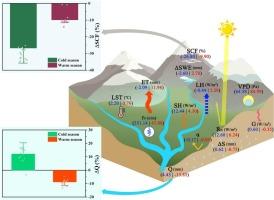
Snow plays a crucial role in land surface hydrological and energy processes. Accurately representing the snow-streamflow relationship is important for understanding how climate change affects alpine hydrology. However, most land surface models and hydrological models’ snow schemes overlook the influences of snow depth and topography, causing uncertainties in snow and related hydrological processes simulations. This issue is more pronounced on the Tibetan Plateau (TP) due to its shallow snow and complex topography. The challenge of how inadequate snow cover parameterization affects snow and streamflow simulations is a critical scientific question. This study targets the upstream areas of the Heihe River basin on the TP. Using multi-source observational datasets and the WRF-Hydro model, we incorporated seven pre-existing snow schemes that consider snow depth and topography into the WRF-Hydro to identify the optimized scheme. Comparing the results simulated with the default and optimized schemes, we quantified the improvement in the representation of the snow-streamflow relationship by considering snow depth and topography and revealed the influencing mechanisms of these two factors. Results show that the default scheme largely overestimates snow cover fraction (SCF). Accounting for snow depth alone reduces the monthly SCF bias by 6.20%. When both snow depth and topography are considered, the monthly SCF bias is reduced by 20.88%. Moreover, the default scheme underestimates the cold-season streamflow and overestimates the warm-season streamflow. The optimized scheme greatly enhances the accuracy of streamflow simulation, reducing the cold-season streamflow underestimation by 12.13% and lowering the warm-season streamflow overestimation by 8.84%. Furthermore, such incorporation reduces albedo overestimation, increases absorbed shortwave radiation, and changes land surface temperature (LST) and surface resistance (rs). LST and rs are key variables through which snow influences evapotranspiration and snow water equivalent, eventually altering the snow-streamflow relationship. These findings highlight the importance of considering snow depth and topography in numerical simulations for alpine areas and provide valuable scientific support for understanding the response of hydrological processes to snow change under climate warming.
期刊介绍:
The Journal of Hydrology publishes original research papers and comprehensive reviews in all the subfields of the hydrological sciences including water based management and policy issues that impact on economics and society. These comprise, but are not limited to the physical, chemical, biogeochemical, stochastic and systems aspects of surface and groundwater hydrology, hydrometeorology and hydrogeology. Relevant topics incorporating the insights and methodologies of disciplines such as climatology, water resource systems, hydraulics, agrohydrology, geomorphology, soil science, instrumentation and remote sensing, civil and environmental engineering are included. Social science perspectives on hydrological problems such as resource and ecological economics, environmental sociology, psychology and behavioural science, management and policy analysis are also invited. Multi-and interdisciplinary analyses of hydrological problems are within scope. The science published in the Journal of Hydrology is relevant to catchment scales rather than exclusively to a local scale or site.




 京公网安备 11010802042870号
京ICP备2023020795号-1
京公网安备 11010802042870号
京ICP备2023020795号-1

 分享
分享
 求助内容:
求助内容: 应助结果提醒方式:
 扫码关注我们
