Wanchen Hou , Jingyuan He , Chenghao Cui , Fan Zhong , Xinbo Jiang , Lin Lu , Jizhe Zhang , Changhe Tu
{"title":"最小条形切口薄裂纹的分割细化","authors":"Wanchen Hou , Jingyuan He , Chenghao Cui , Fan Zhong , Xinbo Jiang , Lin Lu , Jizhe Zhang , Changhe Tu","doi":"10.1016/j.aei.2025.103249","DOIUrl":null,"url":null,"abstract":"<div><div>Accurate segmentation is crucial for dataset labeling and morphological analysis of thin cracks, for which small segmentation error may take great effect to the results. However, due to the complex morphology and thin structures, so far it is still very hard to accurately segment thin cracks either by manual or by segmentation algorithms. In this paper we propose an approach for accurate and efficient segmentation of thin cracks. The core of our approach is an optimization-based image segmentation method designed specifically for extracting optimal thin strip regions from images. Our method can be considered as an extension of previous minimum path search problem, so we call it as Minimum Strip Cuts, or StripCuts for short. An effective objective function for segmentation refinement of thin cracks is proposed, whose global optimal solution can be obtained efficiently based on the proposed volumetric dynamic programming and crack linearization methods. Our method is robust to low-contrast cracks and complex background, and can run in real-time. Therefore, it can be used for refining exist datasets, and also for the post-processing of crack segmentation methods. Based on the proposed refinement method, we introduce a new crack segmentation dataset RefinedCracks, which provides accurate refined annotations for previous main crack segmentation datasets. The importance of refinement to the training and evaluation of crack segmentation methods is also verified by both quantitative and qualitative evaluations.</div></div>","PeriodicalId":50941,"journal":{"name":"Advanced Engineering Informatics","volume":"65 ","pages":"Article 103249"},"PeriodicalIF":11.5000,"publicationDate":"2025-05-01","publicationTypes":"Journal Article","fieldsOfStudy":null,"isOpenAccess":false,"openAccessPdf":"","citationCount":"0","resultStr":"{\"title\":\"Segmentation refinement of thin cracks with Minimum Strip Cuts\",\"authors\":\"Wanchen Hou , Jingyuan He , Chenghao Cui , Fan Zhong , Xinbo Jiang , Lin Lu , Jizhe Zhang , Changhe Tu\",\"doi\":\"10.1016/j.aei.2025.103249\",\"DOIUrl\":null,\"url\":null,\"abstract\":\"<div><div>Accurate segmentation is crucial for dataset labeling and morphological analysis of thin cracks, for which small segmentation error may take great effect to the results. However, due to the complex morphology and thin structures, so far it is still very hard to accurately segment thin cracks either by manual or by segmentation algorithms. In this paper we propose an approach for accurate and efficient segmentation of thin cracks. The core of our approach is an optimization-based image segmentation method designed specifically for extracting optimal thin strip regions from images. Our method can be considered as an extension of previous minimum path search problem, so we call it as Minimum Strip Cuts, or StripCuts for short. An effective objective function for segmentation refinement of thin cracks is proposed, whose global optimal solution can be obtained efficiently based on the proposed volumetric dynamic programming and crack linearization methods. Our method is robust to low-contrast cracks and complex background, and can run in real-time. Therefore, it can be used for refining exist datasets, and also for the post-processing of crack segmentation methods. Based on the proposed refinement method, we introduce a new crack segmentation dataset RefinedCracks, which provides accurate refined annotations for previous main crack segmentation datasets. The importance of refinement to the training and evaluation of crack segmentation methods is also verified by both quantitative and qualitative evaluations.</div></div>\",\"PeriodicalId\":50941,\"journal\":{\"name\":\"Advanced Engineering Informatics\",\"volume\":\"65 \",\"pages\":\"Article 103249\"},\"PeriodicalIF\":11.5000,\"publicationDate\":\"2025-05-01\",\"publicationTypes\":\"Journal Article\",\"fieldsOfStudy\":null,\"isOpenAccess\":false,\"openAccessPdf\":\"\",\"citationCount\":\"0\",\"resultStr\":null,\"platform\":\"Semanticscholar\",\"paperid\":null,\"PeriodicalName\":\"Advanced Engineering Informatics\",\"FirstCategoryId\":\"5\",\"ListUrlMain\":\"https://www.sciencedirect.com/science/article/pii/S1474034625001429\",\"RegionNum\":1,\"RegionCategory\":\"工程技术\",\"ArticlePicture\":[],\"TitleCN\":null,\"AbstractTextCN\":null,\"PMCID\":null,\"EPubDate\":\"2025/3/19 0:00:00\",\"PubModel\":\"Epub\",\"JCR\":\"Q1\",\"JCRName\":\"COMPUTER SCIENCE, ARTIFICIAL INTELLIGENCE\",\"Score\":null,\"Total\":0}","platform":"Semanticscholar","paperid":null,"PeriodicalName":"Advanced Engineering Informatics","FirstCategoryId":"5","ListUrlMain":"https://www.sciencedirect.com/science/article/pii/S1474034625001429","RegionNum":1,"RegionCategory":"工程技术","ArticlePicture":[],"TitleCN":null,"AbstractTextCN":null,"PMCID":null,"EPubDate":"2025/3/19 0:00:00","PubModel":"Epub","JCR":"Q1","JCRName":"COMPUTER SCIENCE, ARTIFICIAL INTELLIGENCE","Score":null,"Total":0}
Segmentation refinement of thin cracks with Minimum Strip Cuts
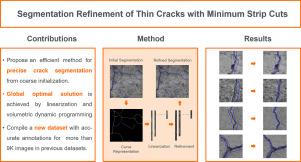
Accurate segmentation is crucial for dataset labeling and morphological analysis of thin cracks, for which small segmentation error may take great effect to the results. However, due to the complex morphology and thin structures, so far it is still very hard to accurately segment thin cracks either by manual or by segmentation algorithms. In this paper we propose an approach for accurate and efficient segmentation of thin cracks. The core of our approach is an optimization-based image segmentation method designed specifically for extracting optimal thin strip regions from images. Our method can be considered as an extension of previous minimum path search problem, so we call it as Minimum Strip Cuts, or StripCuts for short. An effective objective function for segmentation refinement of thin cracks is proposed, whose global optimal solution can be obtained efficiently based on the proposed volumetric dynamic programming and crack linearization methods. Our method is robust to low-contrast cracks and complex background, and can run in real-time. Therefore, it can be used for refining exist datasets, and also for the post-processing of crack segmentation methods. Based on the proposed refinement method, we introduce a new crack segmentation dataset RefinedCracks, which provides accurate refined annotations for previous main crack segmentation datasets. The importance of refinement to the training and evaluation of crack segmentation methods is also verified by both quantitative and qualitative evaluations.
期刊介绍:
Advanced Engineering Informatics is an international Journal that solicits research papers with an emphasis on 'knowledge' and 'engineering applications'. The Journal seeks original papers that report progress in applying methods of engineering informatics. These papers should have engineering relevance and help provide a scientific base for more reliable, spontaneous, and creative engineering decision-making. Additionally, papers should demonstrate the science of supporting knowledge-intensive engineering tasks and validate the generality, power, and scalability of new methods through rigorous evaluation, preferably both qualitatively and quantitatively. Abstracting and indexing for Advanced Engineering Informatics include Science Citation Index Expanded, Scopus and INSPEC.




 京公网安备 11010802042870号
京ICP备2023020795号-1
京公网安备 11010802042870号
京ICP备2023020795号-1

 分享
分享
 求助内容:
求助内容: 应助结果提醒方式:
 扫码关注我们
