Gege Yang , Hairui Cai , Ziran Xu , Chenchen Ji , Zhimao Yang , Shengli Zhang , Yang Zhang , Bin Wang , Bingbao Mei , Chao Liang , Shengchun Yang
{"title":"Fe3原子团簇对Fe-N4高活性氧还原反应的自旋极化调控。","authors":"Gege Yang , Hairui Cai , Ziran Xu , Chenchen Ji , Zhimao Yang , Shengli Zhang , Yang Zhang , Bin Wang , Bingbao Mei , Chao Liang , Shengchun Yang","doi":"10.1016/j.scib.2025.02.041","DOIUrl":null,"url":null,"abstract":"<div><div>The Fe–N<sub>4</sub> motif is regarded as a leading non-precious metal catalyst for the oxygen reduction reaction (ORR) with the potential to replace platinum (Pt), yet achieving or surpassing the performance of Pt-based catalysts remains a significant challenge. In this study, we introduce a modification strategy employing homogeneous few-atom Fe<sub>3</sub> cluster to regulate the spin polarization of Fe–N<sub>4</sub>. Experimental research and theoretical calculations show that the incorporation of the Fe<sub>3</sub> cluster significantly enhances the adsorption of Fe–N<sub>4</sub> motif toward OH ligands, leading to a structural transformation from a square-planar field (Fe–N<sub>4</sub>) to a square-pyramid field structure (Fe(OH) –N<sub>4</sub>). This structural transformation reduces the spin polarization of 3d<em><sub>xz</sub></em>, 3d<em><sub>yz</sub></em>, and 3d<em><sub>z</sub></em><sup>2</sup> orbitals of Fe–N<sub>4</sub>, resulting in a decrease in unpaired electrons within 3d orbitals. As a result, this modulation leads to moderate adsorption/desorption energies of reaction intermediates, thereby facilitating the ORR process. Moreover, the <em>in</em>-<em>situ</em> spectroscopy confirms that the desorption of OH* on Fe<sub>3</sub>/Fe(OH) –NC motif is more favorable compared to atomic Fe–NC, indicating a lower energy barrier for ORR. Consequently, the Fe<sub>3</sub>/Fe–NC catalyst demonstrates outstanding ORR performance with a half-wave potential of 0.836 V vs. reversible hydrogen electrode (RHE) in 0.1 mol L<sup>−1</sup> HClO<sub>4</sub> solution and 0.936 V vs. RHE in 0.1 mol L<sup>−1</sup> KOH solution, even surpassing commercial Pt/C catalyst. It also exhibits excellent Zn–air battery efficiency. Our study introduces a novel approach to modulating the electronic structure of single atoms catalysts by leveraging the robust interaction between single atoms and atomic clusters.</div></div>","PeriodicalId":421,"journal":{"name":"Science Bulletin","volume":"70 11","pages":"Pages 1793-1803"},"PeriodicalIF":21.1000,"publicationDate":"2025-06-15","publicationTypes":"Journal Article","fieldsOfStudy":null,"isOpenAccess":false,"openAccessPdf":"","citationCount":"0","resultStr":"{\"title\":\"Spin polarization regulation of Fe–N4 by Fe3 atomic clusters for highly active oxygen reduction reaction\",\"authors\":\"Gege Yang , Hairui Cai , Ziran Xu , Chenchen Ji , Zhimao Yang , Shengli Zhang , Yang Zhang , Bin Wang , Bingbao Mei , Chao Liang , Shengchun Yang\",\"doi\":\"10.1016/j.scib.2025.02.041\",\"DOIUrl\":null,\"url\":null,\"abstract\":\"<div><div>The Fe–N<sub>4</sub> motif is regarded as a leading non-precious metal catalyst for the oxygen reduction reaction (ORR) with the potential to replace platinum (Pt), yet achieving or surpassing the performance of Pt-based catalysts remains a significant challenge. In this study, we introduce a modification strategy employing homogeneous few-atom Fe<sub>3</sub> cluster to regulate the spin polarization of Fe–N<sub>4</sub>. Experimental research and theoretical calculations show that the incorporation of the Fe<sub>3</sub> cluster significantly enhances the adsorption of Fe–N<sub>4</sub> motif toward OH ligands, leading to a structural transformation from a square-planar field (Fe–N<sub>4</sub>) to a square-pyramid field structure (Fe(OH) –N<sub>4</sub>). This structural transformation reduces the spin polarization of 3d<em><sub>xz</sub></em>, 3d<em><sub>yz</sub></em>, and 3d<em><sub>z</sub></em><sup>2</sup> orbitals of Fe–N<sub>4</sub>, resulting in a decrease in unpaired electrons within 3d orbitals. As a result, this modulation leads to moderate adsorption/desorption energies of reaction intermediates, thereby facilitating the ORR process. Moreover, the <em>in</em>-<em>situ</em> spectroscopy confirms that the desorption of OH* on Fe<sub>3</sub>/Fe(OH) –NC motif is more favorable compared to atomic Fe–NC, indicating a lower energy barrier for ORR. Consequently, the Fe<sub>3</sub>/Fe–NC catalyst demonstrates outstanding ORR performance with a half-wave potential of 0.836 V vs. reversible hydrogen electrode (RHE) in 0.1 mol L<sup>−1</sup> HClO<sub>4</sub> solution and 0.936 V vs. RHE in 0.1 mol L<sup>−1</sup> KOH solution, even surpassing commercial Pt/C catalyst. It also exhibits excellent Zn–air battery efficiency. Our study introduces a novel approach to modulating the electronic structure of single atoms catalysts by leveraging the robust interaction between single atoms and atomic clusters.</div></div>\",\"PeriodicalId\":421,\"journal\":{\"name\":\"Science Bulletin\",\"volume\":\"70 11\",\"pages\":\"Pages 1793-1803\"},\"PeriodicalIF\":21.1000,\"publicationDate\":\"2025-06-15\",\"publicationTypes\":\"Journal Article\",\"fieldsOfStudy\":null,\"isOpenAccess\":false,\"openAccessPdf\":\"\",\"citationCount\":\"0\",\"resultStr\":null,\"platform\":\"Semanticscholar\",\"paperid\":null,\"PeriodicalName\":\"Science Bulletin\",\"FirstCategoryId\":\"103\",\"ListUrlMain\":\"https://www.sciencedirect.com/science/article/pii/S2095927325002336\",\"RegionNum\":1,\"RegionCategory\":\"综合性期刊\",\"ArticlePicture\":[],\"TitleCN\":null,\"AbstractTextCN\":null,\"PMCID\":null,\"EPubDate\":\"2025/3/10 0:00:00\",\"PubModel\":\"Epub\",\"JCR\":\"Q1\",\"JCRName\":\"MULTIDISCIPLINARY SCIENCES\",\"Score\":null,\"Total\":0}","platform":"Semanticscholar","paperid":null,"PeriodicalName":"Science Bulletin","FirstCategoryId":"103","ListUrlMain":"https://www.sciencedirect.com/science/article/pii/S2095927325002336","RegionNum":1,"RegionCategory":"综合性期刊","ArticlePicture":[],"TitleCN":null,"AbstractTextCN":null,"PMCID":null,"EPubDate":"2025/3/10 0:00:00","PubModel":"Epub","JCR":"Q1","JCRName":"MULTIDISCIPLINARY SCIENCES","Score":null,"Total":0}
Spin polarization regulation of Fe–N4 by Fe3 atomic clusters for highly active oxygen reduction reaction
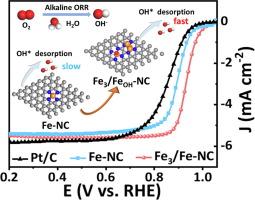
The Fe–N4 motif is regarded as a leading non-precious metal catalyst for the oxygen reduction reaction (ORR) with the potential to replace platinum (Pt), yet achieving or surpassing the performance of Pt-based catalysts remains a significant challenge. In this study, we introduce a modification strategy employing homogeneous few-atom Fe3 cluster to regulate the spin polarization of Fe–N4. Experimental research and theoretical calculations show that the incorporation of the Fe3 cluster significantly enhances the adsorption of Fe–N4 motif toward OH ligands, leading to a structural transformation from a square-planar field (Fe–N4) to a square-pyramid field structure (Fe(OH) –N4). This structural transformation reduces the spin polarization of 3dxz, 3dyz, and 3dz2 orbitals of Fe–N4, resulting in a decrease in unpaired electrons within 3d orbitals. As a result, this modulation leads to moderate adsorption/desorption energies of reaction intermediates, thereby facilitating the ORR process. Moreover, the in-situ spectroscopy confirms that the desorption of OH* on Fe3/Fe(OH) –NC motif is more favorable compared to atomic Fe–NC, indicating a lower energy barrier for ORR. Consequently, the Fe3/Fe–NC catalyst demonstrates outstanding ORR performance with a half-wave potential of 0.836 V vs. reversible hydrogen electrode (RHE) in 0.1 mol L−1 HClO4 solution and 0.936 V vs. RHE in 0.1 mol L−1 KOH solution, even surpassing commercial Pt/C catalyst. It also exhibits excellent Zn–air battery efficiency. Our study introduces a novel approach to modulating the electronic structure of single atoms catalysts by leveraging the robust interaction between single atoms and atomic clusters.
期刊介绍:
Science Bulletin (Sci. Bull., formerly known as Chinese Science Bulletin) is a multidisciplinary academic journal supervised by the Chinese Academy of Sciences (CAS) and co-sponsored by the CAS and the National Natural Science Foundation of China (NSFC). Sci. Bull. is a semi-monthly international journal publishing high-caliber peer-reviewed research on a broad range of natural sciences and high-tech fields on the basis of its originality, scientific significance and whether it is of general interest. In addition, we are committed to serving the scientific community with immediate, authoritative news and valuable insights into upcoming trends around the globe.




 京公网安备 11010802042870号
京ICP备2023020795号-1
京公网安备 11010802042870号
京ICP备2023020795号-1

 分享
分享
 求助内容:
求助内容: 应助结果提醒方式:
 扫码关注我们
