{"title":"酚类内分泌干扰物与继发性非酒精性脂肪肝相关的首个证据:华南地区的病例对照研究","authors":"Henglin Zhang , Shuai Feng , Shiming Song, Qing Zhao, Yanxia Gao, Tao Zhang","doi":"10.1016/j.envpol.2025.126086","DOIUrl":null,"url":null,"abstract":"<div><div>The presence of phenolic endocrine disrupting chemicals (EDCs) in patients with secondary non-alcoholic fatty liver disease (S-NAFLD) and their associations with S-NAFLD incidence have not been previously documented. In this study, serum concentrations of 32 phenolic EDCs, including parabens, benzophenone-type UV-filters, bisphenols, and bisphenol A diglycidyl ether derivatives, were detected in patients with S-NAFLD as well as healthy population from South China. These target EDCs were ubiquitous in serum samples from both cohorts. Interestingly, significantly higher (<em>p</em> < 0.05) serum levels of most analytes were detected in individuals with S-NAFLD compared to those in the healthy population. Through multiple modeling analyses, we observed that parabens and bisphenols mixtures were positively associated with S-NAFLD incidence. A list of high-risk EDCs for S-NAFLD-related diseases was identified, including propyl paraben (PrP), butyl paraben (BuP), bisphenol A (BPA), and bisphenol AP (BPAP). Furthermore, significant positive correlations were found between the serum levels of these high-risk analytes and liver clinic indices. To the best of our knowledge, this study firstly examined the serum levels of multiple phenolic EDCs in patients with S-NAFLD, aiming to provide novel insights into high-risk EDCs associated with S-NAFLD incidence and their associations with clinic liver indices.</div></div>","PeriodicalId":311,"journal":{"name":"Environmental Pollution","volume":"373 ","pages":"Article 126086"},"PeriodicalIF":7.3000,"publicationDate":"2025-05-15","publicationTypes":"Journal Article","fieldsOfStudy":null,"isOpenAccess":false,"openAccessPdf":"","citationCount":"0","resultStr":"{\"title\":\"First evidence in the association of phenolic endocrine-disrupting chemicals with secondary non-alcoholic fatty liver disease: A case-control study in South China\",\"authors\":\"Henglin Zhang , Shuai Feng , Shiming Song, Qing Zhao, Yanxia Gao, Tao Zhang\",\"doi\":\"10.1016/j.envpol.2025.126086\",\"DOIUrl\":null,\"url\":null,\"abstract\":\"<div><div>The presence of phenolic endocrine disrupting chemicals (EDCs) in patients with secondary non-alcoholic fatty liver disease (S-NAFLD) and their associations with S-NAFLD incidence have not been previously documented. In this study, serum concentrations of 32 phenolic EDCs, including parabens, benzophenone-type UV-filters, bisphenols, and bisphenol A diglycidyl ether derivatives, were detected in patients with S-NAFLD as well as healthy population from South China. These target EDCs were ubiquitous in serum samples from both cohorts. Interestingly, significantly higher (<em>p</em> < 0.05) serum levels of most analytes were detected in individuals with S-NAFLD compared to those in the healthy population. Through multiple modeling analyses, we observed that parabens and bisphenols mixtures were positively associated with S-NAFLD incidence. A list of high-risk EDCs for S-NAFLD-related diseases was identified, including propyl paraben (PrP), butyl paraben (BuP), bisphenol A (BPA), and bisphenol AP (BPAP). Furthermore, significant positive correlations were found between the serum levels of these high-risk analytes and liver clinic indices. To the best of our knowledge, this study firstly examined the serum levels of multiple phenolic EDCs in patients with S-NAFLD, aiming to provide novel insights into high-risk EDCs associated with S-NAFLD incidence and their associations with clinic liver indices.</div></div>\",\"PeriodicalId\":311,\"journal\":{\"name\":\"Environmental Pollution\",\"volume\":\"373 \",\"pages\":\"Article 126086\"},\"PeriodicalIF\":7.3000,\"publicationDate\":\"2025-05-15\",\"publicationTypes\":\"Journal Article\",\"fieldsOfStudy\":null,\"isOpenAccess\":false,\"openAccessPdf\":\"\",\"citationCount\":\"0\",\"resultStr\":null,\"platform\":\"Semanticscholar\",\"paperid\":null,\"PeriodicalName\":\"Environmental Pollution\",\"FirstCategoryId\":\"93\",\"ListUrlMain\":\"https://www.sciencedirect.com/science/article/pii/S0269749125004592\",\"RegionNum\":2,\"RegionCategory\":\"环境科学与生态学\",\"ArticlePicture\":[],\"TitleCN\":null,\"AbstractTextCN\":null,\"PMCID\":null,\"EPubDate\":\"2025/3/19 0:00:00\",\"PubModel\":\"Epub\",\"JCR\":\"Q1\",\"JCRName\":\"ENVIRONMENTAL SCIENCES\",\"Score\":null,\"Total\":0}","platform":"Semanticscholar","paperid":null,"PeriodicalName":"Environmental Pollution","FirstCategoryId":"93","ListUrlMain":"https://www.sciencedirect.com/science/article/pii/S0269749125004592","RegionNum":2,"RegionCategory":"环境科学与生态学","ArticlePicture":[],"TitleCN":null,"AbstractTextCN":null,"PMCID":null,"EPubDate":"2025/3/19 0:00:00","PubModel":"Epub","JCR":"Q1","JCRName":"ENVIRONMENTAL SCIENCES","Score":null,"Total":0}
First evidence in the association of phenolic endocrine-disrupting chemicals with secondary non-alcoholic fatty liver disease: A case-control study in South China
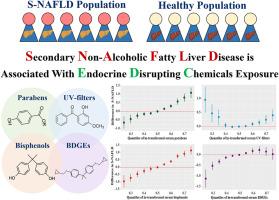
The presence of phenolic endocrine disrupting chemicals (EDCs) in patients with secondary non-alcoholic fatty liver disease (S-NAFLD) and their associations with S-NAFLD incidence have not been previously documented. In this study, serum concentrations of 32 phenolic EDCs, including parabens, benzophenone-type UV-filters, bisphenols, and bisphenol A diglycidyl ether derivatives, were detected in patients with S-NAFLD as well as healthy population from South China. These target EDCs were ubiquitous in serum samples from both cohorts. Interestingly, significantly higher (p < 0.05) serum levels of most analytes were detected in individuals with S-NAFLD compared to those in the healthy population. Through multiple modeling analyses, we observed that parabens and bisphenols mixtures were positively associated with S-NAFLD incidence. A list of high-risk EDCs for S-NAFLD-related diseases was identified, including propyl paraben (PrP), butyl paraben (BuP), bisphenol A (BPA), and bisphenol AP (BPAP). Furthermore, significant positive correlations were found between the serum levels of these high-risk analytes and liver clinic indices. To the best of our knowledge, this study firstly examined the serum levels of multiple phenolic EDCs in patients with S-NAFLD, aiming to provide novel insights into high-risk EDCs associated with S-NAFLD incidence and their associations with clinic liver indices.
期刊介绍:
Environmental Pollution is an international peer-reviewed journal that publishes high-quality research papers and review articles covering all aspects of environmental pollution and its impacts on ecosystems and human health.
Subject areas include, but are not limited to:
• Sources and occurrences of pollutants that are clearly defined and measured in environmental compartments, food and food-related items, and human bodies;
• Interlinks between contaminant exposure and biological, ecological, and human health effects, including those of climate change;
• Contaminants of emerging concerns (including but not limited to antibiotic resistant microorganisms or genes, microplastics/nanoplastics, electronic wastes, light, and noise) and/or their biological, ecological, or human health effects;
• Laboratory and field studies on the remediation/mitigation of environmental pollution via new techniques and with clear links to biological, ecological, or human health effects;
• Modeling of pollution processes, patterns, or trends that is of clear environmental and/or human health interest;
• New techniques that measure and examine environmental occurrences, transport, behavior, and effects of pollutants within the environment or the laboratory, provided that they can be clearly used to address problems within regional or global environmental compartments.





 京公网安备 11010802042870号
京ICP备2023020795号-1
京公网安备 11010802042870号
京ICP备2023020795号-1

 分享
分享
 求助内容:
求助内容: 应助结果提醒方式:
 扫码关注我们
