Zipeng Tang, Chunlong Wang, Chunying Ma, Wenzhen Zou, Chao Wei, Xuanshuo Shangguan, Lu Zhou, Xiaoyu Li, Yongchun Ye, Liguo Gao, Yusran Sulaiman, Tingli Ma and Chu Zhang
{"title":"基于异硫脲的埋藏界面改性高效稳定的钙钛矿太阳能电池","authors":"Zipeng Tang, Chunlong Wang, Chunying Ma, Wenzhen Zou, Chao Wei, Xuanshuo Shangguan, Lu Zhou, Xiaoyu Li, Yongchun Ye, Liguo Gao, Yusran Sulaiman, Tingli Ma and Chu Zhang","doi":"10.1039/D4DT03269A","DOIUrl":null,"url":null,"abstract":"<p >Oxygen-related defects including O vacancies and dangling O–H bonds in the SnO<small><sub>2</sub></small> electron transport layer result in non-radiative carrier recombination, which directly affects the performance efficiency and stability of perovskite solar cells. Additionally, undercoordinated Pb<small><sup>2+</sup></small> can also induce the non-radiative recombination of photogenerated carriers and provide a pathway for ion migration, leading to further degradation of solar cell performance. To tackle such issues, interface modification with multi-functional small molecules is usually considered to be a convenient way to inhibit non-radiative recombination and improve carrier transportation. Here, we employ two isothiourea bridge molecules, CESC (<em>S</em>-carboxyethyl isothiourea hydrochloride) and DASC (<em>S</em>-[2-(dimethylamino) ethyl] isothiourea dihydrochloride), to passivate the buried interface between SnO<small><sub>2</sub></small> and perovskite, realizing dual-functional passivation towards both filling O<small><sup>2−</sup></small> vacancies in the SnO<small><sub>2</sub></small> lattice and binding the uncoordinated ions. Perovskite solar cells fabricated with this method show highly improved optoelectronic performance and resistance against ambient moisture. Compared with that of the control device (17.20%), the efficiency of the devices modified with DASC and CESC increased to 18.75% and 19.04%, respectively. The unpackaged solar cells treated with CESC and DASC maintained 91.2% and 89.5% of their initial efficiency, respectively, after aging for 1000 hours in a high-humidity environment.</p>","PeriodicalId":71,"journal":{"name":"Dalton Transactions","volume":" 17","pages":" 6858-6865"},"PeriodicalIF":3.3000,"publicationDate":"2025-03-20","publicationTypes":"Journal Article","fieldsOfStudy":null,"isOpenAccess":false,"openAccessPdf":"","citationCount":"0","resultStr":"{\"title\":\"Isothiourea-based buried interface modification for high-efficiency and stable perovskite solar cells†\",\"authors\":\"Zipeng Tang, Chunlong Wang, Chunying Ma, Wenzhen Zou, Chao Wei, Xuanshuo Shangguan, Lu Zhou, Xiaoyu Li, Yongchun Ye, Liguo Gao, Yusran Sulaiman, Tingli Ma and Chu Zhang\",\"doi\":\"10.1039/D4DT03269A\",\"DOIUrl\":null,\"url\":null,\"abstract\":\"<p >Oxygen-related defects including O vacancies and dangling O–H bonds in the SnO<small><sub>2</sub></small> electron transport layer result in non-radiative carrier recombination, which directly affects the performance efficiency and stability of perovskite solar cells. Additionally, undercoordinated Pb<small><sup>2+</sup></small> can also induce the non-radiative recombination of photogenerated carriers and provide a pathway for ion migration, leading to further degradation of solar cell performance. To tackle such issues, interface modification with multi-functional small molecules is usually considered to be a convenient way to inhibit non-radiative recombination and improve carrier transportation. Here, we employ two isothiourea bridge molecules, CESC (<em>S</em>-carboxyethyl isothiourea hydrochloride) and DASC (<em>S</em>-[2-(dimethylamino) ethyl] isothiourea dihydrochloride), to passivate the buried interface between SnO<small><sub>2</sub></small> and perovskite, realizing dual-functional passivation towards both filling O<small><sup>2−</sup></small> vacancies in the SnO<small><sub>2</sub></small> lattice and binding the uncoordinated ions. Perovskite solar cells fabricated with this method show highly improved optoelectronic performance and resistance against ambient moisture. Compared with that of the control device (17.20%), the efficiency of the devices modified with DASC and CESC increased to 18.75% and 19.04%, respectively. The unpackaged solar cells treated with CESC and DASC maintained 91.2% and 89.5% of their initial efficiency, respectively, after aging for 1000 hours in a high-humidity environment.</p>\",\"PeriodicalId\":71,\"journal\":{\"name\":\"Dalton Transactions\",\"volume\":\" 17\",\"pages\":\" 6858-6865\"},\"PeriodicalIF\":3.3000,\"publicationDate\":\"2025-03-20\",\"publicationTypes\":\"Journal Article\",\"fieldsOfStudy\":null,\"isOpenAccess\":false,\"openAccessPdf\":\"\",\"citationCount\":\"0\",\"resultStr\":null,\"platform\":\"Semanticscholar\",\"paperid\":null,\"PeriodicalName\":\"Dalton Transactions\",\"FirstCategoryId\":\"92\",\"ListUrlMain\":\"https://pubs.rsc.org/en/content/articlelanding/2025/dt/d4dt03269a\",\"RegionNum\":3,\"RegionCategory\":\"化学\",\"ArticlePicture\":[],\"TitleCN\":null,\"AbstractTextCN\":null,\"PMCID\":null,\"EPubDate\":\"\",\"PubModel\":\"\",\"JCR\":\"Q2\",\"JCRName\":\"CHEMISTRY, INORGANIC & NUCLEAR\",\"Score\":null,\"Total\":0}","platform":"Semanticscholar","paperid":null,"PeriodicalName":"Dalton Transactions","FirstCategoryId":"92","ListUrlMain":"https://pubs.rsc.org/en/content/articlelanding/2025/dt/d4dt03269a","RegionNum":3,"RegionCategory":"化学","ArticlePicture":[],"TitleCN":null,"AbstractTextCN":null,"PMCID":null,"EPubDate":"","PubModel":"","JCR":"Q2","JCRName":"CHEMISTRY, INORGANIC & NUCLEAR","Score":null,"Total":0}
Isothiourea-based buried interface modification for high-efficiency and stable perovskite solar cells†
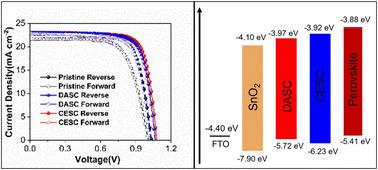
Oxygen-related defects including O vacancies and dangling O–H bonds in the SnO2 electron transport layer result in non-radiative carrier recombination, which directly affects the performance efficiency and stability of perovskite solar cells. Additionally, undercoordinated Pb2+ can also induce the non-radiative recombination of photogenerated carriers and provide a pathway for ion migration, leading to further degradation of solar cell performance. To tackle such issues, interface modification with multi-functional small molecules is usually considered to be a convenient way to inhibit non-radiative recombination and improve carrier transportation. Here, we employ two isothiourea bridge molecules, CESC (S-carboxyethyl isothiourea hydrochloride) and DASC (S-[2-(dimethylamino) ethyl] isothiourea dihydrochloride), to passivate the buried interface between SnO2 and perovskite, realizing dual-functional passivation towards both filling O2− vacancies in the SnO2 lattice and binding the uncoordinated ions. Perovskite solar cells fabricated with this method show highly improved optoelectronic performance and resistance against ambient moisture. Compared with that of the control device (17.20%), the efficiency of the devices modified with DASC and CESC increased to 18.75% and 19.04%, respectively. The unpackaged solar cells treated with CESC and DASC maintained 91.2% and 89.5% of their initial efficiency, respectively, after aging for 1000 hours in a high-humidity environment.
期刊介绍:
Dalton Transactions is a journal for all areas of inorganic chemistry, which encompasses the organometallic, bioinorganic and materials chemistry of the elements, with applications including synthesis, catalysis, energy conversion/storage, electrical devices and medicine. Dalton Transactions welcomes high-quality, original submissions in all of these areas and more, where the advancement of knowledge in inorganic chemistry is significant.




 京公网安备 11010802042870号
京ICP备2023020795号-1
京公网安备 11010802042870号
京ICP备2023020795号-1

 分享
分享
 求助内容:
求助内容: 应助结果提醒方式:
 扫码关注我们
