Haojun Sun , Tianyu Jia , Yeye Qian , Quan Chen , Yongfeng Men , Zhaohui Su
{"title":"用偏振拉曼光谱定量聚对苯二甲酸乙二胺纤维中的分子取向","authors":"Haojun Sun , Tianyu Jia , Yeye Qian , Quan Chen , Yongfeng Men , Zhaohui Su","doi":"10.1016/j.polymer.2025.128310","DOIUrl":null,"url":null,"abstract":"<div><div>Poly(<em>p</em>-phenylene terephthalamide) (PPTA) forms high-performance fibers, and the molecular orientation in the fibers are crucial to their mechanical properties. Here we report a method for quantitative analysis of the molecular orientation in individual PPTA fibers by polarized Raman spectroscopy. Four parallel- and cross-polarized spectra are acquired in a backscattering geometry for each fiber on a confocal Raman spectrometer fitted with a 785 nm laser. The intensity of the aromatic C–C stretching band of the benzene rings at ∼1610 cm<sup>−1</sup> is utilized to quantify the molecular orientation in the fiber. The results thus obtained are in good agreement with the crystal orientation in these fibers revealed by wide-angle X-ray diffraction, especially for the ones of low or high degree of orientation. This method is then applied to monitor the orientation development of PPTA fibers in a post-treatment process of thermal stretching, which reveals that the degree of orientation decreases upon heating at a high temperature, and is enhanced significantly after an external stress is applied.</div></div>","PeriodicalId":405,"journal":{"name":"Polymer","volume":"325 ","pages":"Article 128310"},"PeriodicalIF":4.5000,"publicationDate":"2025-04-22","publicationTypes":"Journal Article","fieldsOfStudy":null,"isOpenAccess":false,"openAccessPdf":"","citationCount":"0","resultStr":"{\"title\":\"Quantifying molecular orientation in Poly(p-phenylene terephthalamide) fibers by polarized Raman spectroscopy\",\"authors\":\"Haojun Sun , Tianyu Jia , Yeye Qian , Quan Chen , Yongfeng Men , Zhaohui Su\",\"doi\":\"10.1016/j.polymer.2025.128310\",\"DOIUrl\":null,\"url\":null,\"abstract\":\"<div><div>Poly(<em>p</em>-phenylene terephthalamide) (PPTA) forms high-performance fibers, and the molecular orientation in the fibers are crucial to their mechanical properties. Here we report a method for quantitative analysis of the molecular orientation in individual PPTA fibers by polarized Raman spectroscopy. Four parallel- and cross-polarized spectra are acquired in a backscattering geometry for each fiber on a confocal Raman spectrometer fitted with a 785 nm laser. The intensity of the aromatic C–C stretching band of the benzene rings at ∼1610 cm<sup>−1</sup> is utilized to quantify the molecular orientation in the fiber. The results thus obtained are in good agreement with the crystal orientation in these fibers revealed by wide-angle X-ray diffraction, especially for the ones of low or high degree of orientation. This method is then applied to monitor the orientation development of PPTA fibers in a post-treatment process of thermal stretching, which reveals that the degree of orientation decreases upon heating at a high temperature, and is enhanced significantly after an external stress is applied.</div></div>\",\"PeriodicalId\":405,\"journal\":{\"name\":\"Polymer\",\"volume\":\"325 \",\"pages\":\"Article 128310\"},\"PeriodicalIF\":4.5000,\"publicationDate\":\"2025-04-22\",\"publicationTypes\":\"Journal Article\",\"fieldsOfStudy\":null,\"isOpenAccess\":false,\"openAccessPdf\":\"\",\"citationCount\":\"0\",\"resultStr\":null,\"platform\":\"Semanticscholar\",\"paperid\":null,\"PeriodicalName\":\"Polymer\",\"FirstCategoryId\":\"92\",\"ListUrlMain\":\"https://www.sciencedirect.com/science/article/pii/S0032386125002964\",\"RegionNum\":2,\"RegionCategory\":\"化学\",\"ArticlePicture\":[],\"TitleCN\":null,\"AbstractTextCN\":null,\"PMCID\":null,\"EPubDate\":\"2025/3/20 0:00:00\",\"PubModel\":\"Epub\",\"JCR\":\"Q2\",\"JCRName\":\"POLYMER SCIENCE\",\"Score\":null,\"Total\":0}","platform":"Semanticscholar","paperid":null,"PeriodicalName":"Polymer","FirstCategoryId":"92","ListUrlMain":"https://www.sciencedirect.com/science/article/pii/S0032386125002964","RegionNum":2,"RegionCategory":"化学","ArticlePicture":[],"TitleCN":null,"AbstractTextCN":null,"PMCID":null,"EPubDate":"2025/3/20 0:00:00","PubModel":"Epub","JCR":"Q2","JCRName":"POLYMER SCIENCE","Score":null,"Total":0}
Quantifying molecular orientation in Poly(p-phenylene terephthalamide) fibers by polarized Raman spectroscopy
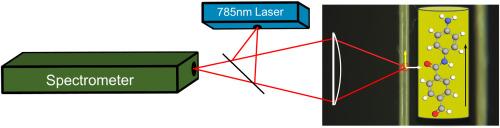
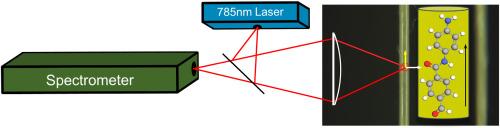
Poly(p-phenylene terephthalamide) (PPTA) forms high-performance fibers, and the molecular orientation in the fibers are crucial to their mechanical properties. Here we report a method for quantitative analysis of the molecular orientation in individual PPTA fibers by polarized Raman spectroscopy. Four parallel- and cross-polarized spectra are acquired in a backscattering geometry for each fiber on a confocal Raman spectrometer fitted with a 785 nm laser. The intensity of the aromatic C–C stretching band of the benzene rings at ∼1610 cm−1 is utilized to quantify the molecular orientation in the fiber. The results thus obtained are in good agreement with the crystal orientation in these fibers revealed by wide-angle X-ray diffraction, especially for the ones of low or high degree of orientation. This method is then applied to monitor the orientation development of PPTA fibers in a post-treatment process of thermal stretching, which reveals that the degree of orientation decreases upon heating at a high temperature, and is enhanced significantly after an external stress is applied.
期刊介绍:
Polymer is an interdisciplinary journal dedicated to publishing innovative and significant advances in Polymer Physics, Chemistry and Technology. We welcome submissions on polymer hybrids, nanocomposites, characterisation and self-assembly. Polymer also publishes work on the technological application of polymers in energy and optoelectronics.
The main scope is covered but not limited to the following core areas:
Polymer Materials
Nanocomposites and hybrid nanomaterials
Polymer blends, films, fibres, networks and porous materials
Physical Characterization
Characterisation, modelling and simulation* of molecular and materials properties in bulk, solution, and thin films
Polymer Engineering
Advanced multiscale processing methods
Polymer Synthesis, Modification and Self-assembly
Including designer polymer architectures, mechanisms and kinetics, and supramolecular polymerization
Technological Applications
Polymers for energy generation and storage
Polymer membranes for separation technology
Polymers for opto- and microelectronics.



 京公网安备 11010802042870号
京ICP备2023020795号-1
京公网安备 11010802042870号
京ICP备2023020795号-1

 分享
分享
 求助内容:
求助内容: 应助结果提醒方式:
 扫码关注我们
