Feng Zhang, Lilin Song, Ruixuan Wang, Bei Zhao, Jian Huang, Luling Wu, Yufan Fan, Hong Lin, Zhengtao Jiang, Xiaodi Yang, Hairong Zeng, Xin Yang, Tony D. James, Guangbo Ge
{"title":"使用ai驱动的高性能荧光基板在多个维度上对CYP3A4进行功能成像","authors":"Feng Zhang, Lilin Song, Ruixuan Wang, Bei Zhao, Jian Huang, Luling Wu, Yufan Fan, Hong Lin, Zhengtao Jiang, Xiaodi Yang, Hairong Zeng, Xin Yang, Tony D. James, Guangbo Ge","doi":"10.1002/smll.202412178","DOIUrl":null,"url":null,"abstract":"<p>Cytochrome P450 3A4 (CYP3A4) is a key mediator in xenobiotic metabolism and drug-drug interactions (DDI), developing orally active fluorogenic substrates for sensing and imaging of a target enzyme in biological systems remains challenging. Here, an artificial intelligence (AI)-driven strategy is used to construct a highly specific and orally active fluorogenic substrate for imaging CYP3A4 in complex biological systems. After the fusion of an AI-selected drug-like fragment with a CYP3A4-preferred fluorophore, three candidates are designed and synthesized. Among all evaluated candidates, NFa exhibits excellent isoform-specificity, ultra-high sensitivity, outstanding spatial resolution, favorable safety profiles, and acceptable oral bioavailability. Specifically, NFa excels at functional in situ imaging of CYP3A4 in living systems with exceptional endoplasmic reticulum (ER)-colocalization performance and high imaging resolution, while this agent can also replace hCYP3A4 drug-substrates for high-throughput screening of CYP3A4 inhibitors and for assessing DDI potential in vivo. With the help of NFa, a novel CYP3A4 inhibitor (D13) was discovered, and its anti-CYP3A4 effects are assessed in live cells, ex vivo and in vivo. Collectively, an AI-powered strategy is adapted for developing highly-specific and drug-like fluorogenic substrates, resulting in the first orally available tool (NFa) for sensing and imaging CYP3A4 activities, which facilitates CYP3A4-associated fundamental investigations and the drug discovery process.</p>","PeriodicalId":228,"journal":{"name":"Small","volume":"21 17","pages":""},"PeriodicalIF":11.8000,"publicationDate":"2025-03-21","publicationTypes":"Journal Article","fieldsOfStudy":null,"isOpenAccess":false,"openAccessPdf":"https://onlinelibrary.wiley.com/doi/epdf/10.1002/smll.202412178","citationCount":"0","resultStr":"{\"title\":\"Functional Imaging of CYP3A4 at Multiple Dimensions Using an AI-Driven High Performance Fluorogenic Substrate\",\"authors\":\"Feng Zhang, Lilin Song, Ruixuan Wang, Bei Zhao, Jian Huang, Luling Wu, Yufan Fan, Hong Lin, Zhengtao Jiang, Xiaodi Yang, Hairong Zeng, Xin Yang, Tony D. James, Guangbo Ge\",\"doi\":\"10.1002/smll.202412178\",\"DOIUrl\":null,\"url\":null,\"abstract\":\"<p>Cytochrome P450 3A4 (CYP3A4) is a key mediator in xenobiotic metabolism and drug-drug interactions (DDI), developing orally active fluorogenic substrates for sensing and imaging of a target enzyme in biological systems remains challenging. Here, an artificial intelligence (AI)-driven strategy is used to construct a highly specific and orally active fluorogenic substrate for imaging CYP3A4 in complex biological systems. After the fusion of an AI-selected drug-like fragment with a CYP3A4-preferred fluorophore, three candidates are designed and synthesized. Among all evaluated candidates, NFa exhibits excellent isoform-specificity, ultra-high sensitivity, outstanding spatial resolution, favorable safety profiles, and acceptable oral bioavailability. Specifically, NFa excels at functional in situ imaging of CYP3A4 in living systems with exceptional endoplasmic reticulum (ER)-colocalization performance and high imaging resolution, while this agent can also replace hCYP3A4 drug-substrates for high-throughput screening of CYP3A4 inhibitors and for assessing DDI potential in vivo. With the help of NFa, a novel CYP3A4 inhibitor (D13) was discovered, and its anti-CYP3A4 effects are assessed in live cells, ex vivo and in vivo. Collectively, an AI-powered strategy is adapted for developing highly-specific and drug-like fluorogenic substrates, resulting in the first orally available tool (NFa) for sensing and imaging CYP3A4 activities, which facilitates CYP3A4-associated fundamental investigations and the drug discovery process.</p>\",\"PeriodicalId\":228,\"journal\":{\"name\":\"Small\",\"volume\":\"21 17\",\"pages\":\"\"},\"PeriodicalIF\":11.8000,\"publicationDate\":\"2025-03-21\",\"publicationTypes\":\"Journal Article\",\"fieldsOfStudy\":null,\"isOpenAccess\":false,\"openAccessPdf\":\"https://onlinelibrary.wiley.com/doi/epdf/10.1002/smll.202412178\",\"citationCount\":\"0\",\"resultStr\":null,\"platform\":\"Semanticscholar\",\"paperid\":null,\"PeriodicalName\":\"Small\",\"FirstCategoryId\":\"88\",\"ListUrlMain\":\"https://onlinelibrary.wiley.com/doi/10.1002/smll.202412178\",\"RegionNum\":2,\"RegionCategory\":\"材料科学\",\"ArticlePicture\":[],\"TitleCN\":null,\"AbstractTextCN\":null,\"PMCID\":null,\"EPubDate\":\"\",\"PubModel\":\"\",\"JCR\":\"Q1\",\"JCRName\":\"CHEMISTRY, MULTIDISCIPLINARY\",\"Score\":null,\"Total\":0}","platform":"Semanticscholar","paperid":null,"PeriodicalName":"Small","FirstCategoryId":"88","ListUrlMain":"https://onlinelibrary.wiley.com/doi/10.1002/smll.202412178","RegionNum":2,"RegionCategory":"材料科学","ArticlePicture":[],"TitleCN":null,"AbstractTextCN":null,"PMCID":null,"EPubDate":"","PubModel":"","JCR":"Q1","JCRName":"CHEMISTRY, MULTIDISCIPLINARY","Score":null,"Total":0}
Functional Imaging of CYP3A4 at Multiple Dimensions Using an AI-Driven High Performance Fluorogenic Substrate
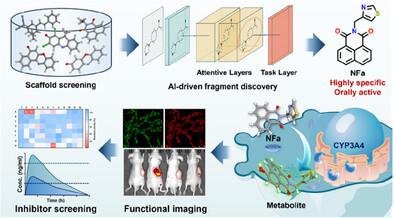
Cytochrome P450 3A4 (CYP3A4) is a key mediator in xenobiotic metabolism and drug-drug interactions (DDI), developing orally active fluorogenic substrates for sensing and imaging of a target enzyme in biological systems remains challenging. Here, an artificial intelligence (AI)-driven strategy is used to construct a highly specific and orally active fluorogenic substrate for imaging CYP3A4 in complex biological systems. After the fusion of an AI-selected drug-like fragment with a CYP3A4-preferred fluorophore, three candidates are designed and synthesized. Among all evaluated candidates, NFa exhibits excellent isoform-specificity, ultra-high sensitivity, outstanding spatial resolution, favorable safety profiles, and acceptable oral bioavailability. Specifically, NFa excels at functional in situ imaging of CYP3A4 in living systems with exceptional endoplasmic reticulum (ER)-colocalization performance and high imaging resolution, while this agent can also replace hCYP3A4 drug-substrates for high-throughput screening of CYP3A4 inhibitors and for assessing DDI potential in vivo. With the help of NFa, a novel CYP3A4 inhibitor (D13) was discovered, and its anti-CYP3A4 effects are assessed in live cells, ex vivo and in vivo. Collectively, an AI-powered strategy is adapted for developing highly-specific and drug-like fluorogenic substrates, resulting in the first orally available tool (NFa) for sensing and imaging CYP3A4 activities, which facilitates CYP3A4-associated fundamental investigations and the drug discovery process.
期刊介绍:
Small serves as an exceptional platform for both experimental and theoretical studies in fundamental and applied interdisciplinary research at the nano- and microscale. The journal offers a compelling mix of peer-reviewed Research Articles, Reviews, Perspectives, and Comments.
With a remarkable 2022 Journal Impact Factor of 13.3 (Journal Citation Reports from Clarivate Analytics, 2023), Small remains among the top multidisciplinary journals, covering a wide range of topics at the interface of materials science, chemistry, physics, engineering, medicine, and biology.
Small's readership includes biochemists, biologists, biomedical scientists, chemists, engineers, information technologists, materials scientists, physicists, and theoreticians alike.





 京公网安备 11010802042870号
京ICP备2023020795号-1
京公网安备 11010802042870号
京ICP备2023020795号-1

 分享
分享
 求助内容:
求助内容: 应助结果提醒方式:
 扫码关注我们
