Jiang Li, Yu-Chen Fang, Xiao Wang, Ling-Tong Ding, Zhi-Jun Wang, Xin-Yao Yang, Jan Lancok, Wei-Min Li, Gao-Kuo Zhong, Xin Wang, Zheng Xing, Shen Zhao, Shu-De Liu, Xia Long, Ming Ma
{"title":"用于高效光电化学制氢的CuGaS2@BiVO4 s型结构自适应能带对接","authors":"Jiang Li, Yu-Chen Fang, Xiao Wang, Ling-Tong Ding, Zhi-Jun Wang, Xin-Yao Yang, Jan Lancok, Wei-Min Li, Gao-Kuo Zhong, Xin Wang, Zheng Xing, Shen Zhao, Shu-De Liu, Xia Long, Ming Ma","doi":"10.1007/s12598-024-03072-2","DOIUrl":null,"url":null,"abstract":"<div><p>Typical p-n junctions have emerged as a promising strategy for contending with charge carrier recombination in solar conversion. However, the photo-corrosion and unsuitable energy band positions still hinder their practical application for hydrogen production from water in photoelectrochemical systems. Here, an in-situ photo-oxidation method is proposed for achieving self-adapting activation of BiVO<sub>4</sub>-based photoanodes with surface-encapsulated CuGaS<sub>2</sub> particles by the ZnO layer. The self-adapting activation demotes the energy band positions of CuGaS<sub>2</sub>, establishing an S-scheme structure with BiVO<sub>4</sub>, resulting in an efficient p-n junction photoanode. The optimal sample exhibits enhanced photocurrent and an onset potential cathodically shifted by ~ 300 mV compared with BiVO<sub>4</sub>, which is attributed to significantly enhanced charge transport and transfer efficiencies. As expected, it attains the highest photocurrent value of 5.87 mA·cm<sup>−2</sup>, aided by a hole scavenger at 1.23 V versus a reversible hydrogen electrode, which significantly surpasses that of BiVO<sub>4</sub> (4.32 mA·cm<sup>−2</sup>).</p></div>","PeriodicalId":749,"journal":{"name":"Rare Metals","volume":"44 3","pages":"1742 - 1755"},"PeriodicalIF":12.1000,"publicationDate":"2024-12-10","publicationTypes":"Journal Article","fieldsOfStudy":null,"isOpenAccess":false,"openAccessPdf":"","citationCount":"0","resultStr":"{\"title\":\"A self-adapting energy-band docking of CuGaS2@BiVO4 S-scheme structure for efficient photoelectrochemical hydrogen production\",\"authors\":\"Jiang Li, Yu-Chen Fang, Xiao Wang, Ling-Tong Ding, Zhi-Jun Wang, Xin-Yao Yang, Jan Lancok, Wei-Min Li, Gao-Kuo Zhong, Xin Wang, Zheng Xing, Shen Zhao, Shu-De Liu, Xia Long, Ming Ma\",\"doi\":\"10.1007/s12598-024-03072-2\",\"DOIUrl\":null,\"url\":null,\"abstract\":\"<div><p>Typical p-n junctions have emerged as a promising strategy for contending with charge carrier recombination in solar conversion. However, the photo-corrosion and unsuitable energy band positions still hinder their practical application for hydrogen production from water in photoelectrochemical systems. Here, an in-situ photo-oxidation method is proposed for achieving self-adapting activation of BiVO<sub>4</sub>-based photoanodes with surface-encapsulated CuGaS<sub>2</sub> particles by the ZnO layer. The self-adapting activation demotes the energy band positions of CuGaS<sub>2</sub>, establishing an S-scheme structure with BiVO<sub>4</sub>, resulting in an efficient p-n junction photoanode. The optimal sample exhibits enhanced photocurrent and an onset potential cathodically shifted by ~ 300 mV compared with BiVO<sub>4</sub>, which is attributed to significantly enhanced charge transport and transfer efficiencies. As expected, it attains the highest photocurrent value of 5.87 mA·cm<sup>−2</sup>, aided by a hole scavenger at 1.23 V versus a reversible hydrogen electrode, which significantly surpasses that of BiVO<sub>4</sub> (4.32 mA·cm<sup>−2</sup>).</p></div>\",\"PeriodicalId\":749,\"journal\":{\"name\":\"Rare Metals\",\"volume\":\"44 3\",\"pages\":\"1742 - 1755\"},\"PeriodicalIF\":12.1000,\"publicationDate\":\"2024-12-10\",\"publicationTypes\":\"Journal Article\",\"fieldsOfStudy\":null,\"isOpenAccess\":false,\"openAccessPdf\":\"\",\"citationCount\":\"0\",\"resultStr\":null,\"platform\":\"Semanticscholar\",\"paperid\":null,\"PeriodicalName\":\"Rare Metals\",\"FirstCategoryId\":\"88\",\"ListUrlMain\":\"https://link.springer.com/article/10.1007/s12598-024-03072-2\",\"RegionNum\":1,\"RegionCategory\":\"材料科学\",\"ArticlePicture\":[],\"TitleCN\":null,\"AbstractTextCN\":null,\"PMCID\":null,\"EPubDate\":\"\",\"PubModel\":\"\",\"JCR\":\"Q1\",\"JCRName\":\"MATERIALS SCIENCE, MULTIDISCIPLINARY\",\"Score\":null,\"Total\":0}","platform":"Semanticscholar","paperid":null,"PeriodicalName":"Rare Metals","FirstCategoryId":"88","ListUrlMain":"https://link.springer.com/article/10.1007/s12598-024-03072-2","RegionNum":1,"RegionCategory":"材料科学","ArticlePicture":[],"TitleCN":null,"AbstractTextCN":null,"PMCID":null,"EPubDate":"","PubModel":"","JCR":"Q1","JCRName":"MATERIALS SCIENCE, MULTIDISCIPLINARY","Score":null,"Total":0}
A self-adapting energy-band docking of CuGaS2@BiVO4 S-scheme structure for efficient photoelectrochemical hydrogen production
Typical p-n junctions have emerged as a promising strategy for contending with charge carrier recombination in solar conversion. However, the photo-corrosion and unsuitable energy band positions still hinder their practical application for hydrogen production from water in photoelectrochemical systems. Here, an in-situ photo-oxidation method is proposed for achieving self-adapting activation of BiVO4-based photoanodes with surface-encapsulated CuGaS2 particles by the ZnO layer. The self-adapting activation demotes the energy band positions of CuGaS2, establishing an S-scheme structure with BiVO4, resulting in an efficient p-n junction photoanode. The optimal sample exhibits enhanced photocurrent and an onset potential cathodically shifted by ~ 300 mV compared with BiVO4, which is attributed to significantly enhanced charge transport and transfer efficiencies. As expected, it attains the highest photocurrent value of 5.87 mA·cm−2, aided by a hole scavenger at 1.23 V versus a reversible hydrogen electrode, which significantly surpasses that of BiVO4 (4.32 mA·cm−2).
期刊介绍:
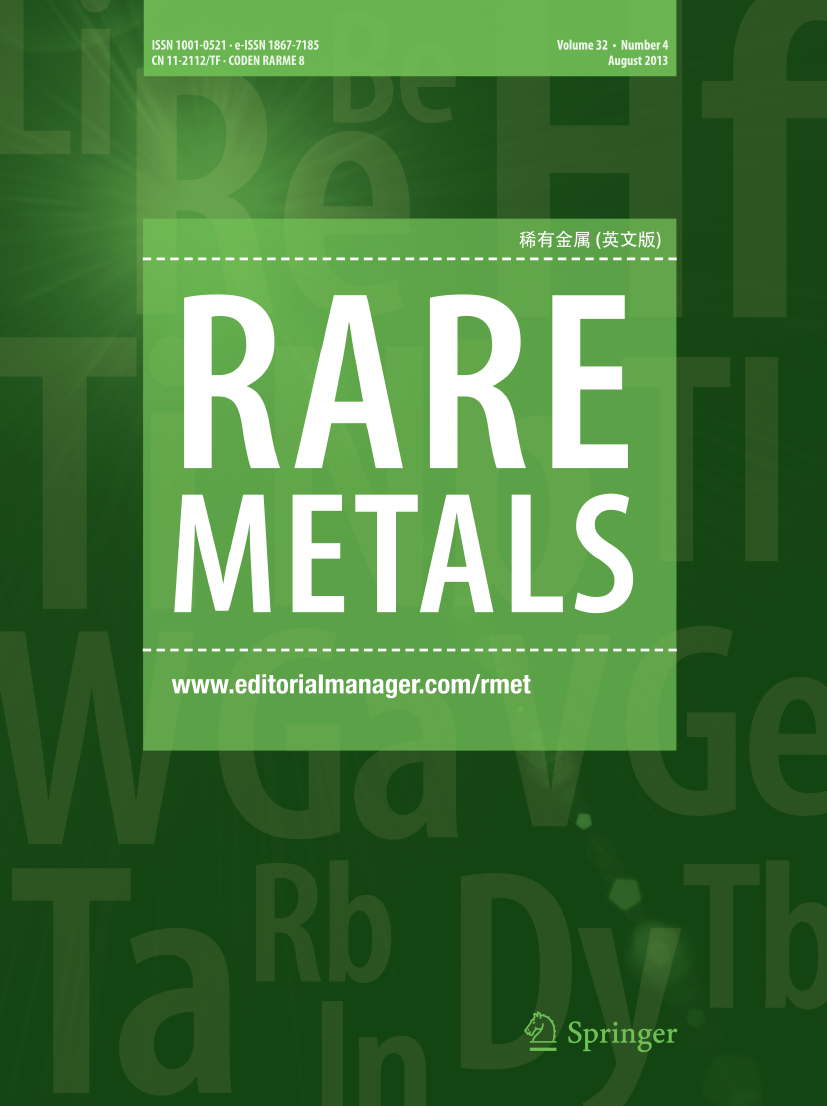
Rare Metals is a monthly peer-reviewed journal published by the Nonferrous Metals Society of China. It serves as a platform for engineers and scientists to communicate and disseminate original research articles in the field of rare metals. The journal focuses on a wide range of topics including metallurgy, processing, and determination of rare metals. Additionally, it showcases the application of rare metals in advanced materials such as superconductors, semiconductors, composites, and ceramics.




 京公网安备 11010802042870号
京ICP备2023020795号-1
京公网安备 11010802042870号
京ICP备2023020795号-1

 分享
分享
 求助内容:
求助内容: 应助结果提醒方式:
 扫码关注我们
