Eudald Correig-Fraga, Roger Guimerà, Marta Sales-Pardo
{"title":"儿童的认知概况和学校内的社会互动之间的相互作用是微妙的,并且随着年龄的不同而不同。","authors":"Eudald Correig-Fraga, Roger Guimerà, Marta Sales-Pardo","doi":"10.1038/s44271-025-00227-4","DOIUrl":null,"url":null,"abstract":"<p><p>Studies investigating the link between school achievement and social networks have shown that both cognitive and non-cognitive factors are integral to academic success. However, these investigations have predominantly been confined by two limitations: 1) they rarely combine cognitive and social data from the same individuals, and 2) when incorporating social data, it is often unidimensional, focusing only on a single type of relationship among children, such as friendship networks or time spent together. This research builds on prior findings by considering cognitive and social data, including preferences for schoolwork relations, leisure/play relations, and friendships, of nearly 5,000 students from Catalonia (Spain) aged 6 through 15. Our findings indicate that children prefer to interact with those who exhibit similar cognitive profiles, but that their preferences diverge between schoolwork and play-related relations during both primary and secondary school. The diverging preferences of children of older ages suggest a greater understanding of the different purposes and expectations of various social interactions.</p>","PeriodicalId":501698,"journal":{"name":"Communications Psychology","volume":"3 1","pages":"44"},"PeriodicalIF":0.0000,"publicationDate":"2025-03-20","publicationTypes":"Journal Article","fieldsOfStudy":null,"isOpenAccess":false,"openAccessPdf":"https://www.ncbi.nlm.nih.gov/pmc/articles/PMC11926095/pdf/","citationCount":"0","resultStr":"{\"title\":\"Interplay between children's cognitive profiles and within-school social interactions is nuanced and differs across ages.\",\"authors\":\"Eudald Correig-Fraga, Roger Guimerà, Marta Sales-Pardo\",\"doi\":\"10.1038/s44271-025-00227-4\",\"DOIUrl\":null,\"url\":null,\"abstract\":\"<p><p>Studies investigating the link between school achievement and social networks have shown that both cognitive and non-cognitive factors are integral to academic success. However, these investigations have predominantly been confined by two limitations: 1) they rarely combine cognitive and social data from the same individuals, and 2) when incorporating social data, it is often unidimensional, focusing only on a single type of relationship among children, such as friendship networks or time spent together. This research builds on prior findings by considering cognitive and social data, including preferences for schoolwork relations, leisure/play relations, and friendships, of nearly 5,000 students from Catalonia (Spain) aged 6 through 15. Our findings indicate that children prefer to interact with those who exhibit similar cognitive profiles, but that their preferences diverge between schoolwork and play-related relations during both primary and secondary school. The diverging preferences of children of older ages suggest a greater understanding of the different purposes and expectations of various social interactions.</p>\",\"PeriodicalId\":501698,\"journal\":{\"name\":\"Communications Psychology\",\"volume\":\"3 1\",\"pages\":\"44\"},\"PeriodicalIF\":0.0000,\"publicationDate\":\"2025-03-20\",\"publicationTypes\":\"Journal Article\",\"fieldsOfStudy\":null,\"isOpenAccess\":false,\"openAccessPdf\":\"https://www.ncbi.nlm.nih.gov/pmc/articles/PMC11926095/pdf/\",\"citationCount\":\"0\",\"resultStr\":null,\"platform\":\"Semanticscholar\",\"paperid\":null,\"PeriodicalName\":\"Communications Psychology\",\"FirstCategoryId\":\"1085\",\"ListUrlMain\":\"https://doi.org/10.1038/s44271-025-00227-4\",\"RegionNum\":0,\"RegionCategory\":null,\"ArticlePicture\":[],\"TitleCN\":null,\"AbstractTextCN\":null,\"PMCID\":null,\"EPubDate\":\"\",\"PubModel\":\"\",\"JCR\":\"\",\"JCRName\":\"\",\"Score\":null,\"Total\":0}","platform":"Semanticscholar","paperid":null,"PeriodicalName":"Communications Psychology","FirstCategoryId":"1085","ListUrlMain":"https://doi.org/10.1038/s44271-025-00227-4","RegionNum":0,"RegionCategory":null,"ArticlePicture":[],"TitleCN":null,"AbstractTextCN":null,"PMCID":null,"EPubDate":"","PubModel":"","JCR":"","JCRName":"","Score":null,"Total":0}
Interplay between children's cognitive profiles and within-school social interactions is nuanced and differs across ages.
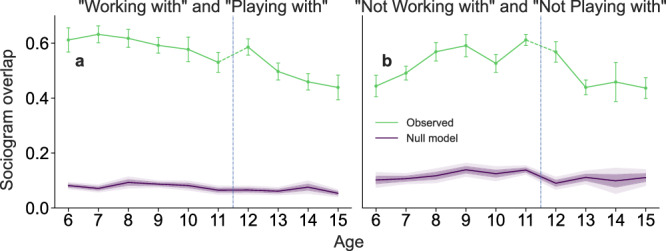
Studies investigating the link between school achievement and social networks have shown that both cognitive and non-cognitive factors are integral to academic success. However, these investigations have predominantly been confined by two limitations: 1) they rarely combine cognitive and social data from the same individuals, and 2) when incorporating social data, it is often unidimensional, focusing only on a single type of relationship among children, such as friendship networks or time spent together. This research builds on prior findings by considering cognitive and social data, including preferences for schoolwork relations, leisure/play relations, and friendships, of nearly 5,000 students from Catalonia (Spain) aged 6 through 15. Our findings indicate that children prefer to interact with those who exhibit similar cognitive profiles, but that their preferences diverge between schoolwork and play-related relations during both primary and secondary school. The diverging preferences of children of older ages suggest a greater understanding of the different purposes and expectations of various social interactions.






 京公网安备 11010802042870号
京ICP备2023020795号-1
京公网安备 11010802042870号
京ICP备2023020795号-1

 分享
分享

 求助内容:
求助内容: 应助结果提醒方式:
 扫码关注我们
