{"title":"CuO掺杂SiO2增强电催化CO2还原过程中电子向产物C2H4的转移","authors":"Xu Ji , Weicong Xu , Chao Liu , Xing Wang","doi":"10.1016/j.electacta.2025.146090","DOIUrl":null,"url":null,"abstract":"<div><div>The electrocatalytic CO₂ reduction reaction (CO₂RR) offers a promising pathway for carbon cycling and high-value fuel synthesis. However, the efficient production of ethylene (C₂H₄), a critical multicarbon product, remains constrained by insufficient catalyst activity and selectivity. Although copper-based materials enable C–C coupling, conventional CuO catalysts suffer from imbalanced *CO intermediate adsorption strength and sluggish charge transfer kinetics.In this study, a silica (SiO₂) doping strategy was employed to synergistically modulate the electronic structure and surface active site distribution of CuO, significantly enhancing CO₂-to-C₂H₄ conversion efficiency. Experimental results demonstrate that SiO₂ incorporation induces local electronic density rearrangement around Cu²⁺, stabilizing *CO adsorption, while the constructed Cu-O-Si interfaces accelerate charge transfer, enhances electron transfer and reduce the energy barrier for *COCHO formation. The optimized SiO₂-10 %/CuO catalyst achieves a C₂H₄ Faraday efficiency of 42 % and a partial current density of 6.3 mA/cm² at −1.4 V (vs. RHE), representing a threefold improvement over pristine CuO. Notably, the catalyst exhibits exceptional stability over 4 hours.Structural characterization and theoretical calculations reveal that SiO₂ doping promotes the self-assembly of CuO nanosheets into flower-like architectures with a high specific surface area and exposes synergistic (111)/(002) facets, which collectively enhance *CO intermediate enrichment and directional coupling. This work provides novel insights into designing high-performance CO₂RR catalysts through multidimensional modulation strategies.</div></div>","PeriodicalId":305,"journal":{"name":"Electrochimica Acta","volume":"525 ","pages":"Article 146090"},"PeriodicalIF":5.6000,"publicationDate":"2025-06-10","publicationTypes":"Journal Article","fieldsOfStudy":null,"isOpenAccess":false,"openAccessPdf":"","citationCount":"0","resultStr":"{\"title\":\"CuO doping SiO2 for enhancing electron transfer to product C2H4 in electrocatalytic CO2 reduction\",\"authors\":\"Xu Ji , Weicong Xu , Chao Liu , Xing Wang\",\"doi\":\"10.1016/j.electacta.2025.146090\",\"DOIUrl\":null,\"url\":null,\"abstract\":\"<div><div>The electrocatalytic CO₂ reduction reaction (CO₂RR) offers a promising pathway for carbon cycling and high-value fuel synthesis. However, the efficient production of ethylene (C₂H₄), a critical multicarbon product, remains constrained by insufficient catalyst activity and selectivity. Although copper-based materials enable C–C coupling, conventional CuO catalysts suffer from imbalanced *CO intermediate adsorption strength and sluggish charge transfer kinetics.In this study, a silica (SiO₂) doping strategy was employed to synergistically modulate the electronic structure and surface active site distribution of CuO, significantly enhancing CO₂-to-C₂H₄ conversion efficiency. Experimental results demonstrate that SiO₂ incorporation induces local electronic density rearrangement around Cu²⁺, stabilizing *CO adsorption, while the constructed Cu-O-Si interfaces accelerate charge transfer, enhances electron transfer and reduce the energy barrier for *COCHO formation. The optimized SiO₂-10 %/CuO catalyst achieves a C₂H₄ Faraday efficiency of 42 % and a partial current density of 6.3 mA/cm² at −1.4 V (vs. RHE), representing a threefold improvement over pristine CuO. Notably, the catalyst exhibits exceptional stability over 4 hours.Structural characterization and theoretical calculations reveal that SiO₂ doping promotes the self-assembly of CuO nanosheets into flower-like architectures with a high specific surface area and exposes synergistic (111)/(002) facets, which collectively enhance *CO intermediate enrichment and directional coupling. This work provides novel insights into designing high-performance CO₂RR catalysts through multidimensional modulation strategies.</div></div>\",\"PeriodicalId\":305,\"journal\":{\"name\":\"Electrochimica Acta\",\"volume\":\"525 \",\"pages\":\"Article 146090\"},\"PeriodicalIF\":5.6000,\"publicationDate\":\"2025-06-10\",\"publicationTypes\":\"Journal Article\",\"fieldsOfStudy\":null,\"isOpenAccess\":false,\"openAccessPdf\":\"\",\"citationCount\":\"0\",\"resultStr\":null,\"platform\":\"Semanticscholar\",\"paperid\":null,\"PeriodicalName\":\"Electrochimica Acta\",\"FirstCategoryId\":\"88\",\"ListUrlMain\":\"https://www.sciencedirect.com/science/article/pii/S0013468625004529\",\"RegionNum\":3,\"RegionCategory\":\"材料科学\",\"ArticlePicture\":[],\"TitleCN\":null,\"AbstractTextCN\":null,\"PMCID\":null,\"EPubDate\":\"2025/3/22 0:00:00\",\"PubModel\":\"Epub\",\"JCR\":\"Q1\",\"JCRName\":\"ELECTROCHEMISTRY\",\"Score\":null,\"Total\":0}","platform":"Semanticscholar","paperid":null,"PeriodicalName":"Electrochimica Acta","FirstCategoryId":"88","ListUrlMain":"https://www.sciencedirect.com/science/article/pii/S0013468625004529","RegionNum":3,"RegionCategory":"材料科学","ArticlePicture":[],"TitleCN":null,"AbstractTextCN":null,"PMCID":null,"EPubDate":"2025/3/22 0:00:00","PubModel":"Epub","JCR":"Q1","JCRName":"ELECTROCHEMISTRY","Score":null,"Total":0}
引用次数: 0
摘要
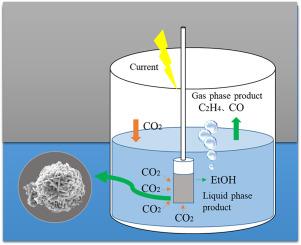
电催化CO₂还原反应(CO₂RR)为碳循环和高价值燃料合成提供了一条有前途的途径。然而,乙烯(c2h₄)是一种重要的多碳产物,其高效生产仍然受到催化剂活性和选择性不足的限制。虽然铜基材料可以实现C-C耦合,但传统的CuO催化剂存在CO中间吸附强度不平衡和电荷转移动力学缓慢的问题。在本研究中,采用二氧化硅(SiO₂)掺杂策略协同调节CuO的电子结构和表面活性位点分布,显著提高CO₂到c₂H₄的转化效率。实验结果表明,SiO₂的加入导致Cu 2 +周围的局部电子密度重排,稳定了*CO的吸附,而构建的Cu- o - si界面加速了电荷转移,增强了电子转移,降低了*COCHO形成的能垒。优化后的SiO₂-10%/CuO催化剂在−1.4 V(相对于RHE)下的C₂H₄法拉第效率为42%,偏电流密度为6.3 mA/cm²,比原始CuO提高了三倍。值得注意的是,该催化剂在4小时内表现出优异的稳定性。结构表征和理论计算表明,SiO₂掺杂促进CuO纳米片自组装成具有高比表面积的花状结构,并暴露出协同(111)/(002)面,共同增强了*CO中间体富集和定向耦合。这项工作为通过多维调制策略设计高性能CO₂RR催化剂提供了新的见解。
CuO doping SiO2 for enhancing electron transfer to product C2H4 in electrocatalytic CO2 reduction
The electrocatalytic CO₂ reduction reaction (CO₂RR) offers a promising pathway for carbon cycling and high-value fuel synthesis. However, the efficient production of ethylene (C₂H₄), a critical multicarbon product, remains constrained by insufficient catalyst activity and selectivity. Although copper-based materials enable C–C coupling, conventional CuO catalysts suffer from imbalanced *CO intermediate adsorption strength and sluggish charge transfer kinetics.In this study, a silica (SiO₂) doping strategy was employed to synergistically modulate the electronic structure and surface active site distribution of CuO, significantly enhancing CO₂-to-C₂H₄ conversion efficiency. Experimental results demonstrate that SiO₂ incorporation induces local electronic density rearrangement around Cu²⁺, stabilizing *CO adsorption, while the constructed Cu-O-Si interfaces accelerate charge transfer, enhances electron transfer and reduce the energy barrier for *COCHO formation. The optimized SiO₂-10 %/CuO catalyst achieves a C₂H₄ Faraday efficiency of 42 % and a partial current density of 6.3 mA/cm² at −1.4 V (vs. RHE), representing a threefold improvement over pristine CuO. Notably, the catalyst exhibits exceptional stability over 4 hours.Structural characterization and theoretical calculations reveal that SiO₂ doping promotes the self-assembly of CuO nanosheets into flower-like architectures with a high specific surface area and exposes synergistic (111)/(002) facets, which collectively enhance *CO intermediate enrichment and directional coupling. This work provides novel insights into designing high-performance CO₂RR catalysts through multidimensional modulation strategies.
期刊介绍:
Electrochimica Acta is an international journal. It is intended for the publication of both original work and reviews in the field of electrochemistry. Electrochemistry should be interpreted to mean any of the research fields covered by the Divisions of the International Society of Electrochemistry listed below, as well as emerging scientific domains covered by ISE New Topics Committee.





 京公网安备 11010802042870号
京ICP备2023020795号-1
京公网安备 11010802042870号
京ICP备2023020795号-1

 分享
分享
 求助内容:
求助内容: 应助结果提醒方式:
 扫码关注我们
