Mayowa Oyebanji, Xuejiao Yang, Ling Chen, Wencai Sun, Ruru Qian, Haizhu Yu and Manzhou Zhu
{"title":"多功能铜-谷胱甘肽簇具有优异的对硝基苯酚降解和辣根过氧化物酶样活性†","authors":"Mayowa Oyebanji, Xuejiao Yang, Ling Chen, Wencai Sun, Ruru Qian, Haizhu Yu and Manzhou Zhu","doi":"10.1039/D5RA00897B","DOIUrl":null,"url":null,"abstract":"<p >Copper nanoclusters (Cu NCs) are emerging as highly promising nanomaterials due to their unique physicochemical properties, making them an ideal platform for catalysis, sensing, and environmental remediation. This study explores the development of ultrasmall, water-soluble copper–glutathione (Cu–SG) nanoclusters, focusing on their catalytic capacity for the degradation of <em>p</em>-nitrophenol (<em>p</em>-NP), horseradish peroxidase (HRP)-like activity, and hydrogen peroxide (H<small><sub>2</sub></small>O<small><sub>2</sub></small>) detection. During synthesis, a combination of one-pot synthesis and acid-etching strategy was employed. The acid-etching approach was specifically utilized as an essential method to precisely regulate the structural properties of the clusters. The water-soluble ultrasmall Cu–SG nanoclusters show superior catalytic efficiency, achieving 98% conversion of <em>p</em>-NP to <em>p</em>-aminophenol (<em>p</em>-AP) within six minutes. The reaction followed first-order kinetics with a rate constant of 0.44 min<small><sup>−1</sup></small>, consistent with the Langmuir–Hinshelwood model. Notably, the Cu–SG retained catalytic efficiency across multiple reaction cycles, highlighting their recyclability and long-term stability. Additionally, Cu–SG exhibited excellent sensitivity and selectivity for rapid colorimetric H<small><sub>2</sub></small>O<small><sub>2</sub></small> detection due to the strong HRP-like activity, achieving a detection limit of 6.03 μM with high resistance to interference from other ions and compounds. Thermodynamic analysis demonstrates an enthalpy driven spontaneous reduction of <em>p</em>-NP with Cu–SG, wherein the van der Waals and hydrogen bonding interactions are predominant. By contrast, the interaction of Cu–SG with H<small><sub>2</sub></small>O<small><sub>2</sub></small> is an entropy-driven, spontaneous process, and the dominating hydrophobic forces drive the HRP-like catalytic mechanism. This study demonstrates the potential of the Cu–SG as an efficient, stable, and recyclable water-soluble copper nanocatalyst for pollutant degradation and as a sensitive sensor for reactive species.</p>","PeriodicalId":102,"journal":{"name":"RSC Advances","volume":" 12","pages":" 8889-8900"},"PeriodicalIF":4.6000,"publicationDate":"2025-03-24","publicationTypes":"Journal Article","fieldsOfStudy":null,"isOpenAccess":false,"openAccessPdf":"https://pubs.rsc.org/en/content/articlepdf/2025/ra/d5ra00897b?page=search","citationCount":"0","resultStr":"{\"title\":\"Multifunctional copper–glutathione clusters with superior p-nitrophenol degradation and horseradish peroxidase-like activity†\",\"authors\":\"Mayowa Oyebanji, Xuejiao Yang, Ling Chen, Wencai Sun, Ruru Qian, Haizhu Yu and Manzhou Zhu\",\"doi\":\"10.1039/D5RA00897B\",\"DOIUrl\":null,\"url\":null,\"abstract\":\"<p >Copper nanoclusters (Cu NCs) are emerging as highly promising nanomaterials due to their unique physicochemical properties, making them an ideal platform for catalysis, sensing, and environmental remediation. This study explores the development of ultrasmall, water-soluble copper–glutathione (Cu–SG) nanoclusters, focusing on their catalytic capacity for the degradation of <em>p</em>-nitrophenol (<em>p</em>-NP), horseradish peroxidase (HRP)-like activity, and hydrogen peroxide (H<small><sub>2</sub></small>O<small><sub>2</sub></small>) detection. During synthesis, a combination of one-pot synthesis and acid-etching strategy was employed. The acid-etching approach was specifically utilized as an essential method to precisely regulate the structural properties of the clusters. The water-soluble ultrasmall Cu–SG nanoclusters show superior catalytic efficiency, achieving 98% conversion of <em>p</em>-NP to <em>p</em>-aminophenol (<em>p</em>-AP) within six minutes. The reaction followed first-order kinetics with a rate constant of 0.44 min<small><sup>−1</sup></small>, consistent with the Langmuir–Hinshelwood model. Notably, the Cu–SG retained catalytic efficiency across multiple reaction cycles, highlighting their recyclability and long-term stability. Additionally, Cu–SG exhibited excellent sensitivity and selectivity for rapid colorimetric H<small><sub>2</sub></small>O<small><sub>2</sub></small> detection due to the strong HRP-like activity, achieving a detection limit of 6.03 μM with high resistance to interference from other ions and compounds. Thermodynamic analysis demonstrates an enthalpy driven spontaneous reduction of <em>p</em>-NP with Cu–SG, wherein the van der Waals and hydrogen bonding interactions are predominant. By contrast, the interaction of Cu–SG with H<small><sub>2</sub></small>O<small><sub>2</sub></small> is an entropy-driven, spontaneous process, and the dominating hydrophobic forces drive the HRP-like catalytic mechanism. This study demonstrates the potential of the Cu–SG as an efficient, stable, and recyclable water-soluble copper nanocatalyst for pollutant degradation and as a sensitive sensor for reactive species.</p>\",\"PeriodicalId\":102,\"journal\":{\"name\":\"RSC Advances\",\"volume\":\" 12\",\"pages\":\" 8889-8900\"},\"PeriodicalIF\":4.6000,\"publicationDate\":\"2025-03-24\",\"publicationTypes\":\"Journal Article\",\"fieldsOfStudy\":null,\"isOpenAccess\":false,\"openAccessPdf\":\"https://pubs.rsc.org/en/content/articlepdf/2025/ra/d5ra00897b?page=search\",\"citationCount\":\"0\",\"resultStr\":null,\"platform\":\"Semanticscholar\",\"paperid\":null,\"PeriodicalName\":\"RSC Advances\",\"FirstCategoryId\":\"92\",\"ListUrlMain\":\"https://pubs.rsc.org/en/content/articlelanding/2025/ra/d5ra00897b\",\"RegionNum\":3,\"RegionCategory\":\"化学\",\"ArticlePicture\":[],\"TitleCN\":null,\"AbstractTextCN\":null,\"PMCID\":null,\"EPubDate\":\"\",\"PubModel\":\"\",\"JCR\":\"Q2\",\"JCRName\":\"CHEMISTRY, MULTIDISCIPLINARY\",\"Score\":null,\"Total\":0}","platform":"Semanticscholar","paperid":null,"PeriodicalName":"RSC Advances","FirstCategoryId":"92","ListUrlMain":"https://pubs.rsc.org/en/content/articlelanding/2025/ra/d5ra00897b","RegionNum":3,"RegionCategory":"化学","ArticlePicture":[],"TitleCN":null,"AbstractTextCN":null,"PMCID":null,"EPubDate":"","PubModel":"","JCR":"Q2","JCRName":"CHEMISTRY, MULTIDISCIPLINARY","Score":null,"Total":0}
Multifunctional copper–glutathione clusters with superior p-nitrophenol degradation and horseradish peroxidase-like activity†
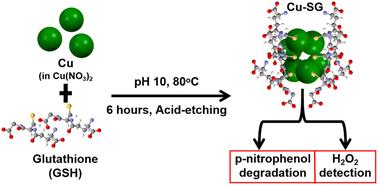
Copper nanoclusters (Cu NCs) are emerging as highly promising nanomaterials due to their unique physicochemical properties, making them an ideal platform for catalysis, sensing, and environmental remediation. This study explores the development of ultrasmall, water-soluble copper–glutathione (Cu–SG) nanoclusters, focusing on their catalytic capacity for the degradation of p-nitrophenol (p-NP), horseradish peroxidase (HRP)-like activity, and hydrogen peroxide (H2O2) detection. During synthesis, a combination of one-pot synthesis and acid-etching strategy was employed. The acid-etching approach was specifically utilized as an essential method to precisely regulate the structural properties of the clusters. The water-soluble ultrasmall Cu–SG nanoclusters show superior catalytic efficiency, achieving 98% conversion of p-NP to p-aminophenol (p-AP) within six minutes. The reaction followed first-order kinetics with a rate constant of 0.44 min−1, consistent with the Langmuir–Hinshelwood model. Notably, the Cu–SG retained catalytic efficiency across multiple reaction cycles, highlighting their recyclability and long-term stability. Additionally, Cu–SG exhibited excellent sensitivity and selectivity for rapid colorimetric H2O2 detection due to the strong HRP-like activity, achieving a detection limit of 6.03 μM with high resistance to interference from other ions and compounds. Thermodynamic analysis demonstrates an enthalpy driven spontaneous reduction of p-NP with Cu–SG, wherein the van der Waals and hydrogen bonding interactions are predominant. By contrast, the interaction of Cu–SG with H2O2 is an entropy-driven, spontaneous process, and the dominating hydrophobic forces drive the HRP-like catalytic mechanism. This study demonstrates the potential of the Cu–SG as an efficient, stable, and recyclable water-soluble copper nanocatalyst for pollutant degradation and as a sensitive sensor for reactive species.
期刊介绍:
An international, peer-reviewed journal covering all of the chemical sciences, including multidisciplinary and emerging areas. RSC Advances is a gold open access journal allowing researchers free access to research articles, and offering an affordable open access publishing option for authors around the world.




 京公网安备 11010802042870号
京ICP备2023020795号-1
京公网安备 11010802042870号
京ICP备2023020795号-1

 分享
分享
 求助内容:
求助内容: 应助结果提醒方式:
 扫码关注我们
