Chubin Huang, Abhishek Rakshit, Gianluca Janka, Zaher Salman, Andreas Suter, Thomas Prokscha, Benjamin A. Frandsen, Yoav Kalcheim
{"title":"V2O3结构相变的磁性前驱体","authors":"Chubin Huang, Abhishek Rakshit, Gianluca Janka, Zaher Salman, Andreas Suter, Thomas Prokscha, Benjamin A. Frandsen, Yoav Kalcheim","doi":"10.1002/aelm.202500028","DOIUrl":null,"url":null,"abstract":"<p>The coupling between structural, electronic and magnetic degrees of freedom across the metal-insulator transition in V<sub>2</sub>O<sub>3</sub> makes it hard to determine the main driving mechanism behind the transition. Specifically, the role of magnetism is debated and its interplay with the other transitions has not been established. To address this issue, this work uses a combination of muon spin relaxation/rotation, electrical transport and reciprocal space mapping which allows to correlate magnetic, electronic and structural degrees of freedom in strain-engineered V<sub>2</sub>O<sub>3</sub> thin films. Evidence is found for a magnetic instability in the vicinity of the structural transition. This is manifested as a decrease in the antiferromagnetic moment in proximity to the structural and electronic transitions. Moreover, this work finds evidence for an onset of antiferromagnetic (AF) fluctuations in the rhombohedral phase even without a structural transition to the monoclinic phase. In samples where the transition is most strongly suppressed by strain, a depth-dependent magnetic state is observed. These results reveal the importance of an AF instability in the paramagnetic phase in triggering the metal-insulator transition and the crucial role of the structural transition in allowing for the formation of an ordered AF state.</p>","PeriodicalId":110,"journal":{"name":"Advanced Electronic Materials","volume":"11 12","pages":""},"PeriodicalIF":5.3000,"publicationDate":"2025-03-24","publicationTypes":"Journal Article","fieldsOfStudy":null,"isOpenAccess":false,"openAccessPdf":"https://onlinelibrary.wiley.com/doi/epdf/10.1002/aelm.202500028","citationCount":"0","resultStr":"{\"title\":\"Magnetic Precursor to the Structural Phase Transition in V2O3\",\"authors\":\"Chubin Huang, Abhishek Rakshit, Gianluca Janka, Zaher Salman, Andreas Suter, Thomas Prokscha, Benjamin A. Frandsen, Yoav Kalcheim\",\"doi\":\"10.1002/aelm.202500028\",\"DOIUrl\":null,\"url\":null,\"abstract\":\"<p>The coupling between structural, electronic and magnetic degrees of freedom across the metal-insulator transition in V<sub>2</sub>O<sub>3</sub> makes it hard to determine the main driving mechanism behind the transition. Specifically, the role of magnetism is debated and its interplay with the other transitions has not been established. To address this issue, this work uses a combination of muon spin relaxation/rotation, electrical transport and reciprocal space mapping which allows to correlate magnetic, electronic and structural degrees of freedom in strain-engineered V<sub>2</sub>O<sub>3</sub> thin films. Evidence is found for a magnetic instability in the vicinity of the structural transition. This is manifested as a decrease in the antiferromagnetic moment in proximity to the structural and electronic transitions. Moreover, this work finds evidence for an onset of antiferromagnetic (AF) fluctuations in the rhombohedral phase even without a structural transition to the monoclinic phase. In samples where the transition is most strongly suppressed by strain, a depth-dependent magnetic state is observed. These results reveal the importance of an AF instability in the paramagnetic phase in triggering the metal-insulator transition and the crucial role of the structural transition in allowing for the formation of an ordered AF state.</p>\",\"PeriodicalId\":110,\"journal\":{\"name\":\"Advanced Electronic Materials\",\"volume\":\"11 12\",\"pages\":\"\"},\"PeriodicalIF\":5.3000,\"publicationDate\":\"2025-03-24\",\"publicationTypes\":\"Journal Article\",\"fieldsOfStudy\":null,\"isOpenAccess\":false,\"openAccessPdf\":\"https://onlinelibrary.wiley.com/doi/epdf/10.1002/aelm.202500028\",\"citationCount\":\"0\",\"resultStr\":null,\"platform\":\"Semanticscholar\",\"paperid\":null,\"PeriodicalName\":\"Advanced Electronic Materials\",\"FirstCategoryId\":\"88\",\"ListUrlMain\":\"https://advanced.onlinelibrary.wiley.com/doi/10.1002/aelm.202500028\",\"RegionNum\":2,\"RegionCategory\":\"材料科学\",\"ArticlePicture\":[],\"TitleCN\":null,\"AbstractTextCN\":null,\"PMCID\":null,\"EPubDate\":\"\",\"PubModel\":\"\",\"JCR\":\"Q2\",\"JCRName\":\"MATERIALS SCIENCE, MULTIDISCIPLINARY\",\"Score\":null,\"Total\":0}","platform":"Semanticscholar","paperid":null,"PeriodicalName":"Advanced Electronic Materials","FirstCategoryId":"88","ListUrlMain":"https://advanced.onlinelibrary.wiley.com/doi/10.1002/aelm.202500028","RegionNum":2,"RegionCategory":"材料科学","ArticlePicture":[],"TitleCN":null,"AbstractTextCN":null,"PMCID":null,"EPubDate":"","PubModel":"","JCR":"Q2","JCRName":"MATERIALS SCIENCE, MULTIDISCIPLINARY","Score":null,"Total":0}
Magnetic Precursor to the Structural Phase Transition in V2O3
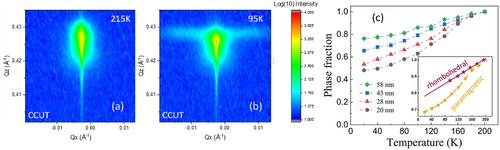
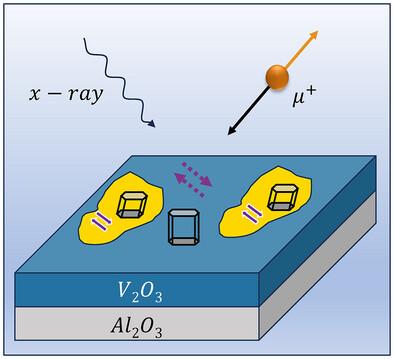
The coupling between structural, electronic and magnetic degrees of freedom across the metal-insulator transition in V2O3 makes it hard to determine the main driving mechanism behind the transition. Specifically, the role of magnetism is debated and its interplay with the other transitions has not been established. To address this issue, this work uses a combination of muon spin relaxation/rotation, electrical transport and reciprocal space mapping which allows to correlate magnetic, electronic and structural degrees of freedom in strain-engineered V2O3 thin films. Evidence is found for a magnetic instability in the vicinity of the structural transition. This is manifested as a decrease in the antiferromagnetic moment in proximity to the structural and electronic transitions. Moreover, this work finds evidence for an onset of antiferromagnetic (AF) fluctuations in the rhombohedral phase even without a structural transition to the monoclinic phase. In samples where the transition is most strongly suppressed by strain, a depth-dependent magnetic state is observed. These results reveal the importance of an AF instability in the paramagnetic phase in triggering the metal-insulator transition and the crucial role of the structural transition in allowing for the formation of an ordered AF state.
期刊介绍:
Advanced Electronic Materials is an interdisciplinary forum for peer-reviewed, high-quality, high-impact research in the fields of materials science, physics, and engineering of electronic and magnetic materials. It includes research on physics and physical properties of electronic and magnetic materials, spintronics, electronics, device physics and engineering, micro- and nano-electromechanical systems, and organic electronics, in addition to fundamental research.





 京公网安备 11010802042870号
京ICP备2023020795号-1
京公网安备 11010802042870号
京ICP备2023020795号-1

 分享
分享
 求助内容:
求助内容: 应助结果提醒方式:
 扫码关注我们
