Ruihao Zhu, Jáchym Jarkulisch, Maarten A.I. Schutyser, Remko M. Boom, Lu Zhang
{"title":"设计3d打印小麦淀粉冷冻箱:几何形状对机械性能的影响","authors":"Ruihao Zhu, Jáchym Jarkulisch, Maarten A.I. Schutyser, Remko M. Boom, Lu Zhang","doi":"10.1016/j.ifset.2025.104003","DOIUrl":null,"url":null,"abstract":"<div><div>Cryogels, porous materials obtained by freeze-drying, are used for various food and biomedical applications due to their interesting material properties. The fracture behaviour of 3D-printed cryogel designs as function of structural parameters such as the infill pattern and the number of outer perimeters, was evaluated by performing uniaxial compression with digital image correlation (DIC) analyses. Both structural parameters influence the mechanical performance of the cryogels, with the infill pattern being the dominant factor. A triangular infill pattern with two outer perimeters gave the highest specific modulus, while a rectilinear infill pattern gave the highest energy absorption capacity. Compression tests revealed that a thinner outer wall gave more ductility. To demonstrate potential applications of 3D-printed wheat starch cryogels, we designed and assembled a partially edible glider which showed gliding stability. Our research shows that edible macroporous structures with tuneable mechanical properties can be manufactured by varying the geometrical design through 3D printing. These structures can potentially replace non-edible materials for various applications.</div></div>","PeriodicalId":329,"journal":{"name":"Innovative Food Science & Emerging Technologies","volume":"102 ","pages":"Article 104003"},"PeriodicalIF":6.8000,"publicationDate":"2025-06-01","publicationTypes":"Journal Article","fieldsOfStudy":null,"isOpenAccess":false,"openAccessPdf":"","citationCount":"0","resultStr":"{\"title\":\"Designing 3D-printed wheat starch cryogels: Effect of geometry on mechanical performance\",\"authors\":\"Ruihao Zhu, Jáchym Jarkulisch, Maarten A.I. Schutyser, Remko M. Boom, Lu Zhang\",\"doi\":\"10.1016/j.ifset.2025.104003\",\"DOIUrl\":null,\"url\":null,\"abstract\":\"<div><div>Cryogels, porous materials obtained by freeze-drying, are used for various food and biomedical applications due to their interesting material properties. The fracture behaviour of 3D-printed cryogel designs as function of structural parameters such as the infill pattern and the number of outer perimeters, was evaluated by performing uniaxial compression with digital image correlation (DIC) analyses. Both structural parameters influence the mechanical performance of the cryogels, with the infill pattern being the dominant factor. A triangular infill pattern with two outer perimeters gave the highest specific modulus, while a rectilinear infill pattern gave the highest energy absorption capacity. Compression tests revealed that a thinner outer wall gave more ductility. To demonstrate potential applications of 3D-printed wheat starch cryogels, we designed and assembled a partially edible glider which showed gliding stability. Our research shows that edible macroporous structures with tuneable mechanical properties can be manufactured by varying the geometrical design through 3D printing. These structures can potentially replace non-edible materials for various applications.</div></div>\",\"PeriodicalId\":329,\"journal\":{\"name\":\"Innovative Food Science & Emerging Technologies\",\"volume\":\"102 \",\"pages\":\"Article 104003\"},\"PeriodicalIF\":6.8000,\"publicationDate\":\"2025-06-01\",\"publicationTypes\":\"Journal Article\",\"fieldsOfStudy\":null,\"isOpenAccess\":false,\"openAccessPdf\":\"\",\"citationCount\":\"0\",\"resultStr\":null,\"platform\":\"Semanticscholar\",\"paperid\":null,\"PeriodicalName\":\"Innovative Food Science & Emerging Technologies\",\"FirstCategoryId\":\"97\",\"ListUrlMain\":\"https://www.sciencedirect.com/science/article/pii/S1466856425000876\",\"RegionNum\":1,\"RegionCategory\":\"农林科学\",\"ArticlePicture\":[],\"TitleCN\":null,\"AbstractTextCN\":null,\"PMCID\":null,\"EPubDate\":\"2025/3/14 0:00:00\",\"PubModel\":\"Epub\",\"JCR\":\"Q1\",\"JCRName\":\"FOOD SCIENCE & TECHNOLOGY\",\"Score\":null,\"Total\":0}","platform":"Semanticscholar","paperid":null,"PeriodicalName":"Innovative Food Science & Emerging Technologies","FirstCategoryId":"97","ListUrlMain":"https://www.sciencedirect.com/science/article/pii/S1466856425000876","RegionNum":1,"RegionCategory":"农林科学","ArticlePicture":[],"TitleCN":null,"AbstractTextCN":null,"PMCID":null,"EPubDate":"2025/3/14 0:00:00","PubModel":"Epub","JCR":"Q1","JCRName":"FOOD SCIENCE & TECHNOLOGY","Score":null,"Total":0}
Designing 3D-printed wheat starch cryogels: Effect of geometry on mechanical performance
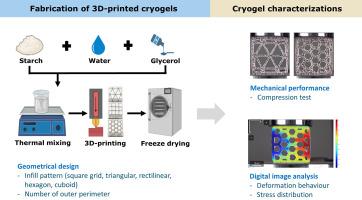
Cryogels, porous materials obtained by freeze-drying, are used for various food and biomedical applications due to their interesting material properties. The fracture behaviour of 3D-printed cryogel designs as function of structural parameters such as the infill pattern and the number of outer perimeters, was evaluated by performing uniaxial compression with digital image correlation (DIC) analyses. Both structural parameters influence the mechanical performance of the cryogels, with the infill pattern being the dominant factor. A triangular infill pattern with two outer perimeters gave the highest specific modulus, while a rectilinear infill pattern gave the highest energy absorption capacity. Compression tests revealed that a thinner outer wall gave more ductility. To demonstrate potential applications of 3D-printed wheat starch cryogels, we designed and assembled a partially edible glider which showed gliding stability. Our research shows that edible macroporous structures with tuneable mechanical properties can be manufactured by varying the geometrical design through 3D printing. These structures can potentially replace non-edible materials for various applications.
期刊介绍:
Innovative Food Science and Emerging Technologies (IFSET) aims to provide the highest quality original contributions and few, mainly upon invitation, reviews on and highly innovative developments in food science and emerging food process technologies. The significance of the results either for the science community or for industrial R&D groups must be specified. Papers submitted must be of highest scientific quality and only those advancing current scientific knowledge and understanding or with technical relevance will be considered.




 京公网安备 11010802042870号
京ICP备2023020795号-1
京公网安备 11010802042870号
京ICP备2023020795号-1

 分享
分享
 求助内容:
求助内容: 应助结果提醒方式:
 扫码关注我们
