Xixi Lai , Yili Zhao , Zhiyuan Shi , Lingxi Xing , Xin Li , Liang Jia , Kuailu Lin
{"title":"植物源性负载紫杉醇的超小Fe₃O₄纳米颗粒用于MR成像介导的抗肿瘤治疗","authors":"Xixi Lai , Yili Zhao , Zhiyuan Shi , Lingxi Xing , Xin Li , Liang Jia , Kuailu Lin","doi":"10.1016/j.indcrop.2025.120902","DOIUrl":null,"url":null,"abstract":"<div><div>Precise tumor imaging and effective drug delivery remain significant challenges in cancer therapy. To address these challenges, a novel drug delivery system, Us-Fe NPs/PLA-PEG@PTX, was developed for combined MR imaging and anti-tumor therapy. Ultra-small Fe<sub>3</sub>O<sub>4</sub> nanoparticles (Us-Fe NPs) were stabilized with citrate and modified with polylactic acid-polyethylene glycol (PLA-PEG) polymers to enhance biocompatibility and facilitate paclitaxel (PTX) incorporation. PTX was initially extracted from the bark of the Pacific yew tree. The system achieved an encapsulation efficiency of 72.3 % and a loading content of 6.74 %. PTX was released in a controlled manner at both neutral (pH 7.4) and mildly acidic (pH 5.5) conditions. MR imaging studies indicated potential for T1-weighted imaging. Us-Fe NPs/PLA-PEG@PTX demonstrated dose-dependent cytotoxicity (IC<sub>50</sub> = 0.06 μg/mL) against MDA-MB-231 cells. PEG modification reduced cellular uptake. Flow cytometry showed G2/M phase arrest and apoptosis induction, and confocal microscopy revealed microtubule disruption. These results suggest that Us-Fe NPs/PLA-PEG@PTX is a promising nano-platform for MR imaging-guided anti-tumor therapy.</div></div>","PeriodicalId":13581,"journal":{"name":"Industrial Crops and Products","volume":"228 ","pages":"Article 120902"},"PeriodicalIF":6.2000,"publicationDate":"2025-06-01","publicationTypes":"Journal Article","fieldsOfStudy":null,"isOpenAccess":false,"openAccessPdf":"","citationCount":"0","resultStr":"{\"title\":\"Plant-derived paclitaxel-loaded ultra-small Fe₃O₄ nanoparticles for MR imaging-mediated antitumor therapy\",\"authors\":\"Xixi Lai , Yili Zhao , Zhiyuan Shi , Lingxi Xing , Xin Li , Liang Jia , Kuailu Lin\",\"doi\":\"10.1016/j.indcrop.2025.120902\",\"DOIUrl\":null,\"url\":null,\"abstract\":\"<div><div>Precise tumor imaging and effective drug delivery remain significant challenges in cancer therapy. To address these challenges, a novel drug delivery system, Us-Fe NPs/PLA-PEG@PTX, was developed for combined MR imaging and anti-tumor therapy. Ultra-small Fe<sub>3</sub>O<sub>4</sub> nanoparticles (Us-Fe NPs) were stabilized with citrate and modified with polylactic acid-polyethylene glycol (PLA-PEG) polymers to enhance biocompatibility and facilitate paclitaxel (PTX) incorporation. PTX was initially extracted from the bark of the Pacific yew tree. The system achieved an encapsulation efficiency of 72.3 % and a loading content of 6.74 %. PTX was released in a controlled manner at both neutral (pH 7.4) and mildly acidic (pH 5.5) conditions. MR imaging studies indicated potential for T1-weighted imaging. Us-Fe NPs/PLA-PEG@PTX demonstrated dose-dependent cytotoxicity (IC<sub>50</sub> = 0.06 μg/mL) against MDA-MB-231 cells. PEG modification reduced cellular uptake. Flow cytometry showed G2/M phase arrest and apoptosis induction, and confocal microscopy revealed microtubule disruption. These results suggest that Us-Fe NPs/PLA-PEG@PTX is a promising nano-platform for MR imaging-guided anti-tumor therapy.</div></div>\",\"PeriodicalId\":13581,\"journal\":{\"name\":\"Industrial Crops and Products\",\"volume\":\"228 \",\"pages\":\"Article 120902\"},\"PeriodicalIF\":6.2000,\"publicationDate\":\"2025-06-01\",\"publicationTypes\":\"Journal Article\",\"fieldsOfStudy\":null,\"isOpenAccess\":false,\"openAccessPdf\":\"\",\"citationCount\":\"0\",\"resultStr\":null,\"platform\":\"Semanticscholar\",\"paperid\":null,\"PeriodicalName\":\"Industrial Crops and Products\",\"FirstCategoryId\":\"97\",\"ListUrlMain\":\"https://www.sciencedirect.com/science/article/pii/S0926669025004480\",\"RegionNum\":1,\"RegionCategory\":\"农林科学\",\"ArticlePicture\":[],\"TitleCN\":null,\"AbstractTextCN\":null,\"PMCID\":null,\"EPubDate\":\"2025/3/24 0:00:00\",\"PubModel\":\"Epub\",\"JCR\":\"Q1\",\"JCRName\":\"AGRICULTURAL ENGINEERING\",\"Score\":null,\"Total\":0}","platform":"Semanticscholar","paperid":null,"PeriodicalName":"Industrial Crops and Products","FirstCategoryId":"97","ListUrlMain":"https://www.sciencedirect.com/science/article/pii/S0926669025004480","RegionNum":1,"RegionCategory":"农林科学","ArticlePicture":[],"TitleCN":null,"AbstractTextCN":null,"PMCID":null,"EPubDate":"2025/3/24 0:00:00","PubModel":"Epub","JCR":"Q1","JCRName":"AGRICULTURAL ENGINEERING","Score":null,"Total":0}
Plant-derived paclitaxel-loaded ultra-small Fe₃O₄ nanoparticles for MR imaging-mediated antitumor therapy
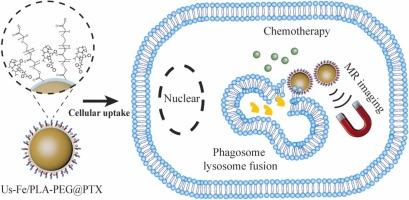
Precise tumor imaging and effective drug delivery remain significant challenges in cancer therapy. To address these challenges, a novel drug delivery system, Us-Fe NPs/PLA-PEG@PTX, was developed for combined MR imaging and anti-tumor therapy. Ultra-small Fe3O4 nanoparticles (Us-Fe NPs) were stabilized with citrate and modified with polylactic acid-polyethylene glycol (PLA-PEG) polymers to enhance biocompatibility and facilitate paclitaxel (PTX) incorporation. PTX was initially extracted from the bark of the Pacific yew tree. The system achieved an encapsulation efficiency of 72.3 % and a loading content of 6.74 %. PTX was released in a controlled manner at both neutral (pH 7.4) and mildly acidic (pH 5.5) conditions. MR imaging studies indicated potential for T1-weighted imaging. Us-Fe NPs/PLA-PEG@PTX demonstrated dose-dependent cytotoxicity (IC50 = 0.06 μg/mL) against MDA-MB-231 cells. PEG modification reduced cellular uptake. Flow cytometry showed G2/M phase arrest and apoptosis induction, and confocal microscopy revealed microtubule disruption. These results suggest that Us-Fe NPs/PLA-PEG@PTX is a promising nano-platform for MR imaging-guided anti-tumor therapy.
期刊介绍:
Industrial Crops and Products is an International Journal publishing academic and industrial research on industrial (defined as non-food/non-feed) crops and products. Papers concern both crop-oriented and bio-based materials from crops-oriented research, and should be of interest to an international audience, hypothesis driven, and where comparisons are made statistics performed.




 京公网安备 11010802042870号
京ICP备2023020795号-1
京公网安备 11010802042870号
京ICP备2023020795号-1

 分享
分享
 求助内容:
求助内容: 应助结果提醒方式:
 扫码关注我们
