{"title":"可变拉伸刚度气动执行器,软齿结构的粘滑摩擦可调","authors":"Yaqing Feng , Pengyuan Wang , Chenghao Wu","doi":"10.1016/j.matdes.2025.113860","DOIUrl":null,"url":null,"abstract":"<div><div>Patients with hemiplegia, neurologic injuries, and sports trauma require muscle strength rehabilitation training, the existing rigid equipment is uncomfortable and bulky, and wearable training devices are not suitable for the whole-stage of passive, assistant, active and resistance rehabilitation training, and are difficult to provide comprehensive and real-time feedback on the current rehabilitation level. This paper proposes a multi-layer cylindric soft actuator with axial tensile stiffness variation, and pneumatic control is utilized to achieve axial elongation and resistance adjustment. The resistance is changed through the stick–slip friction of soft structure during tooth structures engagement and sliding, and the tensile stiffness of the soft actuator can be changed by 7.2 times with air pressure increased by only 20 kPa. Capacitive strain sensing is used to obtain elongation and stiffness feedback, and the closed-loop control errors for axial elongation and stiffness variation are only 2.02 % and 1.20 %, respectively. Finally, an application of elbow joint rehabilitation training demonstrates that the proposed variable stiffness actuator is feasible for whole-stage training and providing feedback on joint angle amplitude and strength.</div></div>","PeriodicalId":383,"journal":{"name":"Materials & Design","volume":"253 ","pages":"Article 113860"},"PeriodicalIF":8.2000,"publicationDate":"2025-05-01","publicationTypes":"Journal Article","fieldsOfStudy":null,"isOpenAccess":false,"openAccessPdf":"","citationCount":"0","resultStr":"{\"title\":\"Variable tensile stiffness pneumatic actuators with adjustable stick-slip friction of soft-tooth structures\",\"authors\":\"Yaqing Feng , Pengyuan Wang , Chenghao Wu\",\"doi\":\"10.1016/j.matdes.2025.113860\",\"DOIUrl\":null,\"url\":null,\"abstract\":\"<div><div>Patients with hemiplegia, neurologic injuries, and sports trauma require muscle strength rehabilitation training, the existing rigid equipment is uncomfortable and bulky, and wearable training devices are not suitable for the whole-stage of passive, assistant, active and resistance rehabilitation training, and are difficult to provide comprehensive and real-time feedback on the current rehabilitation level. This paper proposes a multi-layer cylindric soft actuator with axial tensile stiffness variation, and pneumatic control is utilized to achieve axial elongation and resistance adjustment. The resistance is changed through the stick–slip friction of soft structure during tooth structures engagement and sliding, and the tensile stiffness of the soft actuator can be changed by 7.2 times with air pressure increased by only 20 kPa. Capacitive strain sensing is used to obtain elongation and stiffness feedback, and the closed-loop control errors for axial elongation and stiffness variation are only 2.02 % and 1.20 %, respectively. Finally, an application of elbow joint rehabilitation training demonstrates that the proposed variable stiffness actuator is feasible for whole-stage training and providing feedback on joint angle amplitude and strength.</div></div>\",\"PeriodicalId\":383,\"journal\":{\"name\":\"Materials & Design\",\"volume\":\"253 \",\"pages\":\"Article 113860\"},\"PeriodicalIF\":8.2000,\"publicationDate\":\"2025-05-01\",\"publicationTypes\":\"Journal Article\",\"fieldsOfStudy\":null,\"isOpenAccess\":false,\"openAccessPdf\":\"\",\"citationCount\":\"0\",\"resultStr\":null,\"platform\":\"Semanticscholar\",\"paperid\":null,\"PeriodicalName\":\"Materials & Design\",\"FirstCategoryId\":\"88\",\"ListUrlMain\":\"https://www.sciencedirect.com/science/article/pii/S0264127525002801\",\"RegionNum\":2,\"RegionCategory\":\"材料科学\",\"ArticlePicture\":[],\"TitleCN\":null,\"AbstractTextCN\":null,\"PMCID\":null,\"EPubDate\":\"2025/3/21 0:00:00\",\"PubModel\":\"Epub\",\"JCR\":\"Q1\",\"JCRName\":\"MATERIALS SCIENCE, MULTIDISCIPLINARY\",\"Score\":null,\"Total\":0}","platform":"Semanticscholar","paperid":null,"PeriodicalName":"Materials & Design","FirstCategoryId":"88","ListUrlMain":"https://www.sciencedirect.com/science/article/pii/S0264127525002801","RegionNum":2,"RegionCategory":"材料科学","ArticlePicture":[],"TitleCN":null,"AbstractTextCN":null,"PMCID":null,"EPubDate":"2025/3/21 0:00:00","PubModel":"Epub","JCR":"Q1","JCRName":"MATERIALS SCIENCE, MULTIDISCIPLINARY","Score":null,"Total":0}
Variable tensile stiffness pneumatic actuators with adjustable stick-slip friction of soft-tooth structures
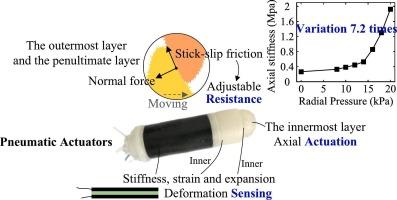
Patients with hemiplegia, neurologic injuries, and sports trauma require muscle strength rehabilitation training, the existing rigid equipment is uncomfortable and bulky, and wearable training devices are not suitable for the whole-stage of passive, assistant, active and resistance rehabilitation training, and are difficult to provide comprehensive and real-time feedback on the current rehabilitation level. This paper proposes a multi-layer cylindric soft actuator with axial tensile stiffness variation, and pneumatic control is utilized to achieve axial elongation and resistance adjustment. The resistance is changed through the stick–slip friction of soft structure during tooth structures engagement and sliding, and the tensile stiffness of the soft actuator can be changed by 7.2 times with air pressure increased by only 20 kPa. Capacitive strain sensing is used to obtain elongation and stiffness feedback, and the closed-loop control errors for axial elongation and stiffness variation are only 2.02 % and 1.20 %, respectively. Finally, an application of elbow joint rehabilitation training demonstrates that the proposed variable stiffness actuator is feasible for whole-stage training and providing feedback on joint angle amplitude and strength.
期刊介绍:
Materials and Design is a multi-disciplinary journal that publishes original research reports, review articles, and express communications. The journal focuses on studying the structure and properties of inorganic and organic materials, advancements in synthesis, processing, characterization, and testing, the design of materials and engineering systems, and their applications in technology. It aims to bring together various aspects of materials science, engineering, physics, and chemistry.
The journal explores themes ranging from materials to design and aims to reveal the connections between natural and artificial materials, as well as experiment and modeling. Manuscripts submitted to Materials and Design should contain elements of discovery and surprise, as they often contribute new insights into the architecture and function of matter.




 京公网安备 11010802042870号
京ICP备2023020795号-1
京公网安备 11010802042870号
京ICP备2023020795号-1

 分享
分享
 求助内容:
求助内容: 应助结果提醒方式:
 扫码关注我们
