{"title":"光驱动Eu2O3/CoNiZn-LDH@g-C3N4三元异质结纳米复合制氢光催化剂","authors":"Madappa C. Maridevaru , Faisal Al Marzouqi , Munnelli Nagaveni , Murikinati Mamatha Kumari , Muthukonda Venkatakrishnan Shankar , Rengaraj Selvaraj","doi":"10.1016/j.renene.2025.122917","DOIUrl":null,"url":null,"abstract":"<div><div>Photocatalytic H<sub>2</sub> generation is a prospective and ecologically suitable way of manufacturing green hydrogen (H<sub>2</sub>). However, finding the best semiconducting substances with considerable performance is not easy. Inspired by this problem, we suggest in this work the use of a simple impregnation method for the customized sunlight-activated configurable broad-band gap semiconductor by coupling graphitic carbon nitride (CN) with Eu<sub>2</sub>O<sub>3</sub>/CoNiZn-LDH (LDH). Herein demonstrated the LDH loading on g-C<sub>3</sub>N<sub>4</sub> surface impacted photocatalytic function by examining the hybrid ternary nanocomposites' microscopic, spectroscopic, and photophysical properties. Under sunlight, 60 wt% of Eu<sub>2</sub>O<sub>3</sub>/CoNiZn-LDH@g-C<sub>3</sub>N<sub>4</sub> (60-LDHCN) nanocomposite exhibited highest rate of H<sub>2</sub> production (168.5 μmol h<sup>−1</sup>g<sup>−1</sup><sub>cat</sub>) explained by both density of catalytic active sites and intimate interface between different components of the catalyst facilitated effective separation/utilization of photogenerated electron-hole pairs. This correspondingly led to a 4.7-fold and 3.2-fold increase in H<sub>2</sub> generating efficiency of compared to CN (36.2 μmol h<sup>−1</sup>g<sup>−1</sup><sub>cat</sub>) and LDH (51.25 μmol h<sup>−1</sup>g<sup>−1</sup><sub>cat</sub>). Evidently, the photocurrent concentration of the 60-LDHCN nanocomposite depicted around 14.3 and 6.1 times better photocurrent than that of CN and LDH, respectively. The essential component of Type-II heterojunctions' immediate interaction between the semiconductors promoted charge separation and enhanced the number of surface-active sites through the absorption of sunlight.</div></div>","PeriodicalId":419,"journal":{"name":"Renewable Energy","volume":"246 ","pages":"Article 122917"},"PeriodicalIF":9.1000,"publicationDate":"2025-06-15","publicationTypes":"Journal Article","fieldsOfStudy":null,"isOpenAccess":false,"openAccessPdf":"","citationCount":"0","resultStr":"{\"title\":\"Sunlight driven Eu2O3/CoNiZn-LDH@g-C3N4 ternary heterojunction nanocomposite photocatalyst for hydrogen generation\",\"authors\":\"Madappa C. Maridevaru , Faisal Al Marzouqi , Munnelli Nagaveni , Murikinati Mamatha Kumari , Muthukonda Venkatakrishnan Shankar , Rengaraj Selvaraj\",\"doi\":\"10.1016/j.renene.2025.122917\",\"DOIUrl\":null,\"url\":null,\"abstract\":\"<div><div>Photocatalytic H<sub>2</sub> generation is a prospective and ecologically suitable way of manufacturing green hydrogen (H<sub>2</sub>). However, finding the best semiconducting substances with considerable performance is not easy. Inspired by this problem, we suggest in this work the use of a simple impregnation method for the customized sunlight-activated configurable broad-band gap semiconductor by coupling graphitic carbon nitride (CN) with Eu<sub>2</sub>O<sub>3</sub>/CoNiZn-LDH (LDH). Herein demonstrated the LDH loading on g-C<sub>3</sub>N<sub>4</sub> surface impacted photocatalytic function by examining the hybrid ternary nanocomposites' microscopic, spectroscopic, and photophysical properties. Under sunlight, 60 wt% of Eu<sub>2</sub>O<sub>3</sub>/CoNiZn-LDH@g-C<sub>3</sub>N<sub>4</sub> (60-LDHCN) nanocomposite exhibited highest rate of H<sub>2</sub> production (168.5 μmol h<sup>−1</sup>g<sup>−1</sup><sub>cat</sub>) explained by both density of catalytic active sites and intimate interface between different components of the catalyst facilitated effective separation/utilization of photogenerated electron-hole pairs. This correspondingly led to a 4.7-fold and 3.2-fold increase in H<sub>2</sub> generating efficiency of compared to CN (36.2 μmol h<sup>−1</sup>g<sup>−1</sup><sub>cat</sub>) and LDH (51.25 μmol h<sup>−1</sup>g<sup>−1</sup><sub>cat</sub>). Evidently, the photocurrent concentration of the 60-LDHCN nanocomposite depicted around 14.3 and 6.1 times better photocurrent than that of CN and LDH, respectively. The essential component of Type-II heterojunctions' immediate interaction between the semiconductors promoted charge separation and enhanced the number of surface-active sites through the absorption of sunlight.</div></div>\",\"PeriodicalId\":419,\"journal\":{\"name\":\"Renewable Energy\",\"volume\":\"246 \",\"pages\":\"Article 122917\"},\"PeriodicalIF\":9.1000,\"publicationDate\":\"2025-06-15\",\"publicationTypes\":\"Journal Article\",\"fieldsOfStudy\":null,\"isOpenAccess\":false,\"openAccessPdf\":\"\",\"citationCount\":\"0\",\"resultStr\":null,\"platform\":\"Semanticscholar\",\"paperid\":null,\"PeriodicalName\":\"Renewable Energy\",\"FirstCategoryId\":\"5\",\"ListUrlMain\":\"https://www.sciencedirect.com/science/article/pii/S0960148125005798\",\"RegionNum\":1,\"RegionCategory\":\"工程技术\",\"ArticlePicture\":[],\"TitleCN\":null,\"AbstractTextCN\":null,\"PMCID\":null,\"EPubDate\":\"2025/3/21 0:00:00\",\"PubModel\":\"Epub\",\"JCR\":\"Q1\",\"JCRName\":\"ENERGY & FUELS\",\"Score\":null,\"Total\":0}","platform":"Semanticscholar","paperid":null,"PeriodicalName":"Renewable Energy","FirstCategoryId":"5","ListUrlMain":"https://www.sciencedirect.com/science/article/pii/S0960148125005798","RegionNum":1,"RegionCategory":"工程技术","ArticlePicture":[],"TitleCN":null,"AbstractTextCN":null,"PMCID":null,"EPubDate":"2025/3/21 0:00:00","PubModel":"Epub","JCR":"Q1","JCRName":"ENERGY & FUELS","Score":null,"Total":0}
Sunlight driven Eu2O3/CoNiZn-LDH@g-C3N4 ternary heterojunction nanocomposite photocatalyst for hydrogen generation
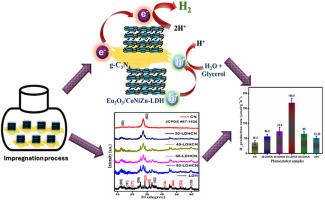
Photocatalytic H2 generation is a prospective and ecologically suitable way of manufacturing green hydrogen (H2). However, finding the best semiconducting substances with considerable performance is not easy. Inspired by this problem, we suggest in this work the use of a simple impregnation method for the customized sunlight-activated configurable broad-band gap semiconductor by coupling graphitic carbon nitride (CN) with Eu2O3/CoNiZn-LDH (LDH). Herein demonstrated the LDH loading on g-C3N4 surface impacted photocatalytic function by examining the hybrid ternary nanocomposites' microscopic, spectroscopic, and photophysical properties. Under sunlight, 60 wt% of Eu2O3/CoNiZn-LDH@g-C3N4 (60-LDHCN) nanocomposite exhibited highest rate of H2 production (168.5 μmol h−1g−1cat) explained by both density of catalytic active sites and intimate interface between different components of the catalyst facilitated effective separation/utilization of photogenerated electron-hole pairs. This correspondingly led to a 4.7-fold and 3.2-fold increase in H2 generating efficiency of compared to CN (36.2 μmol h−1g−1cat) and LDH (51.25 μmol h−1g−1cat). Evidently, the photocurrent concentration of the 60-LDHCN nanocomposite depicted around 14.3 and 6.1 times better photocurrent than that of CN and LDH, respectively. The essential component of Type-II heterojunctions' immediate interaction between the semiconductors promoted charge separation and enhanced the number of surface-active sites through the absorption of sunlight.
期刊介绍:
Renewable Energy journal is dedicated to advancing knowledge and disseminating insights on various topics and technologies within renewable energy systems and components. Our mission is to support researchers, engineers, economists, manufacturers, NGOs, associations, and societies in staying updated on new developments in their respective fields and applying alternative energy solutions to current practices.
As an international, multidisciplinary journal in renewable energy engineering and research, we strive to be a premier peer-reviewed platform and a trusted source of original research and reviews in the field of renewable energy. Join us in our endeavor to drive innovation and progress in sustainable energy solutions.




 京公网安备 11010802042870号
京ICP备2023020795号-1
京公网安备 11010802042870号
京ICP备2023020795号-1

 分享
分享
 求助内容:
求助内容: 应助结果提醒方式:
 扫码关注我们
