Jie Mao , Nan Ye , Zichun Wu , Ziyi Gong , Haiou Zhuo , Wentan Zhu , Jiancheng Tang
{"title":"采用喷雾造粒和冷等静压烧结制备高性能球形W-Cu复合粉末","authors":"Jie Mao , Nan Ye , Zichun Wu , Ziyi Gong , Haiou Zhuo , Wentan Zhu , Jiancheng Tang","doi":"10.1016/j.powtec.2025.120935","DOIUrl":null,"url":null,"abstract":"<div><div>Developing spherical W-Cu composite powders offers a promising solution for achieving additive manufacturing to prepare W-Cu composites with finer microstructures and superior properties. However, the melting point difference and poor wettability of W and Cu hinder traditional powder preparation methods. Spray drying with sintering densification provides an efficient, cost-effective, and eco-friendly approach to producing dense spherical powders for additive manufacturing. This study developed spherical W-Cu composite powders for additive manufacturing using WO<sub>3</sub> and CuO as raw materials. Initially, a spherical W-Cu precursor powder was synthesized from WO<sub>3</sub> and CuO via spray-drying granulation. The precursor powder was then subjected to a three-stage reduction procedure. Finally, high-performance powders were produced via cold isostatic pressing and high-temperature sintering with ultrafine WO<sub>3</sub> as the sintering barrier. The resulting powders exhibited high sphericity, good dispersion, high densification, and fine-grained microstructures with uniform elemental distribution, as well as excellent fluidity (11.6 s/50 g), high loose apparent density (7.65 g/cm<sup>3</sup>), and low oxygen content (225 ppm), rendering them ideal for additive manufacturing. Laser-directed energy deposition (L-DED)-fabricated parts exhibited outstanding properties, including high densification (relative density 96.2 %), excellent tensile strength (512.57 MPa), hardness (260.6 HV<sub>0.5</sub>), electrical conductivity (37.93 % IACS), and thermal conductivity (215.35 W/mK), comparable to the W-Cu parts produced using conventional processes. The proposed method offers a promising approach for the development of advanced materials tailored to AM technologies.</div></div>","PeriodicalId":407,"journal":{"name":"Powder Technology","volume":"457 ","pages":"Article 120935"},"PeriodicalIF":5.5000,"publicationDate":"2025-05-15","publicationTypes":"Journal Article","fieldsOfStudy":null,"isOpenAccess":false,"openAccessPdf":"","citationCount":"0","resultStr":"{\"title\":\"High-performance spherical W-Cu composite powders for additive manufacturing via spray granulation and cold isostatic pressure sintering\",\"authors\":\"Jie Mao , Nan Ye , Zichun Wu , Ziyi Gong , Haiou Zhuo , Wentan Zhu , Jiancheng Tang\",\"doi\":\"10.1016/j.powtec.2025.120935\",\"DOIUrl\":null,\"url\":null,\"abstract\":\"<div><div>Developing spherical W-Cu composite powders offers a promising solution for achieving additive manufacturing to prepare W-Cu composites with finer microstructures and superior properties. However, the melting point difference and poor wettability of W and Cu hinder traditional powder preparation methods. Spray drying with sintering densification provides an efficient, cost-effective, and eco-friendly approach to producing dense spherical powders for additive manufacturing. This study developed spherical W-Cu composite powders for additive manufacturing using WO<sub>3</sub> and CuO as raw materials. Initially, a spherical W-Cu precursor powder was synthesized from WO<sub>3</sub> and CuO via spray-drying granulation. The precursor powder was then subjected to a three-stage reduction procedure. Finally, high-performance powders were produced via cold isostatic pressing and high-temperature sintering with ultrafine WO<sub>3</sub> as the sintering barrier. The resulting powders exhibited high sphericity, good dispersion, high densification, and fine-grained microstructures with uniform elemental distribution, as well as excellent fluidity (11.6 s/50 g), high loose apparent density (7.65 g/cm<sup>3</sup>), and low oxygen content (225 ppm), rendering them ideal for additive manufacturing. Laser-directed energy deposition (L-DED)-fabricated parts exhibited outstanding properties, including high densification (relative density 96.2 %), excellent tensile strength (512.57 MPa), hardness (260.6 HV<sub>0.5</sub>), electrical conductivity (37.93 % IACS), and thermal conductivity (215.35 W/mK), comparable to the W-Cu parts produced using conventional processes. The proposed method offers a promising approach for the development of advanced materials tailored to AM technologies.</div></div>\",\"PeriodicalId\":407,\"journal\":{\"name\":\"Powder Technology\",\"volume\":\"457 \",\"pages\":\"Article 120935\"},\"PeriodicalIF\":5.5000,\"publicationDate\":\"2025-05-15\",\"publicationTypes\":\"Journal Article\",\"fieldsOfStudy\":null,\"isOpenAccess\":false,\"openAccessPdf\":\"\",\"citationCount\":\"0\",\"resultStr\":null,\"platform\":\"Semanticscholar\",\"paperid\":null,\"PeriodicalName\":\"Powder Technology\",\"FirstCategoryId\":\"5\",\"ListUrlMain\":\"https://www.sciencedirect.com/science/article/pii/S0032591025003304\",\"RegionNum\":2,\"RegionCategory\":\"工程技术\",\"ArticlePicture\":[],\"TitleCN\":null,\"AbstractTextCN\":null,\"PMCID\":null,\"EPubDate\":\"2025/3/16 0:00:00\",\"PubModel\":\"Epub\",\"JCR\":\"Q2\",\"JCRName\":\"ENGINEERING, CHEMICAL\",\"Score\":null,\"Total\":0}","platform":"Semanticscholar","paperid":null,"PeriodicalName":"Powder Technology","FirstCategoryId":"5","ListUrlMain":"https://www.sciencedirect.com/science/article/pii/S0032591025003304","RegionNum":2,"RegionCategory":"工程技术","ArticlePicture":[],"TitleCN":null,"AbstractTextCN":null,"PMCID":null,"EPubDate":"2025/3/16 0:00:00","PubModel":"Epub","JCR":"Q2","JCRName":"ENGINEERING, CHEMICAL","Score":null,"Total":0}
High-performance spherical W-Cu composite powders for additive manufacturing via spray granulation and cold isostatic pressure sintering
Developing spherical W-Cu composite powders offers a promising solution for achieving additive manufacturing to prepare W-Cu composites with finer microstructures and superior properties. However, the melting point difference and poor wettability of W and Cu hinder traditional powder preparation methods. Spray drying with sintering densification provides an efficient, cost-effective, and eco-friendly approach to producing dense spherical powders for additive manufacturing. This study developed spherical W-Cu composite powders for additive manufacturing using WO3 and CuO as raw materials. Initially, a spherical W-Cu precursor powder was synthesized from WO3 and CuO via spray-drying granulation. The precursor powder was then subjected to a three-stage reduction procedure. Finally, high-performance powders were produced via cold isostatic pressing and high-temperature sintering with ultrafine WO3 as the sintering barrier. The resulting powders exhibited high sphericity, good dispersion, high densification, and fine-grained microstructures with uniform elemental distribution, as well as excellent fluidity (11.6 s/50 g), high loose apparent density (7.65 g/cm3), and low oxygen content (225 ppm), rendering them ideal for additive manufacturing. Laser-directed energy deposition (L-DED)-fabricated parts exhibited outstanding properties, including high densification (relative density 96.2 %), excellent tensile strength (512.57 MPa), hardness (260.6 HV0.5), electrical conductivity (37.93 % IACS), and thermal conductivity (215.35 W/mK), comparable to the W-Cu parts produced using conventional processes. The proposed method offers a promising approach for the development of advanced materials tailored to AM technologies.
期刊介绍:
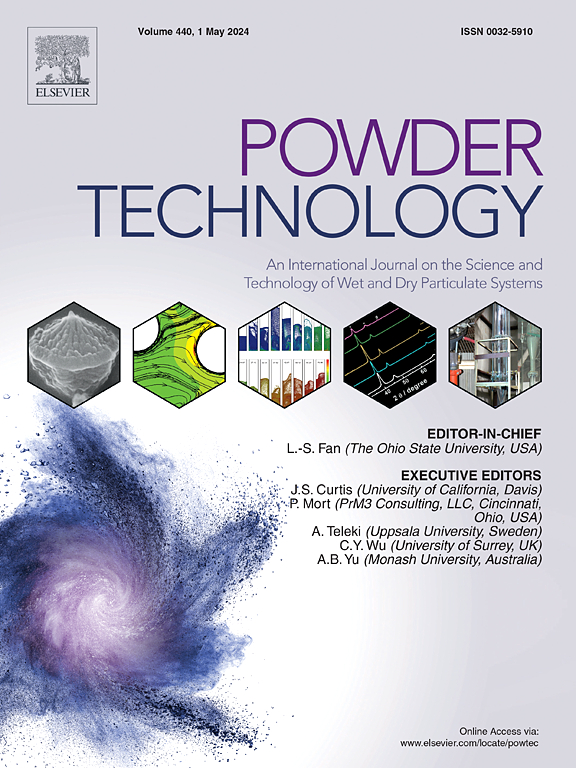
Powder Technology is an International Journal on the Science and Technology of Wet and Dry Particulate Systems. Powder Technology publishes papers on all aspects of the formation of particles and their characterisation and on the study of systems containing particulate solids. No limitation is imposed on the size of the particles, which may range from nanometre scale, as in pigments or aerosols, to that of mined or quarried materials. The following list of topics is not intended to be comprehensive, but rather to indicate typical subjects which fall within the scope of the journal's interests:
Formation and synthesis of particles by precipitation and other methods.
Modification of particles by agglomeration, coating, comminution and attrition.
Characterisation of the size, shape, surface area, pore structure and strength of particles and agglomerates (including the origins and effects of inter particle forces).
Packing, failure, flow and permeability of assemblies of particles.
Particle-particle interactions and suspension rheology.
Handling and processing operations such as slurry flow, fluidization, pneumatic conveying.
Interactions between particles and their environment, including delivery of particulate products to the body.
Applications of particle technology in production of pharmaceuticals, chemicals, foods, pigments, structural, and functional materials and in environmental and energy related matters.
For materials-oriented contributions we are looking for articles revealing the effect of particle/powder characteristics (size, morphology and composition, in that order) on material performance or functionality and, ideally, comparison to any industrial standard.





 京公网安备 11010802042870号
京ICP备2023020795号-1
京公网安备 11010802042870号
京ICP备2023020795号-1

 分享
分享
 求助内容:
求助内容: 应助结果提醒方式:
 扫码关注我们
