Qinrui Ye, Wei Song, Yongqi Bai, Zhenyu Chen, Pengfei Ding, Jinfeng Ge, Yuanyuan Meng, Bin Han, Xin Zhou and Ziyi Ge
{"title":"柔性连接体在大分子受体中的蝴蝶效应:优化结晶和聚集以提高二元有机太阳能电池的机械耐久性和接近19%的效率","authors":"Qinrui Ye, Wei Song, Yongqi Bai, Zhenyu Chen, Pengfei Ding, Jinfeng Ge, Yuanyuan Meng, Bin Han, Xin Zhou and Ziyi Ge","doi":"10.1039/D4EE05456C","DOIUrl":null,"url":null,"abstract":"<p >Achieving a balance between power conversion efficiency (PCE) and mechanical robustness in flexible organic solar cells (OSCs) remains a significant challenge for small molecule acceptors (SMAs) and polymer acceptors. Here, we developed a series of flexible linker giant-molecule acceptors (GMAs), DSY-C4 to DSY-C10, by incorporating flexible linkers of varying lengths at side chain sites. The optimized DSY-C10-based device demonstrated both high efficiency (PCE = 18.89%) and exceptional mechanical resilience (crack-onset strain (COS) = 9.95%) in binary OSCs, representing a new benchmark for highly ductile acceptors. The linkage at side chain sites makes the molecules exhibit butterfly-like conformations and the flexible linker reduces spatial site resistance, significantly improving the crystallinity and aggregation of GMAs. As a result, the PM6:DSY-C10-based device exhibits superior short-circuit current density (<em>J</em><small><sub>SC</sub></small> = 27.51 mA cm<small><sup>−2</sup></small>) and fill factor (FF = 0.785) compared with the PM6:DSY-C4-based device (<em>J</em><small><sub>SC</sub></small> = 26.65 mA cm<small><sup>−2</sup></small> and FF = 0.728). Additionally, the longer flexible linker enhanced donor–acceptor interactions, leading to a 65% higher COS for the PM6:DSY-C10 blend film compared to PM6:DSY-C4 (COS = 6.04%), approaching the performance of a polymer acceptor (PT-IY). In addition, the incorporation of DSY-C10 into the PM6:BTP-eC9 binary blend achieved an efficiency of 19.91% (certified 19.39%), underscoring the potential of flexible linker GMAs for high-efficiency flexible OSCs. These results demonstrate that flexible linker GMAs provide an unprecedented balance of PCE and mechanical robustness in binary OSCs, paving the way for durable flexible OSCs.</p>","PeriodicalId":72,"journal":{"name":"Energy & Environmental Science","volume":" 9","pages":" 4373-4383"},"PeriodicalIF":30.8000,"publicationDate":"2025-03-25","publicationTypes":"Journal Article","fieldsOfStudy":null,"isOpenAccess":false,"openAccessPdf":"","citationCount":"0","resultStr":"{\"title\":\"The butterfly-effect of flexible linkers in giant-molecule acceptors: optimized crystallization and aggregation for enhancing mechanical durability and approaching 19% efficiency in binary organic solar cells†\",\"authors\":\"Qinrui Ye, Wei Song, Yongqi Bai, Zhenyu Chen, Pengfei Ding, Jinfeng Ge, Yuanyuan Meng, Bin Han, Xin Zhou and Ziyi Ge\",\"doi\":\"10.1039/D4EE05456C\",\"DOIUrl\":null,\"url\":null,\"abstract\":\"<p >Achieving a balance between power conversion efficiency (PCE) and mechanical robustness in flexible organic solar cells (OSCs) remains a significant challenge for small molecule acceptors (SMAs) and polymer acceptors. Here, we developed a series of flexible linker giant-molecule acceptors (GMAs), DSY-C4 to DSY-C10, by incorporating flexible linkers of varying lengths at side chain sites. The optimized DSY-C10-based device demonstrated both high efficiency (PCE = 18.89%) and exceptional mechanical resilience (crack-onset strain (COS) = 9.95%) in binary OSCs, representing a new benchmark for highly ductile acceptors. The linkage at side chain sites makes the molecules exhibit butterfly-like conformations and the flexible linker reduces spatial site resistance, significantly improving the crystallinity and aggregation of GMAs. As a result, the PM6:DSY-C10-based device exhibits superior short-circuit current density (<em>J</em><small><sub>SC</sub></small> = 27.51 mA cm<small><sup>−2</sup></small>) and fill factor (FF = 0.785) compared with the PM6:DSY-C4-based device (<em>J</em><small><sub>SC</sub></small> = 26.65 mA cm<small><sup>−2</sup></small> and FF = 0.728). Additionally, the longer flexible linker enhanced donor–acceptor interactions, leading to a 65% higher COS for the PM6:DSY-C10 blend film compared to PM6:DSY-C4 (COS = 6.04%), approaching the performance of a polymer acceptor (PT-IY). In addition, the incorporation of DSY-C10 into the PM6:BTP-eC9 binary blend achieved an efficiency of 19.91% (certified 19.39%), underscoring the potential of flexible linker GMAs for high-efficiency flexible OSCs. These results demonstrate that flexible linker GMAs provide an unprecedented balance of PCE and mechanical robustness in binary OSCs, paving the way for durable flexible OSCs.</p>\",\"PeriodicalId\":72,\"journal\":{\"name\":\"Energy & Environmental Science\",\"volume\":\" 9\",\"pages\":\" 4373-4383\"},\"PeriodicalIF\":30.8000,\"publicationDate\":\"2025-03-25\",\"publicationTypes\":\"Journal Article\",\"fieldsOfStudy\":null,\"isOpenAccess\":false,\"openAccessPdf\":\"\",\"citationCount\":\"0\",\"resultStr\":null,\"platform\":\"Semanticscholar\",\"paperid\":null,\"PeriodicalName\":\"Energy & Environmental Science\",\"FirstCategoryId\":\"88\",\"ListUrlMain\":\"https://pubs.rsc.org/en/content/articlelanding/2025/ee/d4ee05456c\",\"RegionNum\":1,\"RegionCategory\":\"材料科学\",\"ArticlePicture\":[],\"TitleCN\":null,\"AbstractTextCN\":null,\"PMCID\":null,\"EPubDate\":\"\",\"PubModel\":\"\",\"JCR\":\"Q1\",\"JCRName\":\"CHEMISTRY, MULTIDISCIPLINARY\",\"Score\":null,\"Total\":0}","platform":"Semanticscholar","paperid":null,"PeriodicalName":"Energy & Environmental Science","FirstCategoryId":"88","ListUrlMain":"https://pubs.rsc.org/en/content/articlelanding/2025/ee/d4ee05456c","RegionNum":1,"RegionCategory":"材料科学","ArticlePicture":[],"TitleCN":null,"AbstractTextCN":null,"PMCID":null,"EPubDate":"","PubModel":"","JCR":"Q1","JCRName":"CHEMISTRY, MULTIDISCIPLINARY","Score":null,"Total":0}
引用次数: 0
摘要
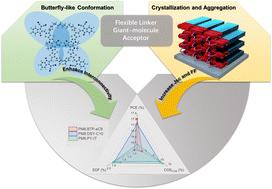
在柔性有机太阳能电池(OSCs)中实现功率转换效率(PCE)和机械稳健性之间的平衡仍然是小分子受体(SMA)和聚合物受体面临的重大挑战。在这里,我们开发了一系列柔性连接体大分子受体(gma), DSY-C4至DSY-C10,通过在侧链位点加入不同长度的柔性连接体。优化后的dsy - c10基器件在二元osc中表现出高效率(PCE=18.89%)和优异的机械弹性(裂纹开始应变(COS)=9.95%),代表了高延展性受体的新基准。侧链位点的连接使分子呈蝴蝶状构象,柔性连接体降低了空间位点阻力,显著提高了GMA的结晶度和聚集性。因此,基于PM6: dsy - c10的器件比基于PM6: dsy - c4的器件(JSC=26.65 mA cm-2, FF=0.728)具有更高的短路电流密度(JSC=27.51 mA cm-2)和填充因子(FF=0.785)。此外,更长的柔性连接体增强了供体-受体相互作用,导致PM6:DSY-C10共混膜的COS比PM6:DSY-C4高65% (COS=6.04%),接近聚合物受体(pt - y)的性能。此外,在PM6:BTP-eC9二元共混物中加入DSY-C10的效率达到19.91%(认证为19.39%),强调了柔性连接器gma用于高效柔性osc的潜力。这些结果表明,柔性连接器gma在二元osc中提供了前所未有的PCE和机械稳健性平衡,为耐用的柔性osc铺平了道路。
The butterfly-effect of flexible linkers in giant-molecule acceptors: optimized crystallization and aggregation for enhancing mechanical durability and approaching 19% efficiency in binary organic solar cells†
Achieving a balance between power conversion efficiency (PCE) and mechanical robustness in flexible organic solar cells (OSCs) remains a significant challenge for small molecule acceptors (SMAs) and polymer acceptors. Here, we developed a series of flexible linker giant-molecule acceptors (GMAs), DSY-C4 to DSY-C10, by incorporating flexible linkers of varying lengths at side chain sites. The optimized DSY-C10-based device demonstrated both high efficiency (PCE = 18.89%) and exceptional mechanical resilience (crack-onset strain (COS) = 9.95%) in binary OSCs, representing a new benchmark for highly ductile acceptors. The linkage at side chain sites makes the molecules exhibit butterfly-like conformations and the flexible linker reduces spatial site resistance, significantly improving the crystallinity and aggregation of GMAs. As a result, the PM6:DSY-C10-based device exhibits superior short-circuit current density (JSC = 27.51 mA cm−2) and fill factor (FF = 0.785) compared with the PM6:DSY-C4-based device (JSC = 26.65 mA cm−2 and FF = 0.728). Additionally, the longer flexible linker enhanced donor–acceptor interactions, leading to a 65% higher COS for the PM6:DSY-C10 blend film compared to PM6:DSY-C4 (COS = 6.04%), approaching the performance of a polymer acceptor (PT-IY). In addition, the incorporation of DSY-C10 into the PM6:BTP-eC9 binary blend achieved an efficiency of 19.91% (certified 19.39%), underscoring the potential of flexible linker GMAs for high-efficiency flexible OSCs. These results demonstrate that flexible linker GMAs provide an unprecedented balance of PCE and mechanical robustness in binary OSCs, paving the way for durable flexible OSCs.
期刊介绍:
Energy & Environmental Science, a peer-reviewed scientific journal, publishes original research and review articles covering interdisciplinary topics in the (bio)chemical and (bio)physical sciences, as well as chemical engineering disciplines. Published monthly by the Royal Society of Chemistry (RSC), a not-for-profit publisher, Energy & Environmental Science is recognized as a leading journal. It boasts an impressive impact factor of 8.500 as of 2009, ranking 8th among 140 journals in the category "Chemistry, Multidisciplinary," second among 71 journals in "Energy & Fuels," second among 128 journals in "Engineering, Chemical," and first among 181 scientific journals in "Environmental Sciences."
Energy & Environmental Science publishes various types of articles, including Research Papers (original scientific work), Review Articles, Perspectives, and Minireviews (feature review-type articles of broad interest), Communications (original scientific work of an urgent nature), Opinions (personal, often speculative viewpoints or hypotheses on current topics), and Analysis Articles (in-depth examination of energy-related issues).




 京公网安备 11010802042870号
京ICP备2023020795号-1
京公网安备 11010802042870号
京ICP备2023020795号-1

 分享
分享
 求助内容:
求助内容: 应助结果提醒方式:
 扫码关注我们
