Min Zhu, Ting Zhang, Jinlong Wu, Xiuli Wang, Jin Zhang, Feng Li, Jing Li
{"title":"在银纳米片上通过cu掺杂诱导晶格压缩将CO2高效转化为CO","authors":"Min Zhu, Ting Zhang, Jinlong Wu, Xiuli Wang, Jin Zhang, Feng Li, Jing Li","doi":"10.1002/smll.202412550","DOIUrl":null,"url":null,"abstract":"<p>Lattice strain is widely recognized as an effective strategy for tuning transition metal catalytic activity, yet its direct impact on electrochemical CO₂ reduction (ECO₂RR) remains not fully understood. In this work, a strategy of Cu-doped Ag is employed to construct a series of AgCu nanosheet structures (NS) with varying lattice compression rates (from −1.90% to −2.75%). Density Functional Theory (DFT) calculations, along with in situ infrared spectroscopic analysis, demonstrate that Cu incorporation efficiently modulates the electronic structure of Ag, promoting enhanced charge transfer. Especially, the changed lattice compression rates can alter the charge density at adsorption sites, thereby ameliorating the surface coverage of CO and adsorption energy of the reaction intermediates (<sup>*</sup>COOH and <sup>*</sup>CO). As a result, the AgCu<sub>5%</sub> catalyst exhibits a maximum Faradaic efficiency (FE) of 95.5% for CO production in an H-cell and 98% in a flow cell at −0.8 V<sub>RHE</sub>, respectively. Simultaneously, the AgCu<sub>5%</sub> catalyst achieves FE<sub>CO</sub> of above 86% in the ultrawide current range of 33–215 mA cm<sup>−2</sup>. The work affords an effective way to use a strain compression strategy to improve the CO<sub>2</sub> reduction performance.</p>","PeriodicalId":228,"journal":{"name":"Small","volume":"21 17","pages":""},"PeriodicalIF":11.8000,"publicationDate":"2025-03-25","publicationTypes":"Journal Article","fieldsOfStudy":null,"isOpenAccess":false,"openAccessPdf":"","citationCount":"0","resultStr":"{\"title\":\"Efficient Electrochemical CO2 Conversion to CO via Cu-Doped Induced Lattice Compression in Ag Nanosheets\",\"authors\":\"Min Zhu, Ting Zhang, Jinlong Wu, Xiuli Wang, Jin Zhang, Feng Li, Jing Li\",\"doi\":\"10.1002/smll.202412550\",\"DOIUrl\":null,\"url\":null,\"abstract\":\"<p>Lattice strain is widely recognized as an effective strategy for tuning transition metal catalytic activity, yet its direct impact on electrochemical CO₂ reduction (ECO₂RR) remains not fully understood. In this work, a strategy of Cu-doped Ag is employed to construct a series of AgCu nanosheet structures (NS) with varying lattice compression rates (from −1.90% to −2.75%). Density Functional Theory (DFT) calculations, along with in situ infrared spectroscopic analysis, demonstrate that Cu incorporation efficiently modulates the electronic structure of Ag, promoting enhanced charge transfer. Especially, the changed lattice compression rates can alter the charge density at adsorption sites, thereby ameliorating the surface coverage of CO and adsorption energy of the reaction intermediates (<sup>*</sup>COOH and <sup>*</sup>CO). As a result, the AgCu<sub>5%</sub> catalyst exhibits a maximum Faradaic efficiency (FE) of 95.5% for CO production in an H-cell and 98% in a flow cell at −0.8 V<sub>RHE</sub>, respectively. Simultaneously, the AgCu<sub>5%</sub> catalyst achieves FE<sub>CO</sub> of above 86% in the ultrawide current range of 33–215 mA cm<sup>−2</sup>. The work affords an effective way to use a strain compression strategy to improve the CO<sub>2</sub> reduction performance.</p>\",\"PeriodicalId\":228,\"journal\":{\"name\":\"Small\",\"volume\":\"21 17\",\"pages\":\"\"},\"PeriodicalIF\":11.8000,\"publicationDate\":\"2025-03-25\",\"publicationTypes\":\"Journal Article\",\"fieldsOfStudy\":null,\"isOpenAccess\":false,\"openAccessPdf\":\"\",\"citationCount\":\"0\",\"resultStr\":null,\"platform\":\"Semanticscholar\",\"paperid\":null,\"PeriodicalName\":\"Small\",\"FirstCategoryId\":\"88\",\"ListUrlMain\":\"https://onlinelibrary.wiley.com/doi/10.1002/smll.202412550\",\"RegionNum\":2,\"RegionCategory\":\"材料科学\",\"ArticlePicture\":[],\"TitleCN\":null,\"AbstractTextCN\":null,\"PMCID\":null,\"EPubDate\":\"\",\"PubModel\":\"\",\"JCR\":\"Q1\",\"JCRName\":\"CHEMISTRY, MULTIDISCIPLINARY\",\"Score\":null,\"Total\":0}","platform":"Semanticscholar","paperid":null,"PeriodicalName":"Small","FirstCategoryId":"88","ListUrlMain":"https://onlinelibrary.wiley.com/doi/10.1002/smll.202412550","RegionNum":2,"RegionCategory":"材料科学","ArticlePicture":[],"TitleCN":null,"AbstractTextCN":null,"PMCID":null,"EPubDate":"","PubModel":"","JCR":"Q1","JCRName":"CHEMISTRY, MULTIDISCIPLINARY","Score":null,"Total":0}
引用次数: 0
摘要
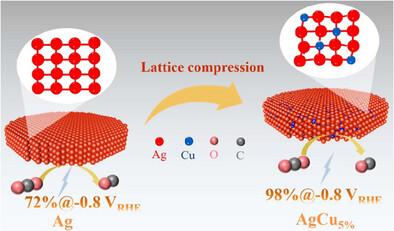
晶格应变被广泛认为是调节过渡金属催化活性的有效策略,但其对电化学CO₂还原(ECO₂RR)的直接影响尚不完全清楚。在这项工作中,采用cu掺杂Ag的策略构建了一系列具有不同晶格压缩率(从- 1.90%到- 2.75%)的AgCu纳米片结构(NS)。密度泛函理论(DFT)计算以及现场红外光谱分析表明,Cu的加入有效地调节了Ag的电子结构,促进了电荷转移的增强。特别是,晶格压缩率的改变可以改变吸附位点的电荷密度,从而改善CO的表面覆盖率和反应中间体(*COOH和*CO)的吸附能。结果表明,在−0.8 VRHE条件下,AgCu5%催化剂在h电池和液流电池中CO生成的最高法拉第效率分别为95.5%和98%。同时,AgCu5%催化剂在33 ~ 215 mA cm−2的超宽电流范围内,FECO达到86%以上。该工作为采用应变压缩策略提高CO2减排量提供了一条有效途径。
Efficient Electrochemical CO2 Conversion to CO via Cu-Doped Induced Lattice Compression in Ag Nanosheets
Lattice strain is widely recognized as an effective strategy for tuning transition metal catalytic activity, yet its direct impact on electrochemical CO₂ reduction (ECO₂RR) remains not fully understood. In this work, a strategy of Cu-doped Ag is employed to construct a series of AgCu nanosheet structures (NS) with varying lattice compression rates (from −1.90% to −2.75%). Density Functional Theory (DFT) calculations, along with in situ infrared spectroscopic analysis, demonstrate that Cu incorporation efficiently modulates the electronic structure of Ag, promoting enhanced charge transfer. Especially, the changed lattice compression rates can alter the charge density at adsorption sites, thereby ameliorating the surface coverage of CO and adsorption energy of the reaction intermediates (*COOH and *CO). As a result, the AgCu5% catalyst exhibits a maximum Faradaic efficiency (FE) of 95.5% for CO production in an H-cell and 98% in a flow cell at −0.8 VRHE, respectively. Simultaneously, the AgCu5% catalyst achieves FECO of above 86% in the ultrawide current range of 33–215 mA cm−2. The work affords an effective way to use a strain compression strategy to improve the CO2 reduction performance.
期刊介绍:
Small serves as an exceptional platform for both experimental and theoretical studies in fundamental and applied interdisciplinary research at the nano- and microscale. The journal offers a compelling mix of peer-reviewed Research Articles, Reviews, Perspectives, and Comments.
With a remarkable 2022 Journal Impact Factor of 13.3 (Journal Citation Reports from Clarivate Analytics, 2023), Small remains among the top multidisciplinary journals, covering a wide range of topics at the interface of materials science, chemistry, physics, engineering, medicine, and biology.
Small's readership includes biochemists, biologists, biomedical scientists, chemists, engineers, information technologists, materials scientists, physicists, and theoreticians alike.





 京公网安备 11010802042870号
京ICP备2023020795号-1
京公网安备 11010802042870号
京ICP备2023020795号-1

 分享
分享
 求助内容:
求助内容: 应助结果提醒方式:
 扫码关注我们
