{"title":"铁矿石非等温分解的化学动力学模型、反应机理估计及热力学参数","authors":"Ceren Eda Delikurt, Meltem Kizilca Coruh","doi":"10.1016/j.csite.2025.106042","DOIUrl":null,"url":null,"abstract":"<div><div>Trona ore, a naturally occurring sodium carbonate mineral, is a crucial raw material in various industrial applications, particularly soda ash production. Despite its significance, trona's thermal decomposition kinetics and underlying reaction mechanisms remain underexplored, limiting the optimization of industrial-scale processing methods. This study comprehensively investigates the non-isothermal thermal decomposition of trona using thermogravimetric analysis under different heating rates in an N<sub>2</sub> atmosphere. To determine the activation energy (Ea) and reaction mechanisms governing the decomposition process, FWO, KAS, Tang, Starink, and CR methods were applied. The results indicate that the thermal decomposition follows a nucleation-controlled reaction mechanism <em>P</em><sub><em>4</em></sub> with activation energy values ranging from 122 to 131 kJ mol<sup>−1</sup>, demonstrating that the process occurs through a single-step reaction. The thermodynamic analysis revealed that the decomposition process is endothermic, as indicated by the positive <em>ΔH</em> values, while the <em>ΔS</em> values suggest an increase in molecular randomness during decomposition. Additionally, <em>ΔG</em> calculations indicate that the reaction is non-spontaneous, necessitating external energy input. These findings provide critical insights into trona's kinetic and thermodynamic behavior, bridging the knowledge gap between experimental analysis and industrial processing applications. Unlike previous studies, this research comprehensively evaluates trona's decomposition behavior, offering valuable data for reactor design and process optimization.</div></div>","PeriodicalId":9658,"journal":{"name":"Case Studies in Thermal Engineering","volume":"69 ","pages":"Article 106042"},"PeriodicalIF":6.6000,"publicationDate":"2025-05-01","publicationTypes":"Journal Article","fieldsOfStudy":null,"isOpenAccess":false,"openAccessPdf":"","citationCount":"0","resultStr":"{\"title\":\"Chemical kinetic models, reaction mechanism estimation, and thermodynamic parameters for the non-isothermal decomposition of trona ore\",\"authors\":\"Ceren Eda Delikurt, Meltem Kizilca Coruh\",\"doi\":\"10.1016/j.csite.2025.106042\",\"DOIUrl\":null,\"url\":null,\"abstract\":\"<div><div>Trona ore, a naturally occurring sodium carbonate mineral, is a crucial raw material in various industrial applications, particularly soda ash production. Despite its significance, trona's thermal decomposition kinetics and underlying reaction mechanisms remain underexplored, limiting the optimization of industrial-scale processing methods. This study comprehensively investigates the non-isothermal thermal decomposition of trona using thermogravimetric analysis under different heating rates in an N<sub>2</sub> atmosphere. To determine the activation energy (Ea) and reaction mechanisms governing the decomposition process, FWO, KAS, Tang, Starink, and CR methods were applied. The results indicate that the thermal decomposition follows a nucleation-controlled reaction mechanism <em>P</em><sub><em>4</em></sub> with activation energy values ranging from 122 to 131 kJ mol<sup>−1</sup>, demonstrating that the process occurs through a single-step reaction. The thermodynamic analysis revealed that the decomposition process is endothermic, as indicated by the positive <em>ΔH</em> values, while the <em>ΔS</em> values suggest an increase in molecular randomness during decomposition. Additionally, <em>ΔG</em> calculations indicate that the reaction is non-spontaneous, necessitating external energy input. These findings provide critical insights into trona's kinetic and thermodynamic behavior, bridging the knowledge gap between experimental analysis and industrial processing applications. Unlike previous studies, this research comprehensively evaluates trona's decomposition behavior, offering valuable data for reactor design and process optimization.</div></div>\",\"PeriodicalId\":9658,\"journal\":{\"name\":\"Case Studies in Thermal Engineering\",\"volume\":\"69 \",\"pages\":\"Article 106042\"},\"PeriodicalIF\":6.6000,\"publicationDate\":\"2025-05-01\",\"publicationTypes\":\"Journal Article\",\"fieldsOfStudy\":null,\"isOpenAccess\":false,\"openAccessPdf\":\"\",\"citationCount\":\"0\",\"resultStr\":null,\"platform\":\"Semanticscholar\",\"paperid\":null,\"PeriodicalName\":\"Case Studies in Thermal Engineering\",\"FirstCategoryId\":\"5\",\"ListUrlMain\":\"https://www.sciencedirect.com/science/article/pii/S2214157X25003028\",\"RegionNum\":2,\"RegionCategory\":\"工程技术\",\"ArticlePicture\":[],\"TitleCN\":null,\"AbstractTextCN\":null,\"PMCID\":null,\"EPubDate\":\"2025/3/25 0:00:00\",\"PubModel\":\"Epub\",\"JCR\":\"Q1\",\"JCRName\":\"THERMODYNAMICS\",\"Score\":null,\"Total\":0}","platform":"Semanticscholar","paperid":null,"PeriodicalName":"Case Studies in Thermal Engineering","FirstCategoryId":"5","ListUrlMain":"https://www.sciencedirect.com/science/article/pii/S2214157X25003028","RegionNum":2,"RegionCategory":"工程技术","ArticlePicture":[],"TitleCN":null,"AbstractTextCN":null,"PMCID":null,"EPubDate":"2025/3/25 0:00:00","PubModel":"Epub","JCR":"Q1","JCRName":"THERMODYNAMICS","Score":null,"Total":0}
引用次数: 0
摘要
Trona矿石是一种天然存在的碳酸钠矿物,是各种工业应用,特别是纯碱生产中的重要原料。尽管具有重要意义,但trona的热分解动力学和潜在的反应机制仍未得到充分研究,限制了工业规模加工方法的优化。本文采用热重分析方法,全面研究了在N2气氛中不同升温速率下trona的非等温热分解。为了确定分解过程的活化能(Ea)和反应机理,采用了two, KAS, Tang, Starink和CR方法。结果表明,热分解遵循核控反应机制P4,活化能范围为122 ~ 131 kJ mol−1,表明该过程为单步反应。热力学分析表明,分解过程是吸热的,如ΔH值为正,而ΔS值表明分解过程中分子随机性增加。此外,ΔG计算表明,该反应是非自发的,需要外部能量输入。这些发现为trona的动力学和热力学行为提供了重要的见解,弥合了实验分析和工业处理应用之间的知识差距。与以往的研究不同,本研究全面评估了trona的分解行为,为反应器设计和工艺优化提供了有价值的数据。
Chemical kinetic models, reaction mechanism estimation, and thermodynamic parameters for the non-isothermal decomposition of trona ore
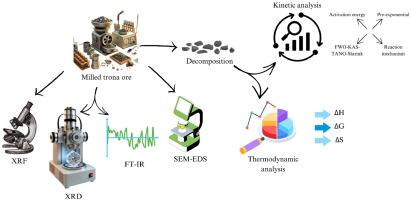
Trona ore, a naturally occurring sodium carbonate mineral, is a crucial raw material in various industrial applications, particularly soda ash production. Despite its significance, trona's thermal decomposition kinetics and underlying reaction mechanisms remain underexplored, limiting the optimization of industrial-scale processing methods. This study comprehensively investigates the non-isothermal thermal decomposition of trona using thermogravimetric analysis under different heating rates in an N2 atmosphere. To determine the activation energy (Ea) and reaction mechanisms governing the decomposition process, FWO, KAS, Tang, Starink, and CR methods were applied. The results indicate that the thermal decomposition follows a nucleation-controlled reaction mechanism P4 with activation energy values ranging from 122 to 131 kJ mol−1, demonstrating that the process occurs through a single-step reaction. The thermodynamic analysis revealed that the decomposition process is endothermic, as indicated by the positive ΔH values, while the ΔS values suggest an increase in molecular randomness during decomposition. Additionally, ΔG calculations indicate that the reaction is non-spontaneous, necessitating external energy input. These findings provide critical insights into trona's kinetic and thermodynamic behavior, bridging the knowledge gap between experimental analysis and industrial processing applications. Unlike previous studies, this research comprehensively evaluates trona's decomposition behavior, offering valuable data for reactor design and process optimization.
期刊介绍:
Case Studies in Thermal Engineering provides a forum for the rapid publication of short, structured Case Studies in Thermal Engineering and related Short Communications. It provides an essential compendium of case studies for researchers and practitioners in the field of thermal engineering and others who are interested in aspects of thermal engineering cases that could affect other engineering processes. The journal not only publishes new and novel case studies, but also provides a forum for the publication of high quality descriptions of classic thermal engineering problems. The scope of the journal includes case studies of thermal engineering problems in components, devices and systems using existing experimental and numerical techniques in the areas of mechanical, aerospace, chemical, medical, thermal management for electronics, heat exchangers, regeneration, solar thermal energy, thermal storage, building energy conservation, and power generation. Case studies of thermal problems in other areas will also be considered.




 京公网安备 11010802042870号
京ICP备2023020795号-1
京公网安备 11010802042870号
京ICP备2023020795号-1

 分享
分享
 求助内容:
求助内容: 应助结果提醒方式:
 扫码关注我们
