Xingzhong Wang, Zhibin Liang, Zhengqing Tang, Shiteng Rui, Kaifu Li and Fuyin Ma
{"title":"基于半解析带隙快速提取方法的弹性超材料按需设计。","authors":"Xingzhong Wang, Zhibin Liang, Zhengqing Tang, Shiteng Rui, Kaifu Li and Fuyin Ma","doi":"10.1039/D5MH00174A","DOIUrl":null,"url":null,"abstract":"<p >For various engineering equipment, design parameters such as the metamaterial band gap range, weight, and size are often variable. Previous design of metamaterials enables customized designs for specific operating frequency requirements, different space size constraints, and other requirements. However, due to the complexity of metamaterial configurations and the cumbersome process of band gap calculation, existing metamaterial design methods cannot accommodate the dynamic and complex design requirements in engineering applications. To this end, we propose an elastic metamaterial on-demand design method based on a semi-analytical band gap rapid extraction approach, implemented using the COMSOL-MATLAB co-simulation platform. This method can quickly identify the vibration-absorbing band gap range through modal displacement calculations at specific wave vector points, enabling semi-analytical band gap extraction for elastic metamaterials. Additionally, through iterative design and genetic algorithm optimization, we build and autonomously update a metamaterial performance database, and establish a metamaterial customized design software platform. Compared to current methods, the semi-analytical band gap extraction ensures high computational efficiency for intelligent algorithms, while the co-simulation design significantly reduces design complexity. The design results of the method proposed in this paper are accurate and reliable, providing a technical approach for the rapid optimization design of vibration-absorbing metamaterials and customized low-frequency vibration control in industrial applications.</p>","PeriodicalId":87,"journal":{"name":"Materials Horizons","volume":" 12","pages":" 4289-4303"},"PeriodicalIF":10.7000,"publicationDate":"2025-03-24","publicationTypes":"Journal Article","fieldsOfStudy":null,"isOpenAccess":false,"openAccessPdf":"","citationCount":"0","resultStr":"{\"title\":\"On-demand design for elastic metamaterial based on a semi-analytical band gap rapid extraction method\",\"authors\":\"Xingzhong Wang, Zhibin Liang, Zhengqing Tang, Shiteng Rui, Kaifu Li and Fuyin Ma\",\"doi\":\"10.1039/D5MH00174A\",\"DOIUrl\":null,\"url\":null,\"abstract\":\"<p >For various engineering equipment, design parameters such as the metamaterial band gap range, weight, and size are often variable. Previous design of metamaterials enables customized designs for specific operating frequency requirements, different space size constraints, and other requirements. However, due to the complexity of metamaterial configurations and the cumbersome process of band gap calculation, existing metamaterial design methods cannot accommodate the dynamic and complex design requirements in engineering applications. To this end, we propose an elastic metamaterial on-demand design method based on a semi-analytical band gap rapid extraction approach, implemented using the COMSOL-MATLAB co-simulation platform. This method can quickly identify the vibration-absorbing band gap range through modal displacement calculations at specific wave vector points, enabling semi-analytical band gap extraction for elastic metamaterials. Additionally, through iterative design and genetic algorithm optimization, we build and autonomously update a metamaterial performance database, and establish a metamaterial customized design software platform. Compared to current methods, the semi-analytical band gap extraction ensures high computational efficiency for intelligent algorithms, while the co-simulation design significantly reduces design complexity. The design results of the method proposed in this paper are accurate and reliable, providing a technical approach for the rapid optimization design of vibration-absorbing metamaterials and customized low-frequency vibration control in industrial applications.</p>\",\"PeriodicalId\":87,\"journal\":{\"name\":\"Materials Horizons\",\"volume\":\" 12\",\"pages\":\" 4289-4303\"},\"PeriodicalIF\":10.7000,\"publicationDate\":\"2025-03-24\",\"publicationTypes\":\"Journal Article\",\"fieldsOfStudy\":null,\"isOpenAccess\":false,\"openAccessPdf\":\"\",\"citationCount\":\"0\",\"resultStr\":null,\"platform\":\"Semanticscholar\",\"paperid\":null,\"PeriodicalName\":\"Materials Horizons\",\"FirstCategoryId\":\"88\",\"ListUrlMain\":\"https://pubs.rsc.org/en/content/articlelanding/2025/mh/d5mh00174a\",\"RegionNum\":2,\"RegionCategory\":\"材料科学\",\"ArticlePicture\":[],\"TitleCN\":null,\"AbstractTextCN\":null,\"PMCID\":null,\"EPubDate\":\"\",\"PubModel\":\"\",\"JCR\":\"Q1\",\"JCRName\":\"CHEMISTRY, MULTIDISCIPLINARY\",\"Score\":null,\"Total\":0}","platform":"Semanticscholar","paperid":null,"PeriodicalName":"Materials Horizons","FirstCategoryId":"88","ListUrlMain":"https://pubs.rsc.org/en/content/articlelanding/2025/mh/d5mh00174a","RegionNum":2,"RegionCategory":"材料科学","ArticlePicture":[],"TitleCN":null,"AbstractTextCN":null,"PMCID":null,"EPubDate":"","PubModel":"","JCR":"Q1","JCRName":"CHEMISTRY, MULTIDISCIPLINARY","Score":null,"Total":0}
On-demand design for elastic metamaterial based on a semi-analytical band gap rapid extraction method
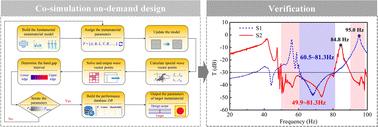
For various engineering equipment, design parameters such as the metamaterial band gap range, weight, and size are often variable. Previous design of metamaterials enables customized designs for specific operating frequency requirements, different space size constraints, and other requirements. However, due to the complexity of metamaterial configurations and the cumbersome process of band gap calculation, existing metamaterial design methods cannot accommodate the dynamic and complex design requirements in engineering applications. To this end, we propose an elastic metamaterial on-demand design method based on a semi-analytical band gap rapid extraction approach, implemented using the COMSOL-MATLAB co-simulation platform. This method can quickly identify the vibration-absorbing band gap range through modal displacement calculations at specific wave vector points, enabling semi-analytical band gap extraction for elastic metamaterials. Additionally, through iterative design and genetic algorithm optimization, we build and autonomously update a metamaterial performance database, and establish a metamaterial customized design software platform. Compared to current methods, the semi-analytical band gap extraction ensures high computational efficiency for intelligent algorithms, while the co-simulation design significantly reduces design complexity. The design results of the method proposed in this paper are accurate and reliable, providing a technical approach for the rapid optimization design of vibration-absorbing metamaterials and customized low-frequency vibration control in industrial applications.





 京公网安备 11010802042870号
京ICP备2023020795号-1
京公网安备 11010802042870号
京ICP备2023020795号-1

 分享
分享
 求助内容:
求助内容: 应助结果提醒方式:
 扫码关注我们
