Hee-Yeong Jung, Tae-Ran Kim, Gwan Hee Han, Jin-Sung Yuk
{"title":"盆腔器官脱垂与绝经期激素治疗的关系:全国性队列研究。","authors":"Hee-Yeong Jung, Tae-Ran Kim, Gwan Hee Han, Jin-Sung Yuk","doi":"10.5468/ogs.24071","DOIUrl":null,"url":null,"abstract":"<p><strong>Objective: </strong>To analyze the relationship between pelvic organ prolapse (POP) and menopausal hormone therapy (MHT).</p><p><strong>Methods: </strong>This retrospective cohort study used Korean National Health checkup and insurance data from 2002 to 2019. Women who used MHT for more than 6 months between 2002 and 2011 were included in the MHT group; postmenopausal women with no MHT use comprised the non-MHT group.</p><p><strong>Results: </strong>In the non-MHT group, there were 1,001,350 women, while the MHT group had 353,206 women. Tibolone (adjusted hazard ratio [aHR], 0.87; 99% confidence interval [CI], 0.818-0.926) and combined estrogen plus progestin by the manufacturer (CEPM) (aHR, 0.821; 99% CI, 0.758-0.89) were associated with reduced POP risk. The other oral MHT groups and the transdermal estrogen group showed no significant difference in POP risk compared with the non-MHT group (other oral MHT: aHR, 1.045; 99% CI, 0.941-1.161) (transdermal estrogen: aHR, 1.252; 99% CI, 0.731-2.145). Lower body mass index (BMI) (<18.5) was associated with reduced POP risk (aHR, 0.822; 99% CI, 0.698-0.968), while a BMI between 23 and 29.9 was associated with increased risk (BMI 23-24.9: aHR, 1.143; 99% CI, 1.088-1.2) (BMI 25-29.9: aHR, 1.173; 99% CI, 1.12-1.228). All parities had a higher POP risk than parity 1 (parity 0 or no response: aHR, 1.785; 99% CI, 1.589-2.005; parity 2: aHR, 1.434; 99% CI, 1.292-1.592; parity ≥3: aHR, 1.916; 99% CI, 1.712-2.144).</p><p><strong>Conclusion: </strong>Tibolone and CEPM use were associated with reduced POP risk in postmenopausal women. Other MHT types showed no significant association with POP.</p>","PeriodicalId":37602,"journal":{"name":"Obstetrics and Gynecology Science","volume":" ","pages":"210-220"},"PeriodicalIF":2.5000,"publicationDate":"2025-05-01","publicationTypes":"Journal Article","fieldsOfStudy":null,"isOpenAccess":false,"openAccessPdf":"https://www.ncbi.nlm.nih.gov/pmc/articles/PMC12104620/pdf/","citationCount":"0","resultStr":"{\"title\":\"Relation between pelvic organ prolapse and menopausal hormone therapy: nationwide cohort study.\",\"authors\":\"Hee-Yeong Jung, Tae-Ran Kim, Gwan Hee Han, Jin-Sung Yuk\",\"doi\":\"10.5468/ogs.24071\",\"DOIUrl\":null,\"url\":null,\"abstract\":\"<p><strong>Objective: </strong>To analyze the relationship between pelvic organ prolapse (POP) and menopausal hormone therapy (MHT).</p><p><strong>Methods: </strong>This retrospective cohort study used Korean National Health checkup and insurance data from 2002 to 2019. Women who used MHT for more than 6 months between 2002 and 2011 were included in the MHT group; postmenopausal women with no MHT use comprised the non-MHT group.</p><p><strong>Results: </strong>In the non-MHT group, there were 1,001,350 women, while the MHT group had 353,206 women. Tibolone (adjusted hazard ratio [aHR], 0.87; 99% confidence interval [CI], 0.818-0.926) and combined estrogen plus progestin by the manufacturer (CEPM) (aHR, 0.821; 99% CI, 0.758-0.89) were associated with reduced POP risk. The other oral MHT groups and the transdermal estrogen group showed no significant difference in POP risk compared with the non-MHT group (other oral MHT: aHR, 1.045; 99% CI, 0.941-1.161) (transdermal estrogen: aHR, 1.252; 99% CI, 0.731-2.145). Lower body mass index (BMI) (<18.5) was associated with reduced POP risk (aHR, 0.822; 99% CI, 0.698-0.968), while a BMI between 23 and 29.9 was associated with increased risk (BMI 23-24.9: aHR, 1.143; 99% CI, 1.088-1.2) (BMI 25-29.9: aHR, 1.173; 99% CI, 1.12-1.228). All parities had a higher POP risk than parity 1 (parity 0 or no response: aHR, 1.785; 99% CI, 1.589-2.005; parity 2: aHR, 1.434; 99% CI, 1.292-1.592; parity ≥3: aHR, 1.916; 99% CI, 1.712-2.144).</p><p><strong>Conclusion: </strong>Tibolone and CEPM use were associated with reduced POP risk in postmenopausal women. Other MHT types showed no significant association with POP.</p>\",\"PeriodicalId\":37602,\"journal\":{\"name\":\"Obstetrics and Gynecology Science\",\"volume\":\" \",\"pages\":\"210-220\"},\"PeriodicalIF\":2.5000,\"publicationDate\":\"2025-05-01\",\"publicationTypes\":\"Journal Article\",\"fieldsOfStudy\":null,\"isOpenAccess\":false,\"openAccessPdf\":\"https://www.ncbi.nlm.nih.gov/pmc/articles/PMC12104620/pdf/\",\"citationCount\":\"0\",\"resultStr\":null,\"platform\":\"Semanticscholar\",\"paperid\":null,\"PeriodicalName\":\"Obstetrics and Gynecology Science\",\"FirstCategoryId\":\"1085\",\"ListUrlMain\":\"https://doi.org/10.5468/ogs.24071\",\"RegionNum\":0,\"RegionCategory\":null,\"ArticlePicture\":[],\"TitleCN\":null,\"AbstractTextCN\":null,\"PMCID\":null,\"EPubDate\":\"2025/3/24 0:00:00\",\"PubModel\":\"Epub\",\"JCR\":\"Q2\",\"JCRName\":\"OBSTETRICS & GYNECOLOGY\",\"Score\":null,\"Total\":0}","platform":"Semanticscholar","paperid":null,"PeriodicalName":"Obstetrics and Gynecology Science","FirstCategoryId":"1085","ListUrlMain":"https://doi.org/10.5468/ogs.24071","RegionNum":0,"RegionCategory":null,"ArticlePicture":[],"TitleCN":null,"AbstractTextCN":null,"PMCID":null,"EPubDate":"2025/3/24 0:00:00","PubModel":"Epub","JCR":"Q2","JCRName":"OBSTETRICS & GYNECOLOGY","Score":null,"Total":0}
Relation between pelvic organ prolapse and menopausal hormone therapy: nationwide cohort study.
Objective: To analyze the relationship between pelvic organ prolapse (POP) and menopausal hormone therapy (MHT).
Methods: This retrospective cohort study used Korean National Health checkup and insurance data from 2002 to 2019. Women who used MHT for more than 6 months between 2002 and 2011 were included in the MHT group; postmenopausal women with no MHT use comprised the non-MHT group.
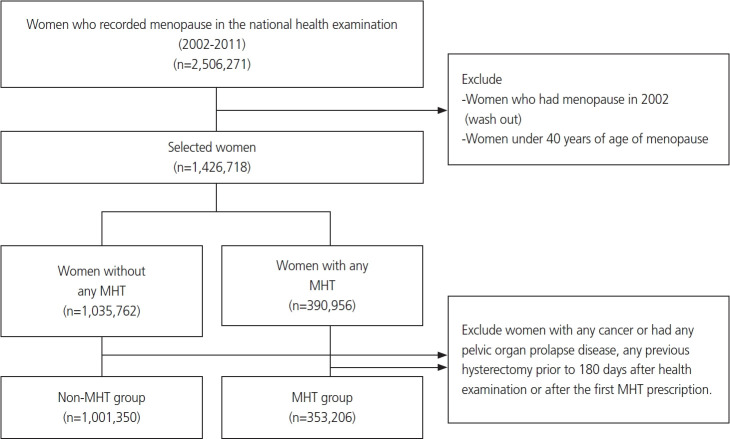
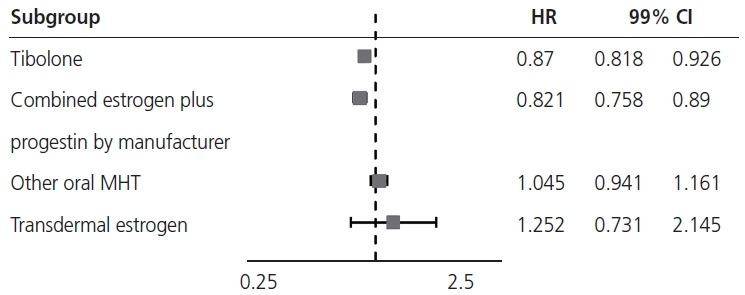
Results: In the non-MHT group, there were 1,001,350 women, while the MHT group had 353,206 women. Tibolone (adjusted hazard ratio [aHR], 0.87; 99% confidence interval [CI], 0.818-0.926) and combined estrogen plus progestin by the manufacturer (CEPM) (aHR, 0.821; 99% CI, 0.758-0.89) were associated with reduced POP risk. The other oral MHT groups and the transdermal estrogen group showed no significant difference in POP risk compared with the non-MHT group (other oral MHT: aHR, 1.045; 99% CI, 0.941-1.161) (transdermal estrogen: aHR, 1.252; 99% CI, 0.731-2.145). Lower body mass index (BMI) (<18.5) was associated with reduced POP risk (aHR, 0.822; 99% CI, 0.698-0.968), while a BMI between 23 and 29.9 was associated with increased risk (BMI 23-24.9: aHR, 1.143; 99% CI, 1.088-1.2) (BMI 25-29.9: aHR, 1.173; 99% CI, 1.12-1.228). All parities had a higher POP risk than parity 1 (parity 0 or no response: aHR, 1.785; 99% CI, 1.589-2.005; parity 2: aHR, 1.434; 99% CI, 1.292-1.592; parity ≥3: aHR, 1.916; 99% CI, 1.712-2.144).
Conclusion: Tibolone and CEPM use were associated with reduced POP risk in postmenopausal women. Other MHT types showed no significant association with POP.
期刊介绍:
Obstetrics & Gynecology Science (NLM title: Obstet Gynecol Sci) is an international peer-review journal that published basic, translational, clinical research, and clinical practice guideline to promote women’s health and prevent obstetric and gynecologic disorders. The journal has an international editorial board and is published in English on the 15th day of every other month. Submitted manuscripts should not contain previously published material and should not be under consideration for publication elsewhere. The journal has been publishing articles since 1958. The aim of the journal is to publish original articles, reviews, case reports, short communications, letters to the editor, and video articles that have the potential to change the practices in women''s health care. The journal’s main focus is the diagnosis, treatment, prediction, and prevention of obstetric and gynecologic disorders. Because the life expectancy of Korean and Asian women is increasing, the journal''s editors are particularly interested in the health of elderly women in these population groups. The journal also publishes articles about reproductive biology, stem cell research, and artificial intelligence research for women; additionally, it provides insights into the physiology and mechanisms of obstetric and gynecologic diseases.





 京公网安备 11010802042870号
京ICP备2023020795号-1
京公网安备 11010802042870号
京ICP备2023020795号-1

 分享
分享
 求助内容:
求助内容: 应助结果提醒方式:
 扫码关注我们
