Yishu Li , Guangdi Liu , Zezhang Song , Mingliang Sun , Xingwang Tian , Dailing Yang , Lianqiang Zhu
{"title":"川中震旦系天然气、热解沥青和烃源岩碳同位素分馏对气藏演化的意义","authors":"Yishu Li , Guangdi Liu , Zezhang Song , Mingliang Sun , Xingwang Tian , Dailing Yang , Lianqiang Zhu","doi":"10.1016/j.marpetgeo.2025.107392","DOIUrl":null,"url":null,"abstract":"<div><div>Hydrocarbon reservoirs in ancient and deeply buried formations typically exhibit complex evolutionary histories. After experiencing high temperatures, pressures, and multiple types of secondary modifications, the geological information carried by hydrocarbons is superimposed and difficult to interpret. Methane carbon isotopes (δ<sup>13</sup>C) in the Sinian natural gas in the central Sichuan Basin are heavier than those of the reservoir solid pyrobitumen (SB) and are considered an ‘anomalous’ fractionation. Therefore, based on the abundant δ<sup>13</sup>C data of the source rock, SB, and natural gas, this study aimed to interpret the geological significance recorded by the ‘anomalous’ fractionation combined with the analysis of geological elements and the evolution process of the gas reservoir. The results showed that the combined contributions of multiple source rocks lead to differences in the original δ<sup>13</sup>C of crude oil in paleo-oil reservoirs. Among them, the slope of the paleo-uplift was closer to the Deyang–Anyue rift trough, where the δ<sup>13</sup>C of the main Cambrian source rocks was negatively biased, making the δ<sup>13</sup>C of the paleo-oil reservoirs more negative. During the late thermal evolution, deasphalting was caused by gas produced from oil cracking under high temperatures and pressures. In contrast, the adsorption of clay minerals and gas intrusion due to kerogen degradation in the source rocks had little effect on deasphalting. The δ<sup>13</sup>C values of the bulk SB precipitated by deasphalting were light and similar to those of the contemporaneous oil. However, the cracked gas with substantial negative δ<sup>13</sup>C produced in the early phase completely escaped as the reservoir pressure increased; the traps concentrated only the late cracked gas, which was isotopically heavier than all the SB produced in the different stages. This study provides new insights into the evolution of isotopic fractionation in ancient oil and gas systems involving oil cracking and phase transformation.</div></div>","PeriodicalId":18189,"journal":{"name":"Marine and Petroleum Geology","volume":"177 ","pages":"Article 107392"},"PeriodicalIF":3.6000,"publicationDate":"2025-07-01","publicationTypes":"Journal Article","fieldsOfStudy":null,"isOpenAccess":false,"openAccessPdf":"","citationCount":"0","resultStr":"{\"title\":\"Implications of carbon isotope fractionation of natural gas, pyrobitumen, and source rock on Sinian gas reservoirs evolution, central Sichuan Basin\",\"authors\":\"Yishu Li , Guangdi Liu , Zezhang Song , Mingliang Sun , Xingwang Tian , Dailing Yang , Lianqiang Zhu\",\"doi\":\"10.1016/j.marpetgeo.2025.107392\",\"DOIUrl\":null,\"url\":null,\"abstract\":\"<div><div>Hydrocarbon reservoirs in ancient and deeply buried formations typically exhibit complex evolutionary histories. After experiencing high temperatures, pressures, and multiple types of secondary modifications, the geological information carried by hydrocarbons is superimposed and difficult to interpret. Methane carbon isotopes (δ<sup>13</sup>C) in the Sinian natural gas in the central Sichuan Basin are heavier than those of the reservoir solid pyrobitumen (SB) and are considered an ‘anomalous’ fractionation. Therefore, based on the abundant δ<sup>13</sup>C data of the source rock, SB, and natural gas, this study aimed to interpret the geological significance recorded by the ‘anomalous’ fractionation combined with the analysis of geological elements and the evolution process of the gas reservoir. The results showed that the combined contributions of multiple source rocks lead to differences in the original δ<sup>13</sup>C of crude oil in paleo-oil reservoirs. Among them, the slope of the paleo-uplift was closer to the Deyang–Anyue rift trough, where the δ<sup>13</sup>C of the main Cambrian source rocks was negatively biased, making the δ<sup>13</sup>C of the paleo-oil reservoirs more negative. During the late thermal evolution, deasphalting was caused by gas produced from oil cracking under high temperatures and pressures. In contrast, the adsorption of clay minerals and gas intrusion due to kerogen degradation in the source rocks had little effect on deasphalting. The δ<sup>13</sup>C values of the bulk SB precipitated by deasphalting were light and similar to those of the contemporaneous oil. However, the cracked gas with substantial negative δ<sup>13</sup>C produced in the early phase completely escaped as the reservoir pressure increased; the traps concentrated only the late cracked gas, which was isotopically heavier than all the SB produced in the different stages. This study provides new insights into the evolution of isotopic fractionation in ancient oil and gas systems involving oil cracking and phase transformation.</div></div>\",\"PeriodicalId\":18189,\"journal\":{\"name\":\"Marine and Petroleum Geology\",\"volume\":\"177 \",\"pages\":\"Article 107392\"},\"PeriodicalIF\":3.6000,\"publicationDate\":\"2025-07-01\",\"publicationTypes\":\"Journal Article\",\"fieldsOfStudy\":null,\"isOpenAccess\":false,\"openAccessPdf\":\"\",\"citationCount\":\"0\",\"resultStr\":null,\"platform\":\"Semanticscholar\",\"paperid\":null,\"PeriodicalName\":\"Marine and Petroleum Geology\",\"FirstCategoryId\":\"89\",\"ListUrlMain\":\"https://www.sciencedirect.com/science/article/pii/S0264817225001096\",\"RegionNum\":2,\"RegionCategory\":\"地球科学\",\"ArticlePicture\":[],\"TitleCN\":null,\"AbstractTextCN\":null,\"PMCID\":null,\"EPubDate\":\"2025/3/24 0:00:00\",\"PubModel\":\"Epub\",\"JCR\":\"Q1\",\"JCRName\":\"GEOSCIENCES, MULTIDISCIPLINARY\",\"Score\":null,\"Total\":0}","platform":"Semanticscholar","paperid":null,"PeriodicalName":"Marine and Petroleum Geology","FirstCategoryId":"89","ListUrlMain":"https://www.sciencedirect.com/science/article/pii/S0264817225001096","RegionNum":2,"RegionCategory":"地球科学","ArticlePicture":[],"TitleCN":null,"AbstractTextCN":null,"PMCID":null,"EPubDate":"2025/3/24 0:00:00","PubModel":"Epub","JCR":"Q1","JCRName":"GEOSCIENCES, MULTIDISCIPLINARY","Score":null,"Total":0}
Implications of carbon isotope fractionation of natural gas, pyrobitumen, and source rock on Sinian gas reservoirs evolution, central Sichuan Basin
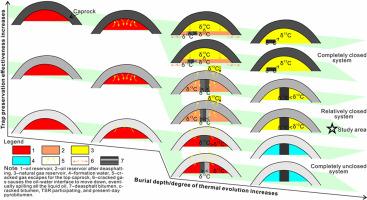
Hydrocarbon reservoirs in ancient and deeply buried formations typically exhibit complex evolutionary histories. After experiencing high temperatures, pressures, and multiple types of secondary modifications, the geological information carried by hydrocarbons is superimposed and difficult to interpret. Methane carbon isotopes (δ13C) in the Sinian natural gas in the central Sichuan Basin are heavier than those of the reservoir solid pyrobitumen (SB) and are considered an ‘anomalous’ fractionation. Therefore, based on the abundant δ13C data of the source rock, SB, and natural gas, this study aimed to interpret the geological significance recorded by the ‘anomalous’ fractionation combined with the analysis of geological elements and the evolution process of the gas reservoir. The results showed that the combined contributions of multiple source rocks lead to differences in the original δ13C of crude oil in paleo-oil reservoirs. Among them, the slope of the paleo-uplift was closer to the Deyang–Anyue rift trough, where the δ13C of the main Cambrian source rocks was negatively biased, making the δ13C of the paleo-oil reservoirs more negative. During the late thermal evolution, deasphalting was caused by gas produced from oil cracking under high temperatures and pressures. In contrast, the adsorption of clay minerals and gas intrusion due to kerogen degradation in the source rocks had little effect on deasphalting. The δ13C values of the bulk SB precipitated by deasphalting were light and similar to those of the contemporaneous oil. However, the cracked gas with substantial negative δ13C produced in the early phase completely escaped as the reservoir pressure increased; the traps concentrated only the late cracked gas, which was isotopically heavier than all the SB produced in the different stages. This study provides new insights into the evolution of isotopic fractionation in ancient oil and gas systems involving oil cracking and phase transformation.
期刊介绍:
Marine and Petroleum Geology is the pre-eminent international forum for the exchange of multidisciplinary concepts, interpretations and techniques for all concerned with marine and petroleum geology in industry, government and academia. Rapid bimonthly publication allows early communications of papers or short communications to the geoscience community.
Marine and Petroleum Geology is essential reading for geologists, geophysicists and explorationists in industry, government and academia working in the following areas: marine geology; basin analysis and evaluation; organic geochemistry; reserve/resource estimation; seismic stratigraphy; thermal models of basic evolution; sedimentary geology; continental margins; geophysical interpretation; structural geology/tectonics; formation evaluation techniques; well logging.




 京公网安备 11010802042870号
京ICP备2023020795号-1
京公网安备 11010802042870号
京ICP备2023020795号-1

 分享
分享
 求助内容:
求助内容: 应助结果提醒方式:
 扫码关注我们
