Jiliang Deng, Wei Li, Zhangying Wang, Jiayue Zeng, Qiang Cai
{"title":"KatB是一种细菌胞外囊泡(ev)分泌的过氧化氢酶,具有解毒活性氧(ROS)和促进植物病原体增殖的作用。","authors":"Jiliang Deng, Wei Li, Zhangying Wang, Jiayue Zeng, Qiang Cai","doi":"10.1111/jipb.13894","DOIUrl":null,"url":null,"abstract":"<div>\n \n <p>Gram-negative bacteria are known to release extracellular vesicles (EVs) into their surrounding environment. However, the biological functions of the proteins contained within these vesicles remain largely unknown. Here, we used tandem mass tag (TMT) proteomic analysis to characterize protein cargoes within EVs of the phytopathogen <i>Pseudomonas syringae</i> pv. <i>tomato</i> DC3000 (<i>Pto</i> DC3000). Our investigation revealed that one catalase, KatB, is enriched in bacterial EVs. This enzyme confers EVs with the capacity to detoxify both exogenous and plant-produced H<sub>2</sub>O<sub>2</sub>, thereby contributing to the pathogen's proliferation within the plants. Interestingly, reactive oxygen species (ROS) stress stimulates bacterial EV secretion and enhances the package of KatB into these vesicles. This regulatory process depends on a periplasmic ankyrin-like protein, AnkB. Both AnkB and KatB are encoded within a small operon, and their mutant strains exhibit impaired growth in plant hosts. Furthermore, the treatment of EVs pelleted from bacterial culture supernatants activates the immune responses of plants, and the absence of KatB in EVs further enhances this protective activity. Collectively, our findings indicate that bacteria secreted KatB via EVs to interact with and reduce the host's oxidative environment, thereby promoting their proliferation within plants.</p></div>","PeriodicalId":195,"journal":{"name":"Journal of Integrative Plant Biology","volume":"67 7","pages":"1928-1946"},"PeriodicalIF":12.5000,"publicationDate":"2025-03-27","publicationTypes":"Journal Article","fieldsOfStudy":null,"isOpenAccess":false,"openAccessPdf":"","citationCount":"0","resultStr":"{\"title\":\"KatB, a bacterial extracellular vesicles (EVs)-secreted catalase, detoxifies reactive oxygen species (ROS) and promotes pathogen proliferation in plants\",\"authors\":\"Jiliang Deng, Wei Li, Zhangying Wang, Jiayue Zeng, Qiang Cai\",\"doi\":\"10.1111/jipb.13894\",\"DOIUrl\":null,\"url\":null,\"abstract\":\"<div>\\n \\n <p>Gram-negative bacteria are known to release extracellular vesicles (EVs) into their surrounding environment. However, the biological functions of the proteins contained within these vesicles remain largely unknown. Here, we used tandem mass tag (TMT) proteomic analysis to characterize protein cargoes within EVs of the phytopathogen <i>Pseudomonas syringae</i> pv. <i>tomato</i> DC3000 (<i>Pto</i> DC3000). Our investigation revealed that one catalase, KatB, is enriched in bacterial EVs. This enzyme confers EVs with the capacity to detoxify both exogenous and plant-produced H<sub>2</sub>O<sub>2</sub>, thereby contributing to the pathogen's proliferation within the plants. Interestingly, reactive oxygen species (ROS) stress stimulates bacterial EV secretion and enhances the package of KatB into these vesicles. This regulatory process depends on a periplasmic ankyrin-like protein, AnkB. Both AnkB and KatB are encoded within a small operon, and their mutant strains exhibit impaired growth in plant hosts. Furthermore, the treatment of EVs pelleted from bacterial culture supernatants activates the immune responses of plants, and the absence of KatB in EVs further enhances this protective activity. Collectively, our findings indicate that bacteria secreted KatB via EVs to interact with and reduce the host's oxidative environment, thereby promoting their proliferation within plants.</p></div>\",\"PeriodicalId\":195,\"journal\":{\"name\":\"Journal of Integrative Plant Biology\",\"volume\":\"67 7\",\"pages\":\"1928-1946\"},\"PeriodicalIF\":12.5000,\"publicationDate\":\"2025-03-27\",\"publicationTypes\":\"Journal Article\",\"fieldsOfStudy\":null,\"isOpenAccess\":false,\"openAccessPdf\":\"\",\"citationCount\":\"0\",\"resultStr\":null,\"platform\":\"Semanticscholar\",\"paperid\":null,\"PeriodicalName\":\"Journal of Integrative Plant Biology\",\"FirstCategoryId\":\"99\",\"ListUrlMain\":\"https://onlinelibrary.wiley.com/doi/10.1111/jipb.13894\",\"RegionNum\":1,\"RegionCategory\":\"生物学\",\"ArticlePicture\":[],\"TitleCN\":null,\"AbstractTextCN\":null,\"PMCID\":null,\"EPubDate\":\"\",\"PubModel\":\"\",\"JCR\":\"Q1\",\"JCRName\":\"BIOCHEMISTRY & MOLECULAR BIOLOGY\",\"Score\":null,\"Total\":0}","platform":"Semanticscholar","paperid":null,"PeriodicalName":"Journal of Integrative Plant Biology","FirstCategoryId":"99","ListUrlMain":"https://onlinelibrary.wiley.com/doi/10.1111/jipb.13894","RegionNum":1,"RegionCategory":"生物学","ArticlePicture":[],"TitleCN":null,"AbstractTextCN":null,"PMCID":null,"EPubDate":"","PubModel":"","JCR":"Q1","JCRName":"BIOCHEMISTRY & MOLECULAR BIOLOGY","Score":null,"Total":0}
KatB, a bacterial extracellular vesicles (EVs)-secreted catalase, detoxifies reactive oxygen species (ROS) and promotes pathogen proliferation in plants
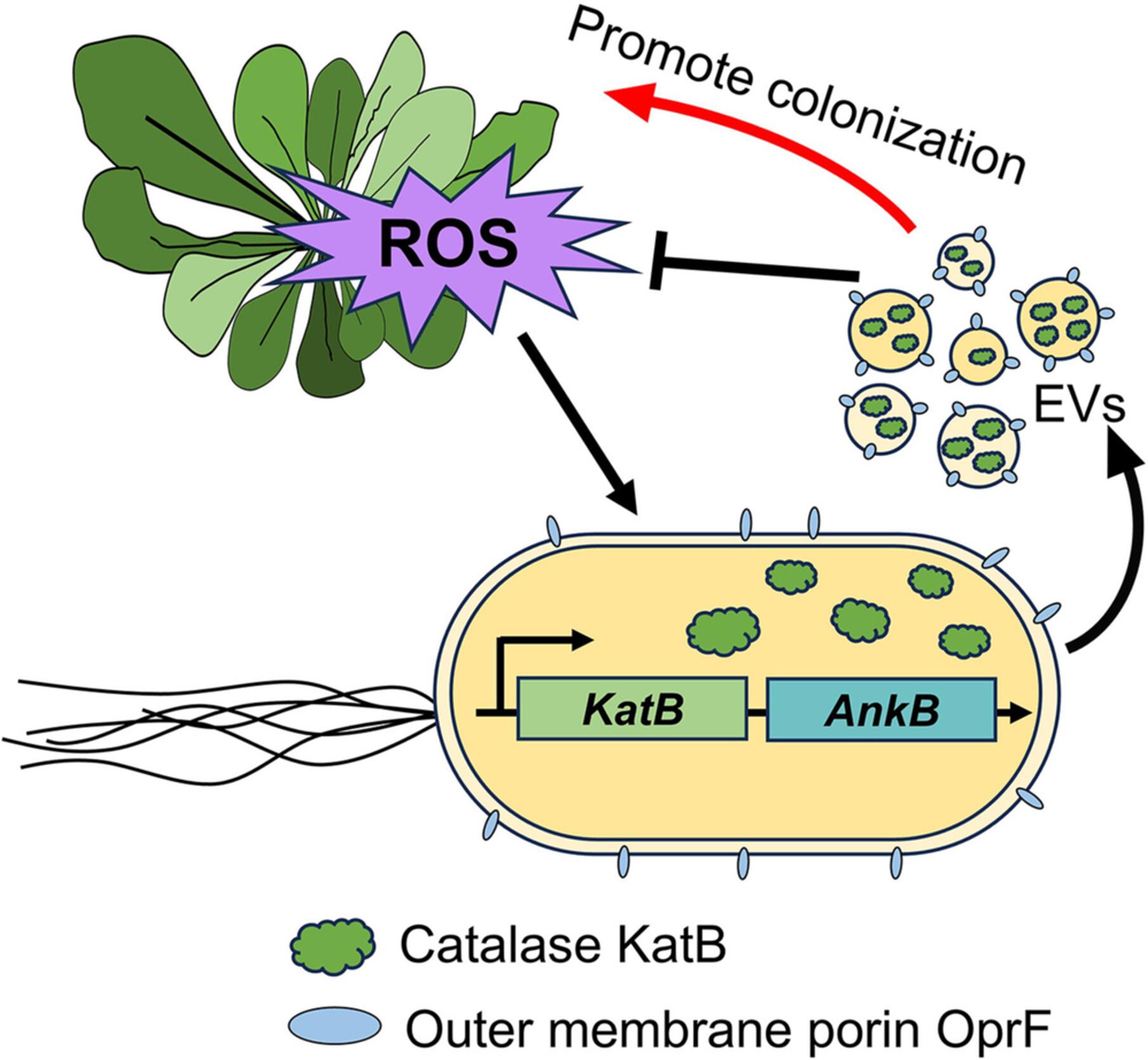
Gram-negative bacteria are known to release extracellular vesicles (EVs) into their surrounding environment. However, the biological functions of the proteins contained within these vesicles remain largely unknown. Here, we used tandem mass tag (TMT) proteomic analysis to characterize protein cargoes within EVs of the phytopathogen Pseudomonas syringae pv. tomato DC3000 (Pto DC3000). Our investigation revealed that one catalase, KatB, is enriched in bacterial EVs. This enzyme confers EVs with the capacity to detoxify both exogenous and plant-produced H2O2, thereby contributing to the pathogen's proliferation within the plants. Interestingly, reactive oxygen species (ROS) stress stimulates bacterial EV secretion and enhances the package of KatB into these vesicles. This regulatory process depends on a periplasmic ankyrin-like protein, AnkB. Both AnkB and KatB are encoded within a small operon, and their mutant strains exhibit impaired growth in plant hosts. Furthermore, the treatment of EVs pelleted from bacterial culture supernatants activates the immune responses of plants, and the absence of KatB in EVs further enhances this protective activity. Collectively, our findings indicate that bacteria secreted KatB via EVs to interact with and reduce the host's oxidative environment, thereby promoting their proliferation within plants.
期刊介绍:
Journal of Integrative Plant Biology is a leading academic journal reporting on the latest discoveries in plant biology.Enjoy the latest news and developments in the field, understand new and improved methods and research tools, and explore basic biological questions through reproducible experimental design, using genetic, biochemical, cell and molecular biological methods, and statistical analyses.




 京公网安备 11010802042870号
京ICP备2023020795号-1
京公网安备 11010802042870号
京ICP备2023020795号-1

 分享
分享
 求助内容:
求助内容: 应助结果提醒方式:
 扫码关注我们
