Ángela Campo , Anand Kunverji , Karl S. Ryder , Gary J. Ellis , Nuria García , Pilar Tiemblo
{"title":"超高分子量PEO对EMIC-AlCl3凝胶电解质离子形态及电化学性能的影响","authors":"Ángela Campo , Anand Kunverji , Karl S. Ryder , Gary J. Ellis , Nuria García , Pilar Tiemblo","doi":"10.1016/j.polymer.2025.128327","DOIUrl":null,"url":null,"abstract":"<div><div>Polymer gel electrolytes based on EMIC-AlCl<sub>3</sub> (1:1.5) and ultra-high molecular weight polyethylene oxide (UHMW PEO M<sub>v</sub> = 8 × 10<sup>6</sup> g mol<sup>−1</sup>) were synthesised with PEO concentrations of 2, 3.5, 5, 10 wt% without the use of auxiliary solvents, by melting the polymer into the electrolyte. This method produced elastic gels with progressively increasing elastic modulus. The speciation of the chloroaluminate anions in the gel electrolytes was characterized by NMR and Raman spectroscopy, revealing a decrease in Al<sub>2</sub>Cl<sub>7</sub><sup>−</sup> and corresponding increase in AlCl<sub>4</sub><sup>−</sup> with rising PEO content. In particular, the gel with 10 wt% PEO showed no detectable Al<sub>2</sub>Cl<sub>7</sub><sup>−</sup>. Electrochemical activity of these gels was evaluated using two configurations: a platinum disc electrode and parallel planar aluminium foil electrode, the latter mimicking a practical electrochemical cell operating geometry. Surprisingly, all gels exhibited electrochemical activity, even in the absence of the Al<sub>2</sub>Cl<sub>7</sub><sup>−</sup> species. Increasing PEO concentration led to reduced current densities but enhanced coulombic efficiency. The study discusses the influence of the molecular weight of PEO on ionic speciation and electrochemical performance of the polymer gel electrolytes, providing insights into the interplay between polymer content, ionic speciation, and electrochemical behaviour. These findings contribute to the development of safer, more sustainable aluminium batteries.</div></div>","PeriodicalId":405,"journal":{"name":"Polymer","volume":"326 ","pages":"Article 128327"},"PeriodicalIF":4.5000,"publicationDate":"2025-05-09","publicationTypes":"Journal Article","fieldsOfStudy":null,"isOpenAccess":false,"openAccessPdf":"","citationCount":"0","resultStr":"{\"title\":\"Impact of UHMW PEO on the ionic speciation and electrochemical properties of EMIC-AlCl3 gel electrolytes\",\"authors\":\"Ángela Campo , Anand Kunverji , Karl S. Ryder , Gary J. Ellis , Nuria García , Pilar Tiemblo\",\"doi\":\"10.1016/j.polymer.2025.128327\",\"DOIUrl\":null,\"url\":null,\"abstract\":\"<div><div>Polymer gel electrolytes based on EMIC-AlCl<sub>3</sub> (1:1.5) and ultra-high molecular weight polyethylene oxide (UHMW PEO M<sub>v</sub> = 8 × 10<sup>6</sup> g mol<sup>−1</sup>) were synthesised with PEO concentrations of 2, 3.5, 5, 10 wt% without the use of auxiliary solvents, by melting the polymer into the electrolyte. This method produced elastic gels with progressively increasing elastic modulus. The speciation of the chloroaluminate anions in the gel electrolytes was characterized by NMR and Raman spectroscopy, revealing a decrease in Al<sub>2</sub>Cl<sub>7</sub><sup>−</sup> and corresponding increase in AlCl<sub>4</sub><sup>−</sup> with rising PEO content. In particular, the gel with 10 wt% PEO showed no detectable Al<sub>2</sub>Cl<sub>7</sub><sup>−</sup>. Electrochemical activity of these gels was evaluated using two configurations: a platinum disc electrode and parallel planar aluminium foil electrode, the latter mimicking a practical electrochemical cell operating geometry. Surprisingly, all gels exhibited electrochemical activity, even in the absence of the Al<sub>2</sub>Cl<sub>7</sub><sup>−</sup> species. Increasing PEO concentration led to reduced current densities but enhanced coulombic efficiency. The study discusses the influence of the molecular weight of PEO on ionic speciation and electrochemical performance of the polymer gel electrolytes, providing insights into the interplay between polymer content, ionic speciation, and electrochemical behaviour. These findings contribute to the development of safer, more sustainable aluminium batteries.</div></div>\",\"PeriodicalId\":405,\"journal\":{\"name\":\"Polymer\",\"volume\":\"326 \",\"pages\":\"Article 128327\"},\"PeriodicalIF\":4.5000,\"publicationDate\":\"2025-05-09\",\"publicationTypes\":\"Journal Article\",\"fieldsOfStudy\":null,\"isOpenAccess\":false,\"openAccessPdf\":\"\",\"citationCount\":\"0\",\"resultStr\":null,\"platform\":\"Semanticscholar\",\"paperid\":null,\"PeriodicalName\":\"Polymer\",\"FirstCategoryId\":\"92\",\"ListUrlMain\":\"https://www.sciencedirect.com/science/article/pii/S0032386125003131\",\"RegionNum\":2,\"RegionCategory\":\"化学\",\"ArticlePicture\":[],\"TitleCN\":null,\"AbstractTextCN\":null,\"PMCID\":null,\"EPubDate\":\"2025/3/28 0:00:00\",\"PubModel\":\"Epub\",\"JCR\":\"Q2\",\"JCRName\":\"POLYMER SCIENCE\",\"Score\":null,\"Total\":0}","platform":"Semanticscholar","paperid":null,"PeriodicalName":"Polymer","FirstCategoryId":"92","ListUrlMain":"https://www.sciencedirect.com/science/article/pii/S0032386125003131","RegionNum":2,"RegionCategory":"化学","ArticlePicture":[],"TitleCN":null,"AbstractTextCN":null,"PMCID":null,"EPubDate":"2025/3/28 0:00:00","PubModel":"Epub","JCR":"Q2","JCRName":"POLYMER SCIENCE","Score":null,"Total":0}
引用次数: 0
摘要
以EMIC-AlCl3(1:1.5)和超高分子量聚乙烯氧化物(UHMW PEO Mv = 8×10⁶ g mol−1)为基料,在PEO浓度分别为2、3.5、5、10 wt.%的情况下,在不使用辅助溶剂的情况下,通过熔融法制备了聚合物凝胶电解质。这种方法生产出弹性模量逐渐增加的弹性凝胶。通过核磁共振和拉曼光谱表征了凝胶电解质中氯铝酸盐阴离子的形态,发现随着PEO含量的增加,Al2Cl7−减少,AlCl4−相应增加。特别是,PEO含量为10 wt.%的凝胶没有检测到Al2Cl7−。这些凝胶的电化学活性评估使用两种配置:铂盘电极和平行平面铝箔电极,后者模仿实际电化学电池的操作几何。令人惊讶的是,所有凝胶都表现出电化学活性,即使在没有Al2Cl7−的情况下。PEO浓度增加导致电流密度降低,但库仑效率提高。该研究讨论了PEO的分子量对聚合物凝胶电解质的离子形态和电化学性能的影响,为聚合物含量、离子形态和电化学行为之间的相互作用提供了见解。这些发现有助于开发更安全、更可持续的铝电池。
Impact of UHMW PEO on the ionic speciation and electrochemical properties of EMIC-AlCl3 gel electrolytes
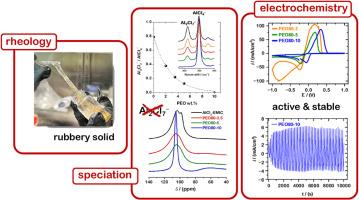
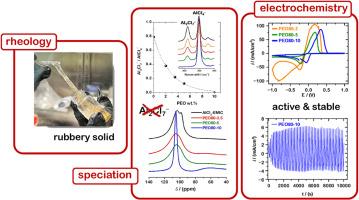
Polymer gel electrolytes based on EMIC-AlCl3 (1:1.5) and ultra-high molecular weight polyethylene oxide (UHMW PEO Mv = 8 × 10⁶ g mol−1) were synthesised with PEO concentrations of 2, 3.5, 5, 10 wt% without the use of auxiliary solvents, by melting the polymer into the electrolyte. This method produced elastic gels with progressively increasing elastic modulus. The speciation of the chloroaluminate anions in the gel electrolytes was characterized by NMR and Raman spectroscopy, revealing a decrease in Al2Cl7− and corresponding increase in AlCl4− with rising PEO content. In particular, the gel with 10 wt% PEO showed no detectable Al2Cl7−. Electrochemical activity of these gels was evaluated using two configurations: a platinum disc electrode and parallel planar aluminium foil electrode, the latter mimicking a practical electrochemical cell operating geometry. Surprisingly, all gels exhibited electrochemical activity, even in the absence of the Al2Cl7− species. Increasing PEO concentration led to reduced current densities but enhanced coulombic efficiency. The study discusses the influence of the molecular weight of PEO on ionic speciation and electrochemical performance of the polymer gel electrolytes, providing insights into the interplay between polymer content, ionic speciation, and electrochemical behaviour. These findings contribute to the development of safer, more sustainable aluminium batteries.
期刊介绍:
Polymer is an interdisciplinary journal dedicated to publishing innovative and significant advances in Polymer Physics, Chemistry and Technology. We welcome submissions on polymer hybrids, nanocomposites, characterisation and self-assembly. Polymer also publishes work on the technological application of polymers in energy and optoelectronics.
The main scope is covered but not limited to the following core areas:
Polymer Materials
Nanocomposites and hybrid nanomaterials
Polymer blends, films, fibres, networks and porous materials
Physical Characterization
Characterisation, modelling and simulation* of molecular and materials properties in bulk, solution, and thin films
Polymer Engineering
Advanced multiscale processing methods
Polymer Synthesis, Modification and Self-assembly
Including designer polymer architectures, mechanisms and kinetics, and supramolecular polymerization
Technological Applications
Polymers for energy generation and storage
Polymer membranes for separation technology
Polymers for opto- and microelectronics.




 京公网安备 11010802042870号
京ICP备2023020795号-1
京公网安备 11010802042870号
京ICP备2023020795号-1

 分享
分享
 求助内容:
求助内容: 应助结果提醒方式:
 扫码关注我们
