Han Zhao, Rong Luo, Jing Cai, Qiurui Ning, Xuewei Gong, Zaimin Jiang
{"title":"高产树基因型的选育:沿根-茎-叶连续体的水力抗性在抑制生长中的作用。","authors":"Han Zhao, Rong Luo, Jing Cai, Qiurui Ning, Xuewei Gong, Zaimin Jiang","doi":"10.1111/pce.15512","DOIUrl":null,"url":null,"abstract":"<p><p>Breeding productive tree genotypes is crucial for sustainable forestry, yet the hydraulic architecture along root-stem-leaf continuum that constrains biomass yield remains unclear. Here, six poplar hybrid genotypes with contrasting yield were used to quantify whole-plant hydraulic resistance, its partitioning patterns, and anatomical traits along the continuum. We observed substantial genetic variations in hydraulic resistance parameters. Roots contributed the largest proportion of whole-plant hydraulic resistance (> 54%). Components along the continuum were well-coordinated, and hydraulic resistance of all components was strongly correlated with yield (R<sup>2</sup> > 0.75), suggesting that hydraulic resistance is a strong predictor of yield. However, resistance partitioning patterns generally showed weak correlations with yield, with more productive genotypes partitioning a smaller proportion of resistance to leaves. Vessel diameter was a key determinant of hydraulic resistance at the root and leaf levels (R<sup>2</sup> ≥ 0.75), and vessel length significantly influenced stem hydraulic resistance (R<sup>2</sup> = 0.80). Additionally, genotypes with higher minor vein density and a lower ratio of palisade to spongy mesophyll thickness exhibited lower leaf resistance. Our results suggest that low hydraulic resistance throughout root-stem-leaf continuum is the functional basis for high yield, and the identification of key hydraulic and structural constraints will help overcome bottlenecks in breeding productive tree genotypes.</p>","PeriodicalId":222,"journal":{"name":"Plant, Cell & Environment","volume":" ","pages":""},"PeriodicalIF":6.3000,"publicationDate":"2025-03-27","publicationTypes":"Journal Article","fieldsOfStudy":null,"isOpenAccess":false,"openAccessPdf":"","citationCount":"0","resultStr":"{\"title\":\"Breeding Productive Tree Genotypes: The Role of Hydraulic Resistance Along the Root-Stem-Leaf Continuum in Constraining Growth.\",\"authors\":\"Han Zhao, Rong Luo, Jing Cai, Qiurui Ning, Xuewei Gong, Zaimin Jiang\",\"doi\":\"10.1111/pce.15512\",\"DOIUrl\":null,\"url\":null,\"abstract\":\"<p><p>Breeding productive tree genotypes is crucial for sustainable forestry, yet the hydraulic architecture along root-stem-leaf continuum that constrains biomass yield remains unclear. Here, six poplar hybrid genotypes with contrasting yield were used to quantify whole-plant hydraulic resistance, its partitioning patterns, and anatomical traits along the continuum. We observed substantial genetic variations in hydraulic resistance parameters. Roots contributed the largest proportion of whole-plant hydraulic resistance (> 54%). Components along the continuum were well-coordinated, and hydraulic resistance of all components was strongly correlated with yield (R<sup>2</sup> > 0.75), suggesting that hydraulic resistance is a strong predictor of yield. However, resistance partitioning patterns generally showed weak correlations with yield, with more productive genotypes partitioning a smaller proportion of resistance to leaves. Vessel diameter was a key determinant of hydraulic resistance at the root and leaf levels (R<sup>2</sup> ≥ 0.75), and vessel length significantly influenced stem hydraulic resistance (R<sup>2</sup> = 0.80). Additionally, genotypes with higher minor vein density and a lower ratio of palisade to spongy mesophyll thickness exhibited lower leaf resistance. Our results suggest that low hydraulic resistance throughout root-stem-leaf continuum is the functional basis for high yield, and the identification of key hydraulic and structural constraints will help overcome bottlenecks in breeding productive tree genotypes.</p>\",\"PeriodicalId\":222,\"journal\":{\"name\":\"Plant, Cell & Environment\",\"volume\":\" \",\"pages\":\"\"},\"PeriodicalIF\":6.3000,\"publicationDate\":\"2025-03-27\",\"publicationTypes\":\"Journal Article\",\"fieldsOfStudy\":null,\"isOpenAccess\":false,\"openAccessPdf\":\"\",\"citationCount\":\"0\",\"resultStr\":null,\"platform\":\"Semanticscholar\",\"paperid\":null,\"PeriodicalName\":\"Plant, Cell & Environment\",\"FirstCategoryId\":\"2\",\"ListUrlMain\":\"https://doi.org/10.1111/pce.15512\",\"RegionNum\":1,\"RegionCategory\":\"生物学\",\"ArticlePicture\":[],\"TitleCN\":null,\"AbstractTextCN\":null,\"PMCID\":null,\"EPubDate\":\"\",\"PubModel\":\"\",\"JCR\":\"Q1\",\"JCRName\":\"PLANT SCIENCES\",\"Score\":null,\"Total\":0}","platform":"Semanticscholar","paperid":null,"PeriodicalName":"Plant, Cell & Environment","FirstCategoryId":"2","ListUrlMain":"https://doi.org/10.1111/pce.15512","RegionNum":1,"RegionCategory":"生物学","ArticlePicture":[],"TitleCN":null,"AbstractTextCN":null,"PMCID":null,"EPubDate":"","PubModel":"","JCR":"Q1","JCRName":"PLANT SCIENCES","Score":null,"Total":0}
Breeding Productive Tree Genotypes: The Role of Hydraulic Resistance Along the Root-Stem-Leaf Continuum in Constraining Growth.
Breeding productive tree genotypes is crucial for sustainable forestry, yet the hydraulic architecture along root-stem-leaf continuum that constrains biomass yield remains unclear. Here, six poplar hybrid genotypes with contrasting yield were used to quantify whole-plant hydraulic resistance, its partitioning patterns, and anatomical traits along the continuum. We observed substantial genetic variations in hydraulic resistance parameters. Roots contributed the largest proportion of whole-plant hydraulic resistance (> 54%). Components along the continuum were well-coordinated, and hydraulic resistance of all components was strongly correlated with yield (R2 > 0.75), suggesting that hydraulic resistance is a strong predictor of yield. However, resistance partitioning patterns generally showed weak correlations with yield, with more productive genotypes partitioning a smaller proportion of resistance to leaves. Vessel diameter was a key determinant of hydraulic resistance at the root and leaf levels (R2 ≥ 0.75), and vessel length significantly influenced stem hydraulic resistance (R2 = 0.80). Additionally, genotypes with higher minor vein density and a lower ratio of palisade to spongy mesophyll thickness exhibited lower leaf resistance. Our results suggest that low hydraulic resistance throughout root-stem-leaf continuum is the functional basis for high yield, and the identification of key hydraulic and structural constraints will help overcome bottlenecks in breeding productive tree genotypes.
期刊介绍:
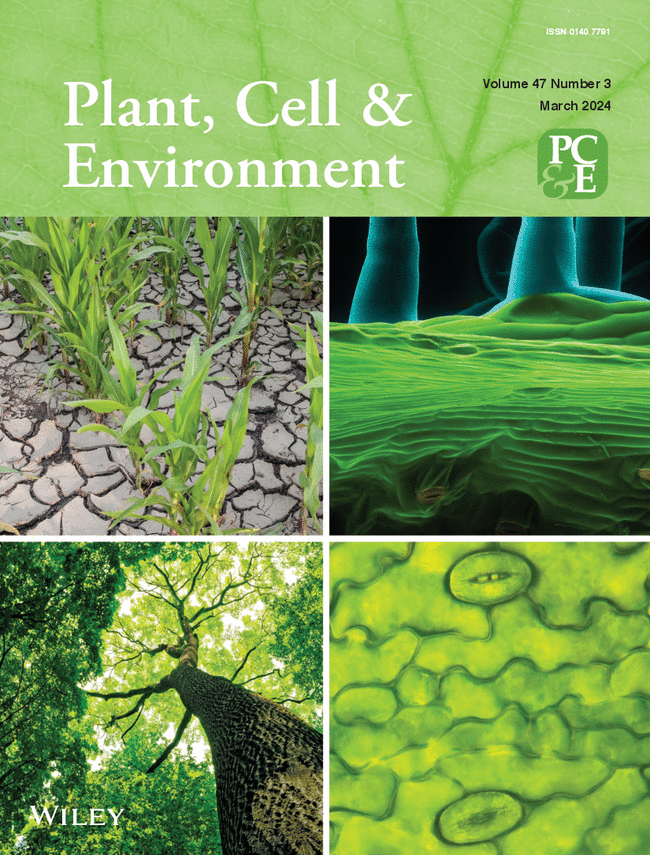
Plant, Cell & Environment is a premier plant science journal, offering valuable insights into plant responses to their environment. Committed to publishing high-quality theoretical and experimental research, the journal covers a broad spectrum of factors, spanning from molecular to community levels. Researchers exploring various aspects of plant biology, physiology, and ecology contribute to the journal's comprehensive understanding of plant-environment interactions.




 京公网安备 11010802042870号
京ICP备2023020795号-1
京公网安备 11010802042870号
京ICP备2023020795号-1

 分享
分享
 求助内容:
求助内容: 应助结果提醒方式:
 扫码关注我们
