A Heegers, S E Rakers, S van Twillert, V R M Moulaert, M M J Gerritsen, J van der Naalt, J M Spikman, H J Westerhof-Evers
{"title":"社会认知治疗(T-ScEmo)用于各种神经患者群体:随机对照试验(T-ScEmo4ALL)的研究原理和方案","authors":"A Heegers, S E Rakers, S van Twillert, V R M Moulaert, M M J Gerritsen, J van der Naalt, J M Spikman, H J Westerhof-Evers","doi":"10.1186/s12883-025-04125-4","DOIUrl":null,"url":null,"abstract":"<p><strong>Background: </strong>Social cognitive impairments often occur in patients with various neurological disorders that involve brain damage, such as traumatic brain injury, stroke, brain tumours, and multiple sclerosis. Patients with social cognitive impairments experience difficulties in perceiving and understanding social information and show social inadequate behaviour. Recently, the first multi-faceted treatment, T-ScEmo (Treatment for Social Cognition and Emotion Regulation) has been developed and evaluated for patients with TBI. T-ScEmo showed to be effective in improving social cognitive functioning, participation, relationships, and quality of life. Up to now, no evidence-based treatment has been available for social cognitive impairments in neurological patients other than traumatic brain injury. Therefore, the main aims of the current study are to investigate the efficacy of T-ScEmo in various neurological patient groups such as stroke (including subarachnoid haemorrhage), brain tumours, and multiple sclerosis and to study factors that might influence this, potential, efficacy.</p><p><strong>Methods: </strong>In this multi-centre, assessor-blind randomized controlled trial, 84 patients with mixed aetiology will be randomly divided over a treatment condition and a waiting list condition. Patients in treatment condition will follow twenty T-ScEmo sessions, of which five are online. Neuropsychological assessment and questionnaires directly after treatment (T1) and follow-up (T2, three to five months after treatment) will be compared to baseline assessment (T0). Ten TBI patients who receive T-ScEmo as regular rehabilitation care will be included as an extra control group. The main outcome measure will be the comparison of proxy rated behaviour between T0 and T2 on the Dysexecutive Questionnaire Social scales proxy version. Moreover, a compact barrier analysis is performed to facilitate the implementation of the treatment and to provide input for a process evaluation in the current study protocol.</p><p><strong>Discussion: </strong>When T-ScEmo is proven effective based on the current study, this will be the first effectual evidence-based multi-faceted treatment for patients with social cognitive impairments caused by various neurological disorders. Implementation of this treatment is expected to contribute to better participation and better quality of life for patients and their significant others.</p><p><strong>Trial registration: </strong>This study is prospectively registered in the database PaNaMa under number 202000479. Furthermore the study is registered in the database of clinicaltrials.gov (Study Details | Improving Social Cognition and Social Behaviour in Various Brain Disorders | ClinicalTrials.gov) under identifier NCT06330298.</p>","PeriodicalId":9170,"journal":{"name":"BMC Neurology","volume":"25 1","pages":"129"},"PeriodicalIF":2.2000,"publicationDate":"2025-03-27","publicationTypes":"Journal Article","fieldsOfStudy":null,"isOpenAccess":false,"openAccessPdf":"https://www.ncbi.nlm.nih.gov/pmc/articles/PMC11948743/pdf/","citationCount":"0","resultStr":"{\"title\":\"Social Cognitive Treatment (T-ScEmo) for Various Neurological Patient Groups: Study Rationale and Protocol for a Randomized Control Trial (T-ScEmo4ALL).\",\"authors\":\"A Heegers, S E Rakers, S van Twillert, V R M Moulaert, M M J Gerritsen, J van der Naalt, J M Spikman, H J Westerhof-Evers\",\"doi\":\"10.1186/s12883-025-04125-4\",\"DOIUrl\":null,\"url\":null,\"abstract\":\"<p><strong>Background: </strong>Social cognitive impairments often occur in patients with various neurological disorders that involve brain damage, such as traumatic brain injury, stroke, brain tumours, and multiple sclerosis. Patients with social cognitive impairments experience difficulties in perceiving and understanding social information and show social inadequate behaviour. Recently, the first multi-faceted treatment, T-ScEmo (Treatment for Social Cognition and Emotion Regulation) has been developed and evaluated for patients with TBI. T-ScEmo showed to be effective in improving social cognitive functioning, participation, relationships, and quality of life. Up to now, no evidence-based treatment has been available for social cognitive impairments in neurological patients other than traumatic brain injury. Therefore, the main aims of the current study are to investigate the efficacy of T-ScEmo in various neurological patient groups such as stroke (including subarachnoid haemorrhage), brain tumours, and multiple sclerosis and to study factors that might influence this, potential, efficacy.</p><p><strong>Methods: </strong>In this multi-centre, assessor-blind randomized controlled trial, 84 patients with mixed aetiology will be randomly divided over a treatment condition and a waiting list condition. Patients in treatment condition will follow twenty T-ScEmo sessions, of which five are online. Neuropsychological assessment and questionnaires directly after treatment (T1) and follow-up (T2, three to five months after treatment) will be compared to baseline assessment (T0). Ten TBI patients who receive T-ScEmo as regular rehabilitation care will be included as an extra control group. The main outcome measure will be the comparison of proxy rated behaviour between T0 and T2 on the Dysexecutive Questionnaire Social scales proxy version. Moreover, a compact barrier analysis is performed to facilitate the implementation of the treatment and to provide input for a process evaluation in the current study protocol.</p><p><strong>Discussion: </strong>When T-ScEmo is proven effective based on the current study, this will be the first effectual evidence-based multi-faceted treatment for patients with social cognitive impairments caused by various neurological disorders. Implementation of this treatment is expected to contribute to better participation and better quality of life for patients and their significant others.</p><p><strong>Trial registration: </strong>This study is prospectively registered in the database PaNaMa under number 202000479. Furthermore the study is registered in the database of clinicaltrials.gov (Study Details | Improving Social Cognition and Social Behaviour in Various Brain Disorders | ClinicalTrials.gov) under identifier NCT06330298.</p>\",\"PeriodicalId\":9170,\"journal\":{\"name\":\"BMC Neurology\",\"volume\":\"25 1\",\"pages\":\"129\"},\"PeriodicalIF\":2.2000,\"publicationDate\":\"2025-03-27\",\"publicationTypes\":\"Journal Article\",\"fieldsOfStudy\":null,\"isOpenAccess\":false,\"openAccessPdf\":\"https://www.ncbi.nlm.nih.gov/pmc/articles/PMC11948743/pdf/\",\"citationCount\":\"0\",\"resultStr\":null,\"platform\":\"Semanticscholar\",\"paperid\":null,\"PeriodicalName\":\"BMC Neurology\",\"FirstCategoryId\":\"3\",\"ListUrlMain\":\"https://doi.org/10.1186/s12883-025-04125-4\",\"RegionNum\":3,\"RegionCategory\":\"医学\",\"ArticlePicture\":[],\"TitleCN\":null,\"AbstractTextCN\":null,\"PMCID\":null,\"EPubDate\":\"\",\"PubModel\":\"\",\"JCR\":\"Q3\",\"JCRName\":\"CLINICAL NEUROLOGY\",\"Score\":null,\"Total\":0}","platform":"Semanticscholar","paperid":null,"PeriodicalName":"BMC Neurology","FirstCategoryId":"3","ListUrlMain":"https://doi.org/10.1186/s12883-025-04125-4","RegionNum":3,"RegionCategory":"医学","ArticlePicture":[],"TitleCN":null,"AbstractTextCN":null,"PMCID":null,"EPubDate":"","PubModel":"","JCR":"Q3","JCRName":"CLINICAL NEUROLOGY","Score":null,"Total":0}
Social Cognitive Treatment (T-ScEmo) for Various Neurological Patient Groups: Study Rationale and Protocol for a Randomized Control Trial (T-ScEmo4ALL).
Background: Social cognitive impairments often occur in patients with various neurological disorders that involve brain damage, such as traumatic brain injury, stroke, brain tumours, and multiple sclerosis. Patients with social cognitive impairments experience difficulties in perceiving and understanding social information and show social inadequate behaviour. Recently, the first multi-faceted treatment, T-ScEmo (Treatment for Social Cognition and Emotion Regulation) has been developed and evaluated for patients with TBI. T-ScEmo showed to be effective in improving social cognitive functioning, participation, relationships, and quality of life. Up to now, no evidence-based treatment has been available for social cognitive impairments in neurological patients other than traumatic brain injury. Therefore, the main aims of the current study are to investigate the efficacy of T-ScEmo in various neurological patient groups such as stroke (including subarachnoid haemorrhage), brain tumours, and multiple sclerosis and to study factors that might influence this, potential, efficacy.
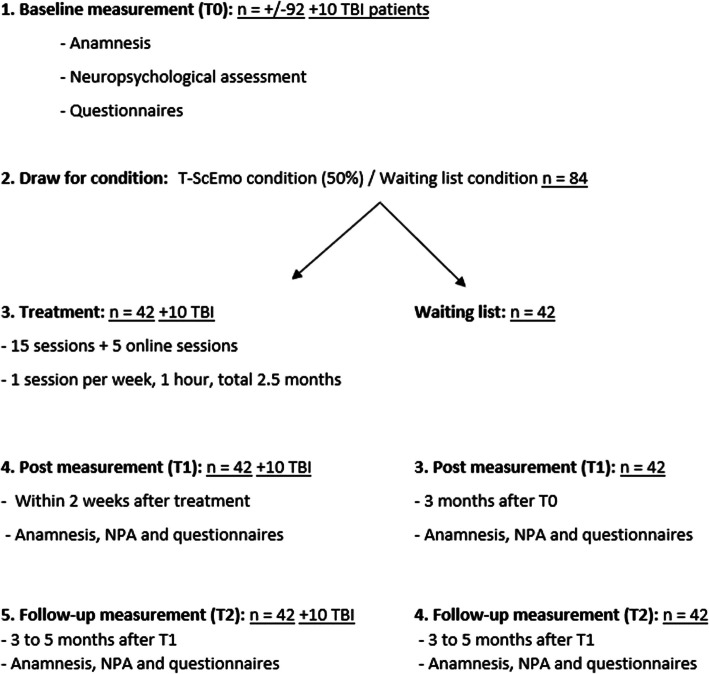
Methods: In this multi-centre, assessor-blind randomized controlled trial, 84 patients with mixed aetiology will be randomly divided over a treatment condition and a waiting list condition. Patients in treatment condition will follow twenty T-ScEmo sessions, of which five are online. Neuropsychological assessment and questionnaires directly after treatment (T1) and follow-up (T2, three to five months after treatment) will be compared to baseline assessment (T0). Ten TBI patients who receive T-ScEmo as regular rehabilitation care will be included as an extra control group. The main outcome measure will be the comparison of proxy rated behaviour between T0 and T2 on the Dysexecutive Questionnaire Social scales proxy version. Moreover, a compact barrier analysis is performed to facilitate the implementation of the treatment and to provide input for a process evaluation in the current study protocol.
Discussion: When T-ScEmo is proven effective based on the current study, this will be the first effectual evidence-based multi-faceted treatment for patients with social cognitive impairments caused by various neurological disorders. Implementation of this treatment is expected to contribute to better participation and better quality of life for patients and their significant others.
Trial registration: This study is prospectively registered in the database PaNaMa under number 202000479. Furthermore the study is registered in the database of clinicaltrials.gov (Study Details | Improving Social Cognition and Social Behaviour in Various Brain Disorders | ClinicalTrials.gov) under identifier NCT06330298.
期刊介绍:
BMC Neurology is an open access, peer-reviewed journal that considers articles on all aspects of the prevention, diagnosis and management of neurological disorders, as well as related molecular genetics, pathophysiology, and epidemiology.




 京公网安备 11010802042870号
京ICP备2023020795号-1
京公网安备 11010802042870号
京ICP备2023020795号-1

 分享
分享
 求助内容:
求助内容: 应助结果提醒方式:
 扫码关注我们
