{"title":"轻度急性缺血性脑卒中患者肌肉减少症对预后的影响:一项前瞻性队列研究。","authors":"Rui Chen, Zhuyun Liu, Ruotong Liao, Hao Liang, Caixia Hu, Xiaopei Zhang, Jiehan Chen, Hui Xiao, Junhua Ye, Jianwen Guo, Lin Wei","doi":"10.1186/s12883-025-04136-1","DOIUrl":null,"url":null,"abstract":"<p><strong>Background: </strong>Ischemic stroke is a common chronic disease worldwide and is correlated with a high disability rate. Sarcopenia is considered a key factor in the disablement process. Limited evidence of sarcopenia in acute ischemic stroke is available. The aim of this study was to investigate the effect of sarcopenia on the prognosis of patients with acute ischemic stroke.</p><p><strong>Methods: </strong>A prospective cohort study was conducted and included patients who were diagnosed with acute ischemic stroke between August 2020 and May 2021. A modified Poisson regression was applied to determine the relative risk (RR) for the change in modified Rankin Scale (mRS) score and allow adjustment for confounders. The modified Poisson regression was used to identify associations between sarcopenia, and multiple linear regression analyses were used to assess the effect of sarcopenia on the Barthel Index (BI) and stroke-specific quality of life (SSQOL). The generalized linear mixed model was used to investigate the effect of sarcopenia on prognosis at 1, 3 and 6 months. Cox regression proportional risk model was used to analyze the effect of sarcopenia on readmission in patients with acute ischemic stroke.</p><p><strong>Results: </strong>The prevalence of sarcopenia was 39.83% among the 118 enrolled acute ischemic stroke patients (aged 64.98 ± 11.053 years; 72.88% males). Modified Poisson regression showed that a poor prognostic outcome occurred in sarcopenia patients (relative risk [RR] = 3.021, 95% CI: 1.621-5.633; P = 0.001). Even after adjusting for confounders, sarcopenia still was a risk predictor of the increase of mRS (RR = 2.149, 95% CI: 1.045-4.420; P = 0.038). And sarcopenia was positively correlated with BI and SSQOL with or without adjustment for confounding factors (P < 0.01). Patients with sarcopenia in mild acute ischemic stroke exhibit worse prognoses compared to those without sarcopenia. (t = 3.128, P = 0.002). Cox regression risk ratio model showed that sarcopenia was a predictor of readmission within 6 months after mild ischemic stroke (hazard ratio [HR] = 3.361, 95% CI: 1.277-8.848; P = 0.014). Sarcopenia remained an independent risk factor for mild acute ischemic stroke readmission after adjusting for confounders.</p><p><strong>Conclusions: </strong>Sarcopenia has a high prevalence in mild acute ischemic stroke patients. Sarcopenia is an independent risk factor for poor outcomes following mild acute ischemic stroke and contributes to high rates of readmission. These findings may be useful for selecting therapeutic strategies for mild acute ischemic stroke patients with sarcopenia.</p>","PeriodicalId":9170,"journal":{"name":"BMC Neurology","volume":"25 1","pages":"130"},"PeriodicalIF":2.6000,"publicationDate":"2025-03-27","publicationTypes":"Journal Article","fieldsOfStudy":null,"isOpenAccess":false,"openAccessPdf":"https://www.ncbi.nlm.nih.gov/pmc/articles/PMC11948707/pdf/","citationCount":"0","resultStr":"{\"title\":\"The effect of sarcopenia on prognosis in patients with mild acute ischemic stroke: a prospective cohort study.\",\"authors\":\"Rui Chen, Zhuyun Liu, Ruotong Liao, Hao Liang, Caixia Hu, Xiaopei Zhang, Jiehan Chen, Hui Xiao, Junhua Ye, Jianwen Guo, Lin Wei\",\"doi\":\"10.1186/s12883-025-04136-1\",\"DOIUrl\":null,\"url\":null,\"abstract\":\"<p><strong>Background: </strong>Ischemic stroke is a common chronic disease worldwide and is correlated with a high disability rate. Sarcopenia is considered a key factor in the disablement process. Limited evidence of sarcopenia in acute ischemic stroke is available. The aim of this study was to investigate the effect of sarcopenia on the prognosis of patients with acute ischemic stroke.</p><p><strong>Methods: </strong>A prospective cohort study was conducted and included patients who were diagnosed with acute ischemic stroke between August 2020 and May 2021. A modified Poisson regression was applied to determine the relative risk (RR) for the change in modified Rankin Scale (mRS) score and allow adjustment for confounders. The modified Poisson regression was used to identify associations between sarcopenia, and multiple linear regression analyses were used to assess the effect of sarcopenia on the Barthel Index (BI) and stroke-specific quality of life (SSQOL). The generalized linear mixed model was used to investigate the effect of sarcopenia on prognosis at 1, 3 and 6 months. Cox regression proportional risk model was used to analyze the effect of sarcopenia on readmission in patients with acute ischemic stroke.</p><p><strong>Results: </strong>The prevalence of sarcopenia was 39.83% among the 118 enrolled acute ischemic stroke patients (aged 64.98 ± 11.053 years; 72.88% males). Modified Poisson regression showed that a poor prognostic outcome occurred in sarcopenia patients (relative risk [RR] = 3.021, 95% CI: 1.621-5.633; P = 0.001). Even after adjusting for confounders, sarcopenia still was a risk predictor of the increase of mRS (RR = 2.149, 95% CI: 1.045-4.420; P = 0.038). And sarcopenia was positively correlated with BI and SSQOL with or without adjustment for confounding factors (P < 0.01). Patients with sarcopenia in mild acute ischemic stroke exhibit worse prognoses compared to those without sarcopenia. (t = 3.128, P = 0.002). Cox regression risk ratio model showed that sarcopenia was a predictor of readmission within 6 months after mild ischemic stroke (hazard ratio [HR] = 3.361, 95% CI: 1.277-8.848; P = 0.014). Sarcopenia remained an independent risk factor for mild acute ischemic stroke readmission after adjusting for confounders.</p><p><strong>Conclusions: </strong>Sarcopenia has a high prevalence in mild acute ischemic stroke patients. Sarcopenia is an independent risk factor for poor outcomes following mild acute ischemic stroke and contributes to high rates of readmission. These findings may be useful for selecting therapeutic strategies for mild acute ischemic stroke patients with sarcopenia.</p>\",\"PeriodicalId\":9170,\"journal\":{\"name\":\"BMC Neurology\",\"volume\":\"25 1\",\"pages\":\"130\"},\"PeriodicalIF\":2.6000,\"publicationDate\":\"2025-03-27\",\"publicationTypes\":\"Journal Article\",\"fieldsOfStudy\":null,\"isOpenAccess\":false,\"openAccessPdf\":\"https://www.ncbi.nlm.nih.gov/pmc/articles/PMC11948707/pdf/\",\"citationCount\":\"0\",\"resultStr\":null,\"platform\":\"Semanticscholar\",\"paperid\":null,\"PeriodicalName\":\"BMC Neurology\",\"FirstCategoryId\":\"3\",\"ListUrlMain\":\"https://doi.org/10.1186/s12883-025-04136-1\",\"RegionNum\":3,\"RegionCategory\":\"医学\",\"ArticlePicture\":[],\"TitleCN\":null,\"AbstractTextCN\":null,\"PMCID\":null,\"EPubDate\":\"\",\"PubModel\":\"\",\"JCR\":\"Q3\",\"JCRName\":\"CLINICAL NEUROLOGY\",\"Score\":null,\"Total\":0}","platform":"Semanticscholar","paperid":null,"PeriodicalName":"BMC Neurology","FirstCategoryId":"3","ListUrlMain":"https://doi.org/10.1186/s12883-025-04136-1","RegionNum":3,"RegionCategory":"医学","ArticlePicture":[],"TitleCN":null,"AbstractTextCN":null,"PMCID":null,"EPubDate":"","PubModel":"","JCR":"Q3","JCRName":"CLINICAL NEUROLOGY","Score":null,"Total":0}
The effect of sarcopenia on prognosis in patients with mild acute ischemic stroke: a prospective cohort study.
Background: Ischemic stroke is a common chronic disease worldwide and is correlated with a high disability rate. Sarcopenia is considered a key factor in the disablement process. Limited evidence of sarcopenia in acute ischemic stroke is available. The aim of this study was to investigate the effect of sarcopenia on the prognosis of patients with acute ischemic stroke.
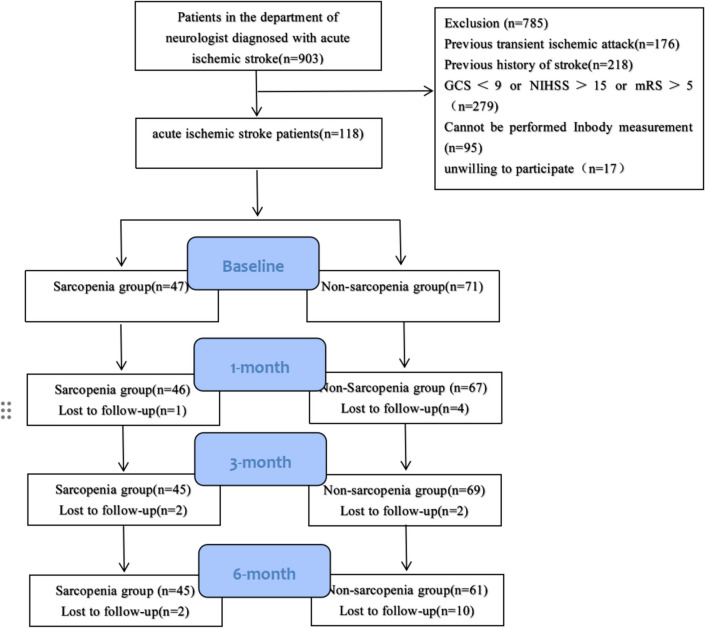
Methods: A prospective cohort study was conducted and included patients who were diagnosed with acute ischemic stroke between August 2020 and May 2021. A modified Poisson regression was applied to determine the relative risk (RR) for the change in modified Rankin Scale (mRS) score and allow adjustment for confounders. The modified Poisson regression was used to identify associations between sarcopenia, and multiple linear regression analyses were used to assess the effect of sarcopenia on the Barthel Index (BI) and stroke-specific quality of life (SSQOL). The generalized linear mixed model was used to investigate the effect of sarcopenia on prognosis at 1, 3 and 6 months. Cox regression proportional risk model was used to analyze the effect of sarcopenia on readmission in patients with acute ischemic stroke.
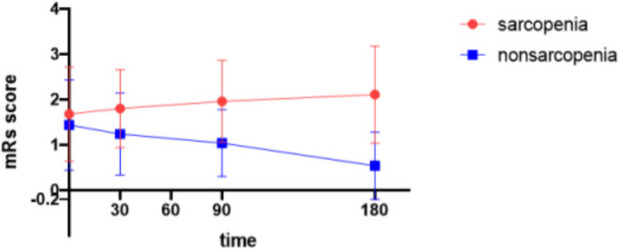
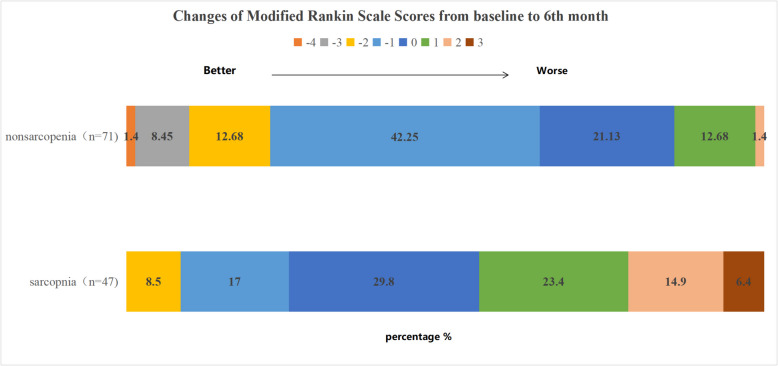
Results: The prevalence of sarcopenia was 39.83% among the 118 enrolled acute ischemic stroke patients (aged 64.98 ± 11.053 years; 72.88% males). Modified Poisson regression showed that a poor prognostic outcome occurred in sarcopenia patients (relative risk [RR] = 3.021, 95% CI: 1.621-5.633; P = 0.001). Even after adjusting for confounders, sarcopenia still was a risk predictor of the increase of mRS (RR = 2.149, 95% CI: 1.045-4.420; P = 0.038). And sarcopenia was positively correlated with BI and SSQOL with or without adjustment for confounding factors (P < 0.01). Patients with sarcopenia in mild acute ischemic stroke exhibit worse prognoses compared to those without sarcopenia. (t = 3.128, P = 0.002). Cox regression risk ratio model showed that sarcopenia was a predictor of readmission within 6 months after mild ischemic stroke (hazard ratio [HR] = 3.361, 95% CI: 1.277-8.848; P = 0.014). Sarcopenia remained an independent risk factor for mild acute ischemic stroke readmission after adjusting for confounders.
Conclusions: Sarcopenia has a high prevalence in mild acute ischemic stroke patients. Sarcopenia is an independent risk factor for poor outcomes following mild acute ischemic stroke and contributes to high rates of readmission. These findings may be useful for selecting therapeutic strategies for mild acute ischemic stroke patients with sarcopenia.
期刊介绍:
BMC Neurology is an open access, peer-reviewed journal that considers articles on all aspects of the prevention, diagnosis and management of neurological disorders, as well as related molecular genetics, pathophysiology, and epidemiology.




 京公网安备 11010802042870号
京ICP备2023020795号-1
京公网安备 11010802042870号
京ICP备2023020795号-1

 分享
分享
 求助内容:
求助内容: 应助结果提醒方式:
 扫码关注我们
