{"title":"MOF/COF及其衍生物在锌离子电池中的作用机理研究进展","authors":"Hai Ni , Zengyuan Fan , Jiawei Wang , Yunpeng Wu","doi":"10.1016/j.ensm.2025.104220","DOIUrl":null,"url":null,"abstract":"<div><div>The rapid depletion of fossil fuels and growing concerns about environmental issues is driving the demand for renewable energy storage systems. Zinc−ion batteries (ZIBs) have emerged as a promising alternative due to their cost−effectiveness, safety, and environmental compatibility. However, practical applications of ZIBs are hindered by challenges such as zinc dendrite formation, hydrogen evolution reactions (HER), and cathode material dissolution. To address these issues, metal−organic framework (MOF) and covalent organic framework (COF) have emerged as promising solutions, owing to their high porosity, tunable structures, and excellent ionic conductivity. This paper provides a comprehensive overview of the latest advancements in MOF/COF and their derivatives in ZIBs. It also examines their roles in cathodes, anodes, electrolytes, and separators, with a particular focus on the relationship between material structure and electrochemical performance, as well as reaction mechanisms. Finally, the paper identifies the challenges faced by MOF/COF and their derivatives, and explores potential molecular−level strategies for overcoming these issues.</div></div>","PeriodicalId":306,"journal":{"name":"Energy Storage Materials","volume":"77 ","pages":"Article 104220"},"PeriodicalIF":20.2000,"publicationDate":"2025-04-01","publicationTypes":"Journal Article","fieldsOfStudy":null,"isOpenAccess":false,"openAccessPdf":"","citationCount":"0","resultStr":"{\"title\":\"Research Progress on the Mechanisms of MOF/COF and Their Derivatives in Zinc−Ion Batteries\",\"authors\":\"Hai Ni , Zengyuan Fan , Jiawei Wang , Yunpeng Wu\",\"doi\":\"10.1016/j.ensm.2025.104220\",\"DOIUrl\":null,\"url\":null,\"abstract\":\"<div><div>The rapid depletion of fossil fuels and growing concerns about environmental issues is driving the demand for renewable energy storage systems. Zinc−ion batteries (ZIBs) have emerged as a promising alternative due to their cost−effectiveness, safety, and environmental compatibility. However, practical applications of ZIBs are hindered by challenges such as zinc dendrite formation, hydrogen evolution reactions (HER), and cathode material dissolution. To address these issues, metal−organic framework (MOF) and covalent organic framework (COF) have emerged as promising solutions, owing to their high porosity, tunable structures, and excellent ionic conductivity. This paper provides a comprehensive overview of the latest advancements in MOF/COF and their derivatives in ZIBs. It also examines their roles in cathodes, anodes, electrolytes, and separators, with a particular focus on the relationship between material structure and electrochemical performance, as well as reaction mechanisms. Finally, the paper identifies the challenges faced by MOF/COF and their derivatives, and explores potential molecular−level strategies for overcoming these issues.</div></div>\",\"PeriodicalId\":306,\"journal\":{\"name\":\"Energy Storage Materials\",\"volume\":\"77 \",\"pages\":\"Article 104220\"},\"PeriodicalIF\":20.2000,\"publicationDate\":\"2025-04-01\",\"publicationTypes\":\"Journal Article\",\"fieldsOfStudy\":null,\"isOpenAccess\":false,\"openAccessPdf\":\"\",\"citationCount\":\"0\",\"resultStr\":null,\"platform\":\"Semanticscholar\",\"paperid\":null,\"PeriodicalName\":\"Energy Storage Materials\",\"FirstCategoryId\":\"88\",\"ListUrlMain\":\"https://www.sciencedirect.com/science/article/pii/S240582972500220X\",\"RegionNum\":1,\"RegionCategory\":\"材料科学\",\"ArticlePicture\":[],\"TitleCN\":null,\"AbstractTextCN\":null,\"PMCID\":null,\"EPubDate\":\"2025/3/31 0:00:00\",\"PubModel\":\"Epub\",\"JCR\":\"Q1\",\"JCRName\":\"CHEMISTRY, PHYSICAL\",\"Score\":null,\"Total\":0}","platform":"Semanticscholar","paperid":null,"PeriodicalName":"Energy Storage Materials","FirstCategoryId":"88","ListUrlMain":"https://www.sciencedirect.com/science/article/pii/S240582972500220X","RegionNum":1,"RegionCategory":"材料科学","ArticlePicture":[],"TitleCN":null,"AbstractTextCN":null,"PMCID":null,"EPubDate":"2025/3/31 0:00:00","PubModel":"Epub","JCR":"Q1","JCRName":"CHEMISTRY, PHYSICAL","Score":null,"Total":0}
Research Progress on the Mechanisms of MOF/COF and Their Derivatives in Zinc−Ion Batteries
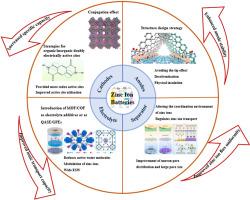
The rapid depletion of fossil fuels and growing concerns about environmental issues is driving the demand for renewable energy storage systems. Zinc−ion batteries (ZIBs) have emerged as a promising alternative due to their cost−effectiveness, safety, and environmental compatibility. However, practical applications of ZIBs are hindered by challenges such as zinc dendrite formation, hydrogen evolution reactions (HER), and cathode material dissolution. To address these issues, metal−organic framework (MOF) and covalent organic framework (COF) have emerged as promising solutions, owing to their high porosity, tunable structures, and excellent ionic conductivity. This paper provides a comprehensive overview of the latest advancements in MOF/COF and their derivatives in ZIBs. It also examines their roles in cathodes, anodes, electrolytes, and separators, with a particular focus on the relationship between material structure and electrochemical performance, as well as reaction mechanisms. Finally, the paper identifies the challenges faced by MOF/COF and their derivatives, and explores potential molecular−level strategies for overcoming these issues.
期刊介绍:
Energy Storage Materials is a global interdisciplinary journal dedicated to sharing scientific and technological advancements in materials and devices for advanced energy storage and related energy conversion, such as in metal-O2 batteries. The journal features comprehensive research articles, including full papers and short communications, as well as authoritative feature articles and reviews by leading experts in the field.
Energy Storage Materials covers a wide range of topics, including the synthesis, fabrication, structure, properties, performance, and technological applications of energy storage materials. Additionally, the journal explores strategies, policies, and developments in the field of energy storage materials and devices for sustainable energy.
Published papers are selected based on their scientific and technological significance, their ability to provide valuable new knowledge, and their relevance to the international research community.





 京公网安备 11010802042870号
京ICP备2023020795号-1
京公网安备 11010802042870号
京ICP备2023020795号-1

 分享
分享
 求助内容:
求助内容: 应助结果提醒方式:
 扫码关注我们
