So Youn Lee , Jong-Gil Oh , Dong Hee Kim , Il Seok Chae , Jong Hak Kim
{"title":"使用点击化学为高性能碳氢聚合物电解质膜剪裁嵌段接枝共聚物的离子网络","authors":"So Youn Lee , Jong-Gil Oh , Dong Hee Kim , Il Seok Chae , Jong Hak Kim","doi":"10.1016/j.memsci.2025.124045","DOIUrl":null,"url":null,"abstract":"<div><div>To address the environmental and economic concerns associated with perfluorinated sulfonic acids (PFSAs), we propose a novel approach to synthesize block-graft copolymers for hydrocarbon polymer electrolyte membranes (PEMs) designed for clean energy applications including fuel cells and water electrolysis. This study introduces an efficient “graft-onto” approach using click chemistry, which couples side chains onto a main polymer backbone, enabling the precise structural construction of block-graft copolymers. This method allows the formation of long side chains and enables stepwise tuning of ionic channel through adjustments of the graft degree. Our membrane, poly(styrene-<em>b</em>-ethylene-<em>co</em>-butylene-<em>b</em>-styrene)-<em>graft</em>-triazole-poly(styrene sulfonic acid) (SEBS-<em>g</em>-TzPSSA, referred to as Click SgP) exhibited a highly ordered, microphase-separated morphology. The Click SgP membranes achieved record-high ion conductivities even at low ion exchange capacity (IEC) values. Their well-defined nanostructure, coupled with extended side chains, provided enhanced mechanical stability and elongation properties while efficiently regulating water uptake and minimizing swelling. Unlike conventional hydrocarbon PEMs, the Click SgP membranes were successfully employed in a large-scale, mass-production-compatible decal transfer method for fabricating membrane electrode assemblies (MEAs). This study explores vapor sorption, ion transport, and electrochemical performance, highlighting the pivotal role of click chemistry in developing advanced nanostructured polymer architectures.</div></div>","PeriodicalId":368,"journal":{"name":"Journal of Membrane Science","volume":"726 ","pages":"Article 124045"},"PeriodicalIF":9.0000,"publicationDate":"2025-05-01","publicationTypes":"Journal Article","fieldsOfStudy":null,"isOpenAccess":false,"openAccessPdf":"","citationCount":"0","resultStr":"{\"title\":\"Tailoring ion networks of block-graft copolymers using click chemistry for high-performance hydrocarbon polymer electrolyte membranes\",\"authors\":\"So Youn Lee , Jong-Gil Oh , Dong Hee Kim , Il Seok Chae , Jong Hak Kim\",\"doi\":\"10.1016/j.memsci.2025.124045\",\"DOIUrl\":null,\"url\":null,\"abstract\":\"<div><div>To address the environmental and economic concerns associated with perfluorinated sulfonic acids (PFSAs), we propose a novel approach to synthesize block-graft copolymers for hydrocarbon polymer electrolyte membranes (PEMs) designed for clean energy applications including fuel cells and water electrolysis. This study introduces an efficient “graft-onto” approach using click chemistry, which couples side chains onto a main polymer backbone, enabling the precise structural construction of block-graft copolymers. This method allows the formation of long side chains and enables stepwise tuning of ionic channel through adjustments of the graft degree. Our membrane, poly(styrene-<em>b</em>-ethylene-<em>co</em>-butylene-<em>b</em>-styrene)-<em>graft</em>-triazole-poly(styrene sulfonic acid) (SEBS-<em>g</em>-TzPSSA, referred to as Click SgP) exhibited a highly ordered, microphase-separated morphology. The Click SgP membranes achieved record-high ion conductivities even at low ion exchange capacity (IEC) values. Their well-defined nanostructure, coupled with extended side chains, provided enhanced mechanical stability and elongation properties while efficiently regulating water uptake and minimizing swelling. Unlike conventional hydrocarbon PEMs, the Click SgP membranes were successfully employed in a large-scale, mass-production-compatible decal transfer method for fabricating membrane electrode assemblies (MEAs). This study explores vapor sorption, ion transport, and electrochemical performance, highlighting the pivotal role of click chemistry in developing advanced nanostructured polymer architectures.</div></div>\",\"PeriodicalId\":368,\"journal\":{\"name\":\"Journal of Membrane Science\",\"volume\":\"726 \",\"pages\":\"Article 124045\"},\"PeriodicalIF\":9.0000,\"publicationDate\":\"2025-05-01\",\"publicationTypes\":\"Journal Article\",\"fieldsOfStudy\":null,\"isOpenAccess\":false,\"openAccessPdf\":\"\",\"citationCount\":\"0\",\"resultStr\":null,\"platform\":\"Semanticscholar\",\"paperid\":null,\"PeriodicalName\":\"Journal of Membrane Science\",\"FirstCategoryId\":\"5\",\"ListUrlMain\":\"https://www.sciencedirect.com/science/article/pii/S0376738825003588\",\"RegionNum\":1,\"RegionCategory\":\"工程技术\",\"ArticlePicture\":[],\"TitleCN\":null,\"AbstractTextCN\":null,\"PMCID\":null,\"EPubDate\":\"2025/3/25 0:00:00\",\"PubModel\":\"Epub\",\"JCR\":\"Q1\",\"JCRName\":\"ENGINEERING, CHEMICAL\",\"Score\":null,\"Total\":0}","platform":"Semanticscholar","paperid":null,"PeriodicalName":"Journal of Membrane Science","FirstCategoryId":"5","ListUrlMain":"https://www.sciencedirect.com/science/article/pii/S0376738825003588","RegionNum":1,"RegionCategory":"工程技术","ArticlePicture":[],"TitleCN":null,"AbstractTextCN":null,"PMCID":null,"EPubDate":"2025/3/25 0:00:00","PubModel":"Epub","JCR":"Q1","JCRName":"ENGINEERING, CHEMICAL","Score":null,"Total":0}
Tailoring ion networks of block-graft copolymers using click chemistry for high-performance hydrocarbon polymer electrolyte membranes
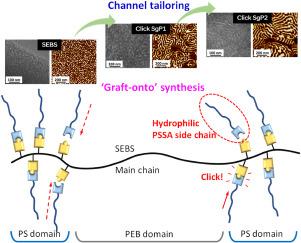
To address the environmental and economic concerns associated with perfluorinated sulfonic acids (PFSAs), we propose a novel approach to synthesize block-graft copolymers for hydrocarbon polymer electrolyte membranes (PEMs) designed for clean energy applications including fuel cells and water electrolysis. This study introduces an efficient “graft-onto” approach using click chemistry, which couples side chains onto a main polymer backbone, enabling the precise structural construction of block-graft copolymers. This method allows the formation of long side chains and enables stepwise tuning of ionic channel through adjustments of the graft degree. Our membrane, poly(styrene-b-ethylene-co-butylene-b-styrene)-graft-triazole-poly(styrene sulfonic acid) (SEBS-g-TzPSSA, referred to as Click SgP) exhibited a highly ordered, microphase-separated morphology. The Click SgP membranes achieved record-high ion conductivities even at low ion exchange capacity (IEC) values. Their well-defined nanostructure, coupled with extended side chains, provided enhanced mechanical stability and elongation properties while efficiently regulating water uptake and minimizing swelling. Unlike conventional hydrocarbon PEMs, the Click SgP membranes were successfully employed in a large-scale, mass-production-compatible decal transfer method for fabricating membrane electrode assemblies (MEAs). This study explores vapor sorption, ion transport, and electrochemical performance, highlighting the pivotal role of click chemistry in developing advanced nanostructured polymer architectures.
期刊介绍:
The Journal of Membrane Science is a publication that focuses on membrane systems and is aimed at academic and industrial chemists, chemical engineers, materials scientists, and membranologists. It publishes original research and reviews on various aspects of membrane transport, membrane formation/structure, fouling, module/process design, and processes/applications. The journal primarily focuses on the structure, function, and performance of non-biological membranes but also includes papers that relate to biological membranes. The Journal of Membrane Science publishes Full Text Papers, State-of-the-Art Reviews, Letters to the Editor, and Perspectives.




 京公网安备 11010802042870号
京ICP备2023020795号-1
京公网安备 11010802042870号
京ICP备2023020795号-1

 分享
分享
 求助内容:
求助内容: 应助结果提醒方式:
 扫码关注我们
